
America’s $40 Trillion Debt Is Closing In on the AI Boom — And One Number Could Trigger the Reckoning

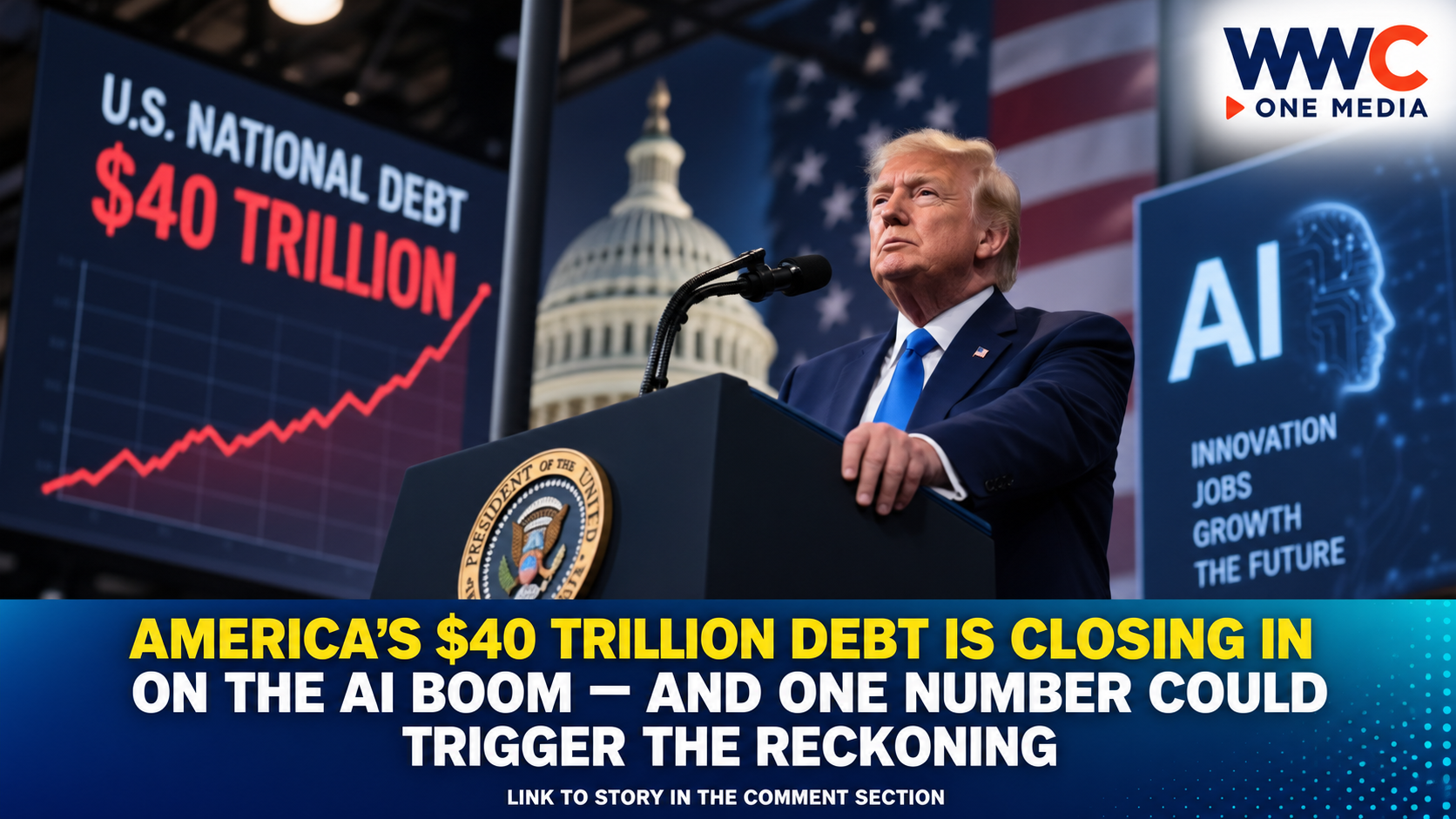
NEW YORK — Artificial intelligence has powered one of the biggest investment booms in modern markets, sending technology companies racing to build data centers, secure advanced chips and lock in enormous amounts of electricity.
But a threat to that boom may be developing far away from Silicon Valley.
It is coming from the US bond market.
America’s gross federal debt has now crossed the US$40 trillion mark, while borrowing costs have climbed sharply enough to force investors to confront a question that was easier to ignore when interest rates were lower: What happens when the US government and the world’s biggest technology companies are competing for increasingly expensive capital at the same time? Reuters reported that gross US federal debt surpassed US$40 trillion in early September.
That concern sits at the center of a new commentary by investor and author Ruchir Sharma, published by the Financial Times and carried by Channel NewsAsia. His argument is striking: if the benchmark 10-year US Treasury yield decisively moves above 5%, financing conditions could become restrictive enough to seriously disrupt the artificial-intelligence investment cycle.
It is an argument investors may no longer be able to dismiss.
The 5% number Wall Street is watching
The 10-year Treasury yield was trading around 4.8% in early September, close enough to 5% to make the threshold more than a theoretical discussion.
Reuters reported that the 10-year yield reached about 4.78% on September 4, after stronger US employment data reinforced expectations that interest rates could remain elevated. Several days earlier, it had climbed close to its highest level since early 2025.
But rising yields are not being caused by federal debt alone.
Markets are confronting a combination of massive government borrowing, persistent inflation risks, elevated energy prices, expectations surrounding Federal Reserve policy and a growing flood of corporate debt linked to AI infrastructure. Reuters noted that these forces have been contributing to the global bond selloff and pushing borrowing costs higher.
That matters because Treasury yields form the foundation for borrowing costs across much of the global financial system.
When government bonds offer investors higher returns with relatively low credit risk, companies generally have to offer even higher yields to persuade investors to lend to them.
For AI companies spending hundreds of billions of dollars on infrastructure, that equation could become increasingly uncomfortable.
Big Tech is no longer paying for everything with cash
For years, America’s largest technology companies were extraordinary cash-generating machines.
That has not disappeared.
What has changed is the scale of their investment ambitions.
The AI race requires massive spending on graphics processors, servers, data centers, electricity generation, transmission equipment, cooling infrastructure and networking capacity.
Reuters reported in August that global technology companies were increasingly turning to capital markets as AI spending surged, with industry spending expected to exceed US$730 billion in 2026.
The shift can already be seen in corporate bond markets.
AI-related US corporate debt issuance reached roughly US$220 billion in 2026 by August 21, compared with only about US$12.5 billion during the comparable period a year earlier, according to Reuters. Investors have begun demanding higher premiums to absorb the wave of supply.
Amazon, Alphabet, Meta and other technology giants have all tapped debt markets as the AI infrastructure race accelerates.
And the phenomenon is spreading beyond the United States. US technology companies have become major borrowers in European bond markets as well, with the European Central Bank warning that large-scale hyperscaler issuance could eventually crowd out other corporate and government borrowers.
The AI revolution, in other words, is increasingly becoming a financing story as much as a technology story.
Washington is competing for the same money
That is where America’s fiscal position becomes especially important.
The headline US$40 trillion national-debt figure represents gross federal debt, which includes both debt held by investors and debt held within government accounts.
For assessing pressure on financial markets, economists often focus more closely on debt held by the public.
The Congressional Budget Office projects public debt at roughly 101% of US GDP in 2026, rising to 120% by 2036 under current law — above the previous historical record reached after World War II.
The federal deficit is also expected to remain unusually large.
CBO projects a US$1.9 trillion deficit in fiscal 2026, equal to approximately 5.8% of GDP. By 2036, the annual deficit is projected to reach US$3.1 trillion, or 6.7% of GDP. The average deficit during the previous 50 years was significantly smaller at about 3.8% of GDP.
Washington therefore needs to keep issuing enormous amounts of debt.
The Treasury said in August that it expected US$739 billion in privately held net marketable borrowing during the July-to-September quarter, followed by another US$628 billion during October through December.
Every additional Treasury security entering the market must ultimately find a buyer.
And when investors demand greater compensation for absorbing that supply, yields can rise.
The interest bill is becoming the bigger warning
Perhaps the more important figure is not America's total debt but the cost of servicing it.
CBO expects federal net interest spending to exceed US$1 trillion in fiscal 2026, equivalent to about 3.3% of GDP.
By 2036, that figure is projected to reach roughly US$2.1 trillion annually, or 4.6% of GDP. At that point, interest costs would consume nearly one-fifth of federal spending under CBO's baseline projections.
That creates a potentially self-reinforcing problem.
Higher debt means more interest payments.
Higher interest rates make refinancing that debt more expensive.
Higher interest costs increase deficits.
And larger deficits require still more borrowing.
That does not mean the United States is on the verge of default. US Treasuries remain central to the global financial system, and the US borrows in a currency it controls.
The more immediate risk is different: persistently heavy government borrowing could help keep long-term interest rates higher than companies and investors became accustomed to during the low-rate era.
Why 5% could hurt AI stocks even before projects are cancelled
Higher Treasury yields do not only affect companies issuing bonds.
They also change the mathematics investors use to value stocks.
Technology stocks often command high valuations because investors are paying today for earnings expected many years into the future. When risk-free bond yields rise, those distant earnings become less valuable in present-value calculations.
At the same time, investors suddenly have an alternative.
If government bonds offer yields approaching or exceeding 5%, investors can earn substantial returns without accepting the same business and valuation risks associated with high-growth technology shares.
That does not automatically mean investors abandon AI.
But the price they are willing to pay for future AI profits may fall.
And companies that need external financing for expensive data-center projects could face a second hit: a higher cost of debt at exactly the moment their equity valuations are under pressure.
Reuters reported in July that rapidly rising AI investment was already squeezing free cash flow at Microsoft, Alphabet, Amazon, Meta and Oracle, with analysts increasingly focused on whether AI spending will generate sufficient financial returns.
A bubble — or the infrastructure of the next industrial revolution?
None of this proves that artificial intelligence is a bubble.
AI companies are generating real revenue. Cloud demand is growing. Businesses are deploying generative-AI systems, and data centers are becoming critical infrastructure for governments and corporations.
The fundamental technology may ultimately transform productivity across industries.
But transformative technologies can still experience financial bubbles.
Railroads changed the world and produced spectacular investment crashes. The internet transformed the global economy even though the dot-com boom ended in a brutal market collapse.
The technology can be revolutionary while investors still pay too much, too quickly, for the companies building it.
That is why the financing side of the current AI race deserves attention.
The world's biggest technology companies are simultaneously spending historic amounts of money while governments are issuing enormous quantities of debt.
Those two forces increasingly meet in the same bond market.
The real warning isn't $40 trillion
Investors should therefore be careful about focusing exclusively on America's US$40 trillion headline debt number.
It is dramatic, but it does not function as a countdown clock to a financial crisis.
The more useful signals are the cost of servicing that debt, the amount Washington must continue borrowing, the direction of long-term Treasury yields and whether companies can generate enough AI revenue to justify extraordinary investment spending.
For now, the AI boom remains alive.
Capital is still flowing. Data centers are still being built. Technology companies are still borrowing billions of dollars, and investors continue to finance them.
But the margin for error is shrinking.
If Treasury yields push decisively beyond 5%, particularly if the move reflects persistent inflation and rising concerns about government borrowing, the market could enter a very different regime.
AI companies would no longer be building the future with cheap money.
They would be attempting to finance one of history's largest infrastructure booms while competing directly with a US government borrowing trillions of dollars itself.
And that may be the moment when America's debt problem stops being background noise — and starts becoming an AI problem too.
WWC ONE MEDIA M.J.E