
Capiz Vegetable Farmers Are Changing How They Farm—But the Bigger Test Is Coming

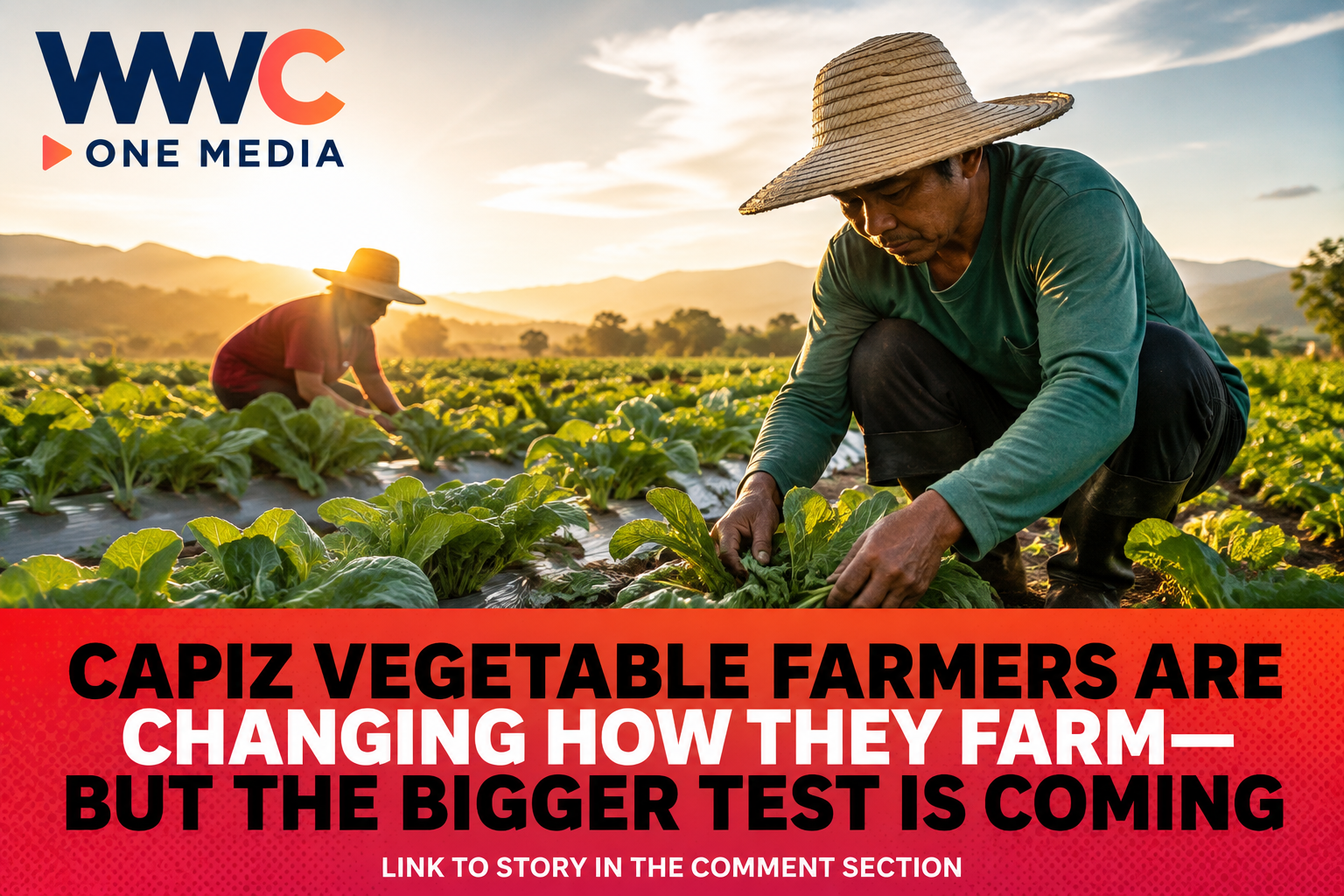
CAPIZ, Philippines — Vegetable growers in Capiz are being urged to change the way they farm as climate pressures, production risks and market demands continue to reshape the country’s agricultural sector.
A total of 30 vegetable growers representing cluster associations from various municipalities in Capiz recently completed a three-day training on Good Agricultural Practices (GAP) and lowland vegetable production conducted by the Department of Agriculture (DA) Western Visayas in Roxas City.
The training focused on giving growers practical knowledge they can use to improve farm productivity, produce safer and higher-quality vegetables, increase income and adopt more sustainable and climate-resilient farming technologies, according to the Philippine Information Agency.
From planting to postharvest, growers get hands-on training
The program covered several critical stages of vegetable production.
DA Western Visayas High Value Crops Development Program Agriculturist I Paul Andrew Villeta led discussions on land preparation, crop management and postharvest practices, including techniques growers can apply directly in their farms.
The training also placed strong emphasis on Good Agricultural Practices, which include proper farm-input management, sanitation and hygiene, appropriate handling of harvested produce and responsible use of natural resources.
DA Regulatory Division Senior Agriculturist Rene Baldivia discussed GAP as a way of improving farm production and management while helping ensure the safety and quality of agricultural products.
For growers, however, producing a good harvest is only part of the challenge.
The training also tackled market linkages, including the Farmers and Fisherfolk Enterprise Development Information System and the Sagip Saka Program, giving participants information on potential buyers and market opportunities for their produce.
Why climate resilience is becoming critical
The Capiz training comes as the Philippine government increasingly shifts toward farming systems designed to withstand increasingly unpredictable weather.
The DA has been expanding its Climate Resilient Agriculture (CRA) initiatives, including programs that provide farmers with localized climate information, technologies, financing and market support.
One major initiative is the Adapting Philippine Agriculture to Climate Change (APA) Project, a seven-year program involving the DA, DOST-PAGASA and the Food and Agriculture Organization of the United Nations.
The project has a US$26.27-million Green Climate Fund grant, plus US$12.98 million in DA and DOST-PAGASA co-financing, and is designed to directly support about 1.25 million farming household members while indirectly benefiting roughly 5 million farmers and rural residents through climate information and resilience measures.
The strategy includes improving access to localized climate information so farmers can make better decisions about planting, crop management and other farm activities.
The DA's National Color-Coded Agricultural Guide also uses information on soil, elevation, rainfall, temperature, water availability and projected climate hazards to help determine which crops are better suited to specific agricultural areas.
The bigger push: protected and climate-smart vegetable farming
The government is also putting money behind technologies designed to shield high-value vegetables from extreme weather.
In February 2026, the DA announced approximately P300 million for expanding climate-resilient production of high-value vegetables, including tomatoes, chili and bell peppers.
The planned support includes basic greenhouses, rainshelters, drip irrigation and water-impounding systems intended to reduce farmers' exposure to heavy rainfall, flooding and other weather disruptions while allowing more consistent production throughout the year.
The DA has described this broader strategy as a “White Revolution,” centered on protected cultivation, food corridors, improved logistics and stronger connections between producers and urban markets.
The approach is already being demonstrated on the ground. In Aklan, the DA and Korea International Cooperation Agency launched a smart-greenhouse project in January 2026 aimed at demonstrating climate-resilient and high-efficiency production systems for vegetables and other high-value crops.
Knowledge-sharing could determine what happens next
For Capiz growers, the immediate challenge is turning training into actual changes on the farm.
The DA training included a workshop for developing a five-year vegetable production plan for Capiz, allowing participants to identify sector priorities, problems and possible strategies for strengthening the province's vegetable industry.
The 30 participating growers are also expected to share what they learned with fellow members of their respective cluster associations and apply the recommended practices in their own farms.
That knowledge-sharing component could prove important because climate-resilient agriculture is not simply about buying new equipment. It also involves better farm planning, appropriate crop choices, improved water management, responsible input use, postharvest handling and access to timely climate information.
The DA has previously emphasized that Philippine agriculture must adapt to increasingly erratic weather, including typhoons, drought and shifting seasons. Its climate-smart initiatives include adjusted cropping calendars, greenhouse production, fertigation, water-saving practices and mobile soil laboratories.
The real test starts after the training
For Capiz's vegetable growers, the three-day program may be over—but the more difficult phase is only beginning.
The real measure of success will not be the number of farmers who attended the training. It will be whether the lessons translate into healthier crops, safer vegetables, stronger farm incomes, less postharvest loss and farms that can keep producing even when weather conditions turn against them.
As climate risks increasingly threaten agricultural production, the ability to adapt may become just as important as the ability to produce.
And for vegetable farmers whose livelihoods depend on every planting season, that shift could determine whether the next harvest survives the weather—or becomes another casualty of it.