
China Warns of ‘Consequences’ Over Taiwan’s Pacific Summit Role — But Palau’s Response Could Set a Bigger Precedent

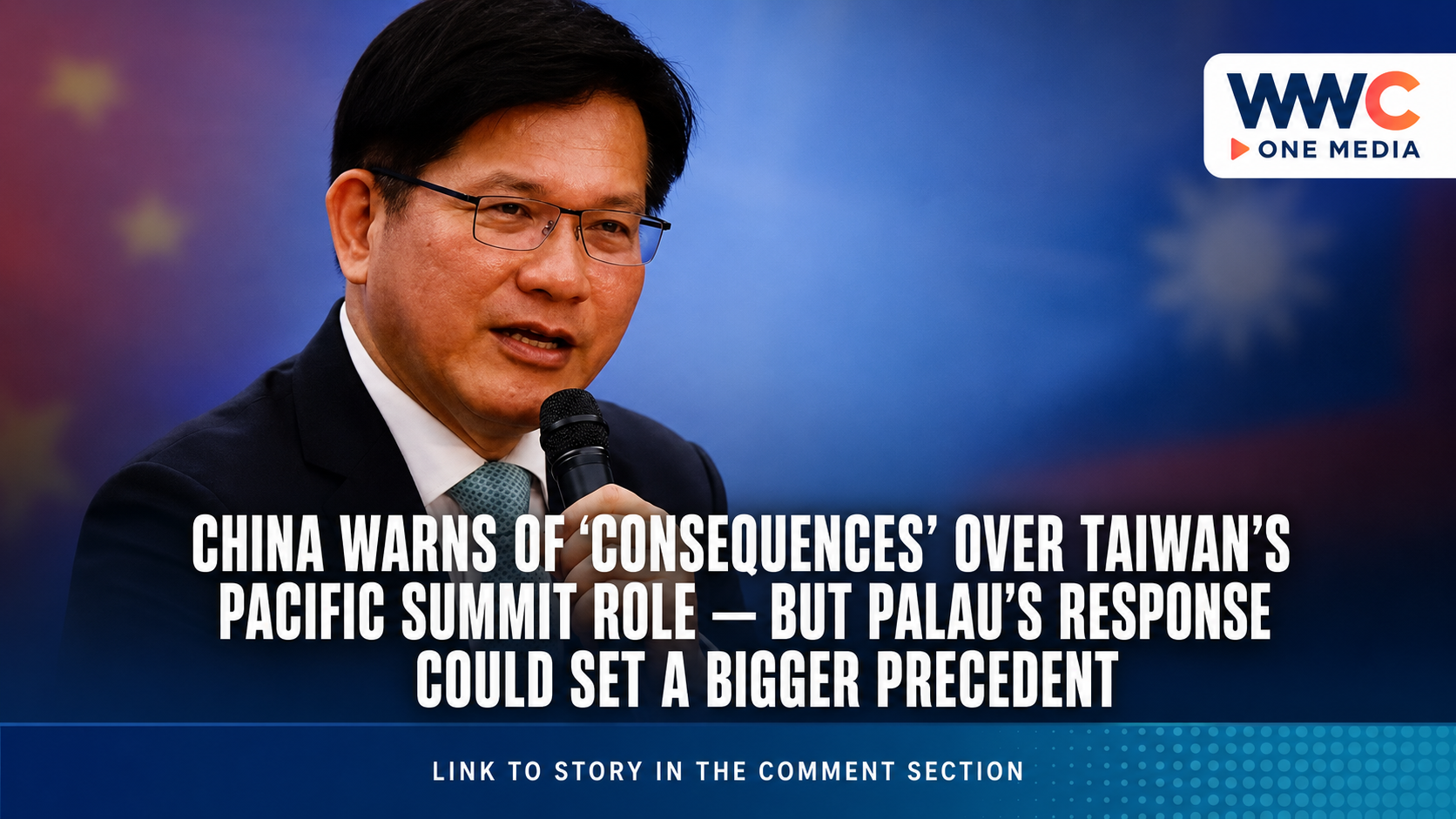
KOROR, Palau — A gathering meant to showcase Pacific unity has quickly become the latest flashpoint in the widening diplomatic struggle between China and Taiwan, after Beijing warned of unspecified “consequences” over Taiwan’s high-profile presence at the Pacific Islands Forum Leaders Meeting in Palau.
China’s special envoy for Pacific island affairs, Qian Bo, said Beijing had “serious concerns” after Taiwan Foreign Minister Lin Chia-lung attended the forum’s opening ceremony on August 31. Asked whether Taiwan’s participation would bring consequences, Qian said there would be, while insisting his remarks should not be interpreted as a threat. He did not specify what Beijing might do.
The warning has put a sensitive question at the center of the 55th Pacific Islands Forum: Who gets to decide which outside partners the Pacific engages with — the island nations themselves or the major powers competing for influence across the region?
Why Taiwan’s Presence Matters
Taiwan is not one of the Pacific Islands Forum’s 18 members, nor does it hold the same formal “dialogue partner” status as China, the United States, Japan and other outside powers.
Instead, Taiwan has participated as a development partner since 1993, a status that allows it to engage with Pacific countries and take part in related dialogues and side events. Taiwan’s Foreign Ministry says Lin is in Palau from August 27 to September 3 for activities connected with the summit, including the Taiwan/ROC-Forum Countries Dialogue and the Pacific Prosperity Exhibit.
This year, however, Taiwan’s visibility is particularly striking.
Palau is one of only three Pacific Island countries that still maintain formal diplomatic relations with Taipei, alongside Tuvalu and the Marshall Islands. China has persuaded several former Taiwanese partners in the region to switch diplomatic recognition to Beijing over the years, leaving Taiwan with a much smaller group of official allies.
Hosting the summit therefore gives Palau considerably more room to engage openly with Taiwan than Taipei often enjoys at international gatherings.
Palau Pushes Back Against Outside Pressure
Palau President Surangel Whipps Jr. has repeatedly stressed that Pacific countries should determine their own diplomatic relationships and regional agenda.
At the summit, Whipps declared that outside partners were welcome to work with Pacific nations but should not determine the region’s direction. His message echoed a broader frustration among Pacific leaders who want discussions centered on their own priorities rather than dominated by rivalry between Beijing, Washington and Taipei.
Australian Prime Minister Anthony Albanese delivered a similarly pointed response after Qian’s warning, saying the Pacific Islands Forum determines what happens at the gathering, not another country. New Zealand Foreign Minister Winston Peters also said outside states do not dictate how the regional organization operates.
Taiwan’s Lin, meanwhile, framed his country’s participation around development and regional stability, saying Taipei wanted to continue working with Pacific partners toward greater prosperity and peace.
This Fight Has Been Building for Years
The dispute did not begin in Palau.
At the 2024 Pacific Islands Forum in Tonga, a reference to Taiwan was removed from the final communiqué after China objected. The PIF Secretariat later said the revision did not change Taiwan’s existing participation arrangements.
Then, at the 2025 summit in Solomon Islands, external partners were kept out altogether while the forum considered changes to how it manages outside partners. The final communiqué nevertheless reaffirmed the longstanding 1992 decision underpinning Taiwan’s participation, according to Taiwan’s Foreign Ministry and Australian parliamentary research.
That history makes the current confrontation in Palau about far more than one foreign minister attending one ceremony.
The larger issue is whether Beijing can persuade Pacific governments to reduce Taiwan’s already limited diplomatic space — or whether member states will insist that decisions about the forum’s partners remain in Pacific hands.
A Pacific Summit Already Loaded With Geopolitical Tension
Taiwan is only one part of a much larger strategic contest.
The Pacific’s vast exclusive economic zones, shipping routes, fisheries, seabed resources and military geography have made relatively small island states increasingly important to China, the United States, Australia, New Zealand and other powers. AP reported that Pacific leaders are increasingly concerned that competition among those powers could overwhelm discussions about climate change, fragile economies and other issues island governments consider more urgent.
The summit also follows tensions over a Chinese ballistic missile test in the Pacific in July. Pacific foreign ministers subsequently failed to reach consensus on a joint statement criticizing the launch, exposing divisions within a regional organization that traditionally works by consensus.
At the same time, the United States and New Zealand announced during the Palau gathering that they would jointly fund an upgrade of a World War II-era port in the Cook Islands, another indication of how quickly strategic investment is expanding across the Pacific.
Several Leaders Are Missing
Regional unity is also being tested by the absence of several national leaders.
Reuters reported that the leaders of Fiji, Vanuatu, Samoa, Solomon Islands and Kiribati were not attending, with ministers representing their countries. Solomon Islands Prime Minister Matthew Wale had initially travelled to Palau but returned home after a no-confidence motion was filed against him.
Officials and commentators have raised questions about whether geopolitical pressures have contributed to some of the absences, but there is not sufficient public evidence to state that Beijing caused them. Peters has voiced concern about possible foreign interference while stopping short of presenting proof tying China directly to individual leaders’ decisions not to attend.
What Happens Next Could Matter Beyond Palau
Beijing has not explained what its promised “consequences” could involve.
That uncertainty may now be the most important part of the story.
China could restrict its reaction to diplomatic protests, increase pressure over Taiwan’s future status within the Pacific Islands Forum, or take other steps. Until Beijing announces a specific measure, anything more remains speculation.
But Palau’s response already points to a bigger confrontation taking shape.
For Pacific governments, the dispute is becoming less about choosing between China, Taiwan or the United States and more about defending their ability to make those choices themselves.
And as Taiwan’s diplomatic space continues to shrink globally while China’s economic and strategic footprint in the Pacific expands, the argument unfolding in Palau could become a test of something much larger than one summit:
whether the Pacific Islands Forum can keep outside powers as partners without allowing their rivalries to determine the Pacific’s agenda.