
Civic Groups Renew Push for UNESCO Listing of Comfort Women Records as Survivors Dwindle

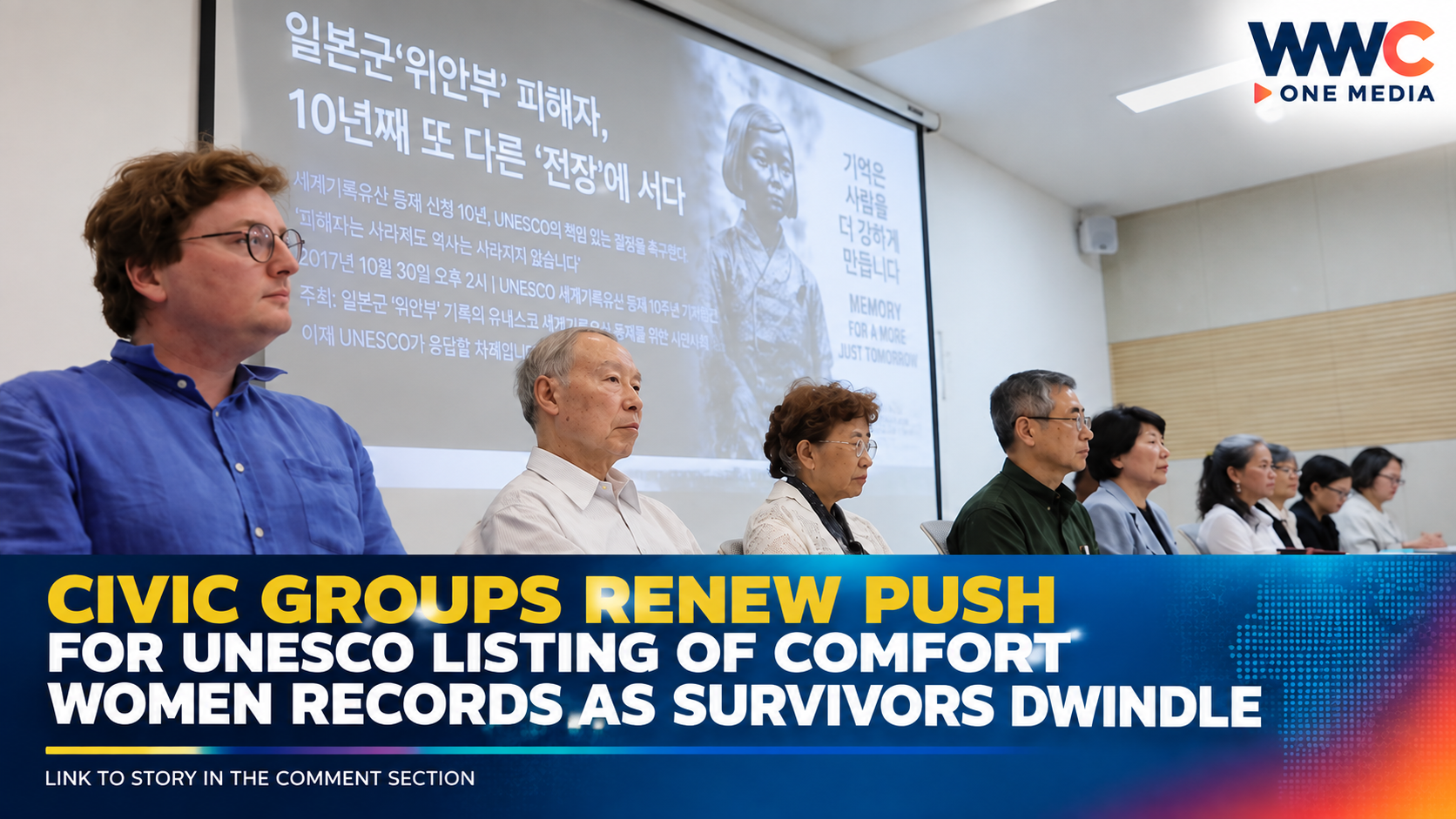
SEOUL, South Korea — A coalition of civic groups is once again pressing UNESCO to move forward with a long-delayed effort to place historical records documenting Japan's wartime sexual slavery system on the Memory of the World Register.
The renewed campaign comes as the number of surviving victims continues to fall, adding urgency to efforts to preserve their testimonies and related historical records.
At a press conference in Seoul on Sept. 6, the groups called on UNESCO to accelerate consideration of the proposed inscription, according to Yonhap News Agency and The Korea Times.
A 10-year-old UNESCO battle
The effort dates back to May 2016, when civic organizations from eight countries and regions submitted a joint nomination concerning records of women subjected to Japan's wartime military sexual slavery.
The nomination, known as “Voices of the Comfort Women,” contains testimonies from victims along with historical records and other materials documenting the system and efforts to seek recognition and justice.
Research published by Cambridge University Press notes that the joint effort involved 14 civic organizations from eight countries and compiled 2,744 documents for the UNESCO nomination.
The materials were drawn from multiple countries and institutions and included official and private records, victim-related documents and records concerning civil-society efforts surrounding the issue.
Why the UNESCO listing remains unresolved
The controversy has never simply been about whether historical documents exist.
In 2017, UNESCO's International Advisory Committee did not proceed with the inscription. Instead, the committee recommended dialogue between the groups behind the competing nominations concerning comfort-women records.
One nomination came from the international coalition supporting “Voices of the Comfort Women.” Another was submitted by organizations from Japan and the United States containing records concerning the comfort-women system and Japanese military discipline.
UNESCO's process was subsequently left in limbo.
According to Yonhap's Sept. 6 report, talks between the competing groups were initially scheduled for June 2025 but have since been postponed twice.
That means the latest campaign is a call for UNESCO to resume or advance the process — not an announcement that UNESCO has approved the records.
The clock is also running on survivor testimony
The campaign has taken on greater urgency because very few survivors remain.
According to the civic coalition cited by Yonhap, only five surviving victims remain in South Korea, while the groups estimate six in China, five in the Philippines, about 20 in Indonesia and one in Timor-Leste.
The declining number of survivors has made preservation of firsthand testimony increasingly important to activists and researchers.
The proposed UNESCO collection is significant precisely because it goes beyond a single country's historical record. The nomination brought together material connected to victims and organizations across several countries affected by Japan's wartime expansion.
Why the “Memory of the World” label matters
UNESCO's Memory of the World Programme is intended to preserve and improve access to documentary heritage considered significant to humanity.
For supporters of the comfort-women nomination, inclusion would therefore represent more than symbolic recognition. It would place the nominated documentary material within an international framework for preserving documentary heritage and increasing awareness of its historical significance.
The nomination's supporters argue that the testimonies and records should remain accessible to future generations regardless of continuing political disagreements surrounding the history.
A deeply sensitive Korea-Japan issue
The dispute is also intertwined with one of the most difficult issues in modern South Korea-Japan relations.
The term “comfort women” is widely used to describe women and girls who were subjected to sexual exploitation in military-run or military-associated comfort stations during Japan's wartime expansion. The issue remains deeply contested politically, particularly over questions surrounding coercion, responsibility, historical interpretation and compensation.
Academic research shows that the UNESCO nomination itself became entangled with broader diplomatic tensions between Seoul and Tokyo. A 2025 Cambridge study described the nomination as an effort by civil-society organizations across multiple countries to preserve the documentary record, while also examining the political disputes that surrounded the UNESCO process.
The issue has also been discussed in United Nations human-rights communications concerning survivors' efforts to preserve testimony and seek recognition.
What happens next?
The immediate question is whether UNESCO's stalled dialogue process can finally move forward.
For the civic groups campaigning in Seoul, the argument is increasingly framed around time: the historical dispute may continue for generations, but the people who experienced the wartime system firsthand cannot.
The original nomination was submitted more than a decade ago. Since then, the number of surviving victims has fallen dramatically.
That leaves UNESCO facing a difficult question: how long can a documentary record wait for a political dispute to be resolved before the last firsthand witnesses are gone?
For supporters of the nomination, preserving the records is not about ending the historical debate. It is about making sure the evidence and voices of those who lived through it remain available for the generations that come next.