
COMELEC Says BARMM Is Ready for Sept. 14 — But the Biggest Test Begins When 2.39 Million Voters Arrive

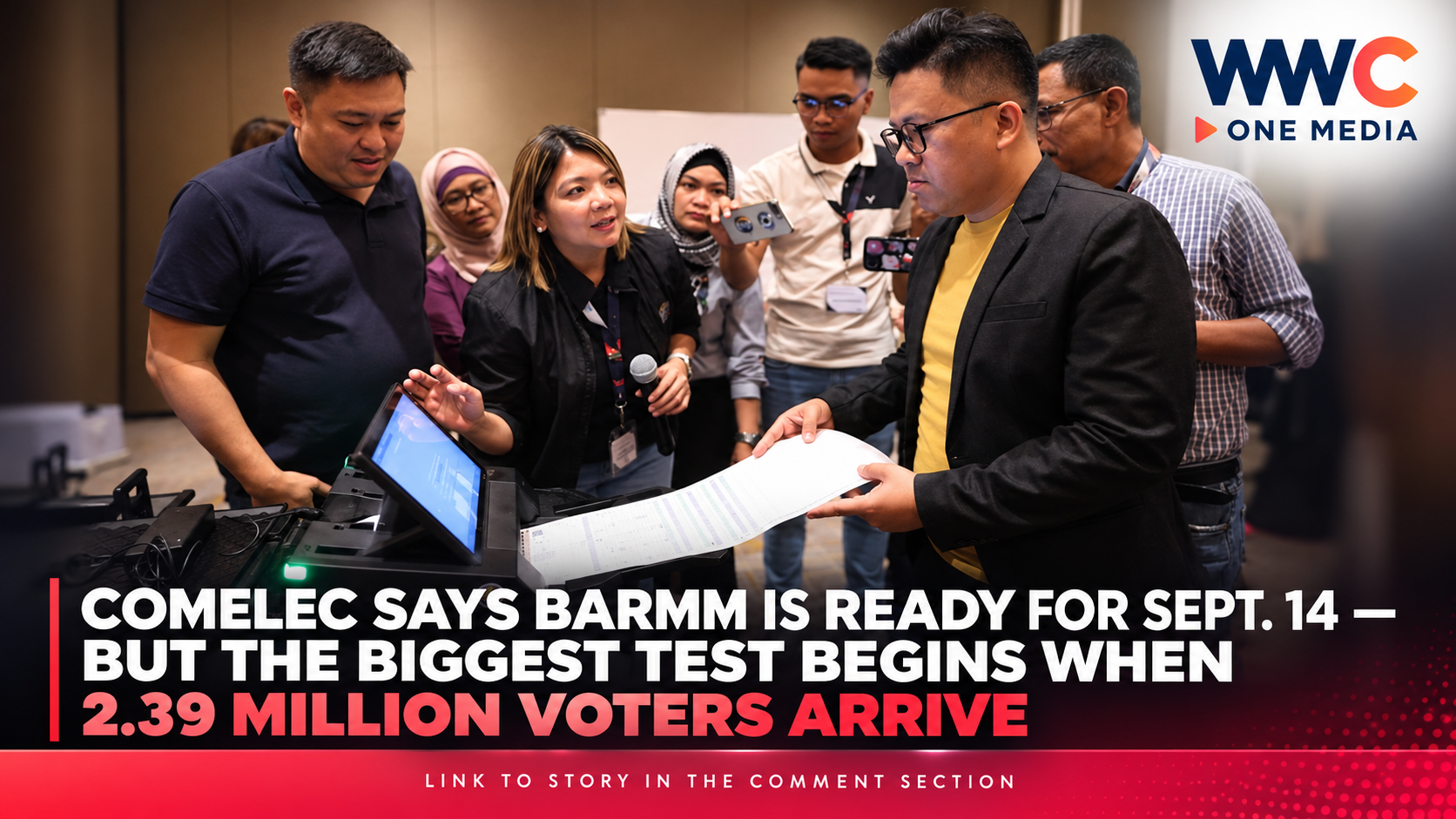
MANILA, Philippines — With less than a week before a landmark political exercise in Muslim Mindanao, the Commission on Elections (COMELEC) says preparations are entering their final stage for the September 14, 2026 Bangsamoro Autonomous Region in Muslim Mindanao parliamentary elections, when nearly 2.4 million voters will choose the region’s first regularly elected parliament.
COMELEC Chairman George Erwin Garcia said election materials, including official ballots, automated counting machines and other equipment, have already reached deployment hubs and are being transported to municipalities and cities across BARMM.
The poll body has targeted September 8 for completing the distribution of election materials to local areas, clearing the way for election officers, teachers and other personnel to prepare for the final testing of voting equipment.
Final testing and sealing of automated counting machines is scheduled for September 12, just two days before election day.
For COMELEC, the message is clear: barring an extraordinary disruption, the historic vote is pushing through.
Malacañang has also confirmed that the elections remain scheduled for September 14, dismissing uncertainty over whether another postponement could derail the region's long-awaited transition to an elected parliamentary government.
2.39 Million Voters, 5,212 Precincts
The scale of the operation is significant.
Around 2.393 million registered voters are expected to participate across 5,212 polling precincts, covering 105 municipalities and two cities in the autonomous region.
The election will determine the composition of the 80-member Bangsamoro Parliament.
Under the parliamentary system, the seats are divided into:
- 40 regional political party representatives
- 32 parliamentary district representatives
- 8 sectoral representatives
Unlike conventional Philippine elections dominated by separately elected executive officials, the Bangsamoro parliamentary system places political parties and parliamentary representation at the center of regional governance.
The election therefore represents far more than another local political contest.
It is a crucial stage in BARMM's transition from the appointed Bangsamoro Transition Authority toward a regional government carrying a direct electoral mandate.
COMELEC Eyes Strong Voter Turnout
Election officials are hoping the historic nature of the polls will translate into heavy voter participation.
COMELEC spokesperson John Rex Laudiangco said the commission is aiming for voter turnout of at least 80 percent, after seeing strong public interest during voter education activities conducted in communities throughout the region.
The poll body has been intensifying voter education because the September election introduces a parliamentary voting system unfamiliar to many residents.
Voters will encounter ballots designed specifically for the Bangsamoro system, including political party names and logos and candidate photographs intended to help voters distinguish among their choices.
COMELEC has also activated its online Precinct Finder from September 7 through the close of voting on September 14, allowing voters to check their assigned polling places before election day.
But Logistics Are Only Half the Battle
While election officials are signaling operational readiness, security remains one of the biggest challenges hanging over the vote.
Police and military forces have intensified election security operations across BARMM, with additional checkpoints, visibility patrols and deployments planned around areas considered vulnerable to political violence.
COMELEC has said the overall security environment remains manageable.
But the region has not been completely free of violence.
The August 15 attack on BARMM Interim Chief Minister Abdulraof Macacua intensified scrutiny of the security situation ahead of the polls, even as authorities maintained that one incident should not be used to characterize conditions across the entire autonomous region.
Security officials have emphasized that sufficient personnel will be positioned before, during and after election day to protect voters, election workers and voting equipment.
Vote-Buying and Intimidation Also Under Scrutiny
Physical security is not the only threat being watched.
A pre-election assessment by the Asia Network for Free Elections and the National Democratic Institute for International Affairs, reported by GMA News, identified voter intimidation, alleged “flying voters,” vote-buying and political pressure as continuing risks, particularly in remote communities.
The assessment also pointed to rido, or clan conflict, political rivalries, private armed groups and remaining violent extremist elements as potential drivers of election-related violence.
Voter education remains another concern.
Observers said awareness of the new parliamentary system is still uneven, particularly in isolated areas and among communities with limited access to election information.
COMELEC has responded by intensifying voter education and creating task forces in several BARMM areas to combat vote-buying.
A Vote That Goes Beyond Choosing Candidates
The September 14 election carries enormous political and historical weight.
BARMM grew out of decades of armed conflict and negotiations between the Philippine government and Moro revolutionary movements, particularly the Moro Islamic Liberation Front.
The creation of an elected parliament is consequently viewed as one of the most important political milestones in the implementation of the Bangsamoro peace process.
For years, the autonomous region has been governed through a transitional authority.
September 14 is designed to change that.
Instead of appointed transitional leaders, voters will help determine the political forces that will control the next phase of Bangsamoro governance.
That makes the election a test not only of COMELEC's machines, ballots and security preparations, but also of whether parliamentary democracy can strengthen political legitimacy and help consolidate peace in a region historically marked by conflict.
COMELEC may now be declaring “all systems go.”
But when millions of Bangsamoro voters head to the polls, the harder test will begin: ensuring that they can vote freely, safely and without intimidation — and that the result earns the confidence of the people it is supposed to represent.
WWC ONE MEDIA M.J.E