
Defense Stipulates Nolasco ‘Received’ P112.5M DepEd Confidential Funds—What the Senate Trial Is Uncovering

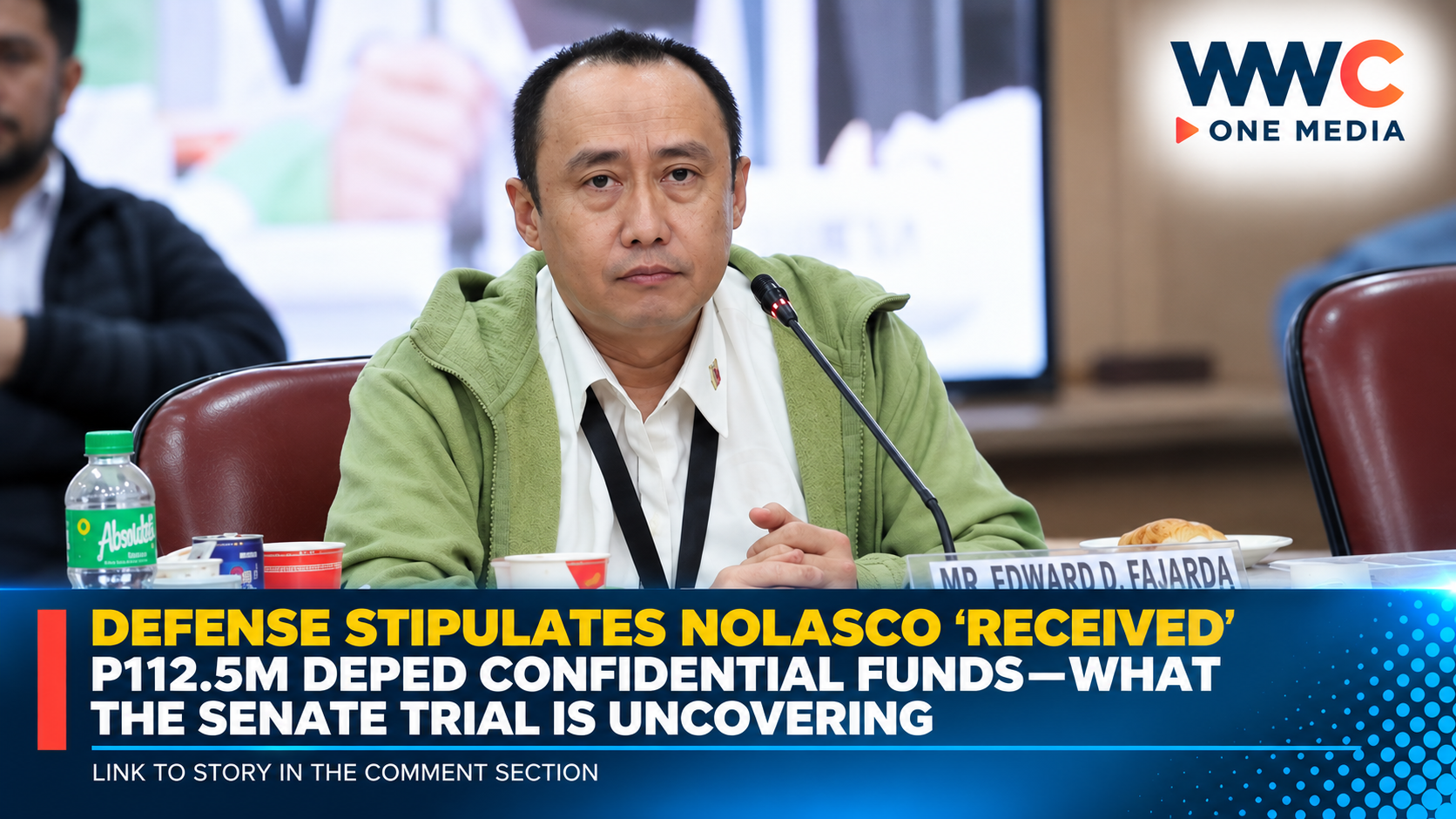
MANILA, Philippines — The impeachment trial of Vice President Sara Duterte took another turn Monday after her defense agreed to a stipulation that former Department of Education (DepEd) security officer Col. Dennis Nolasco received confidential funds released by the agency’s special disbursing officer, Edward Fajarda.
The stipulation concerns P112.5 million in DepEd confidential funds released in three tranches of P37.5 million during Duterte’s tenure as education secretary.
But a critical distinction emerged during the proceedings: the Senate impeachment court has yet to determine whether the funds were properly used, and the agreement that Nolasco “received” the money does not by itself establish that the alleged misuse has been proven.
Defense agrees to “received” instead of “turned over”
The wording itself became a point of contention during Monday’s proceedings.
Prosecutors initially wanted to use the term “turned over” to describe the movement of the confidential funds from Fajarda to Nolasco.
Defense lawyer Lindon Bacquel objected, arguing that “disbursed” was the more appropriate description.
Presiding officer Senate President Francis Escudero suggested using the word “received” while leaving the legal implications of the transaction to the impeachment court.
The defense eventually agreed to the wording that the funds were “received by Col. Dennis Nolasco as security officer.”
The prosecution, however, pointed out that no evidence had been submitted directly showing Nolasco's receipt of the money. Escudero likewise acknowledged that the court had not received such evidence.
That distinction could become important as the Senate evaluates the prosecution's allegations.
Poa previously confirmed VP Sara ordered the transfer
The latest stipulation follows testimony last week from Michael Wesley Poa, a former DepEd undersecretary, chief of staff and spokesperson who is now part of Duterte's defense team.
During questioning, Poa confirmed that Duterte had instructed the transfer of P112.5 million in DepEd confidential funds to Nolasco.
Poa was asked about the testimony of Fajarda during the 2024 House investigation into the use of confidential funds.
Fajarda had identified Duterte as the person who gave authority for Nolasco to disburse the funds.
When prosecutor Benjamin “Jay” Tolosa Jr. pressed Poa on whether Duterte had merely advised Fajarda or actually instructed him, Poa acknowledged that it was the Vice President who had given the authority.
The money trail is now under intense scrutiny
Poa also testified that he did not personally know how the P112.5 million was spent when he helped prepare DepEd's response to questions from the Commission on Audit (COA).
He said Duterte and Fajarda were among those who knew about the handling of the confidential funds, while he learned about Nolasco's involvement only during the 2024 House inquiry.
Poa further acknowledged that he did not consult Nolasco when preparing DepEd's response to COA because he was unaware at the time that the security officer had allegedly handled the funds.
The testimony has placed the movement of the confidential funds—and the people who had knowledge of their use—at the center of the Senate proceedings.
AFP certifications also face questions
Another issue emerging from the trial involves certifications from the Armed Forces of the Philippines (AFP) that were attached to DepEd's response to COA.
Poa confirmed that the certifications did not identify the supposed informants who received rewards or specify the information allegedly purchased using confidential funds.
The issue gained further attention after an Army officer testified that his unit had not received DepEd confidential funds for Youth Leadership Summits and information, education and communication activities cited in a certification.
House prosecutors subsequently criticized the use of AFP documentation to support the questioned expenditures.
Why the “received” wording matters
The Senate's decision to use the word “received” instead of “turned over” or “disbursed” may appear technical, but the distinction could matter in determining what exactly has been established in the impeachment record.
A stipulation generally allows parties to agree on certain facts without requiring a witness to personally testify about every detail.
In this case, however, the parties continue to disagree over the characterization of the transaction and what evidence proves that Nolasco actually received the funds.
The court has therefore been careful not to treat the stipulation as a final finding that the funds were misused.
Nolasco is not expected to testify
The development also comes after prosecutors earlier indicated that they were not inclined to call Nolasco to the witness stand.
Prosecutor Lorna Kapunan previously said the prosecution had concerns about the credibility and verifiability of testimony from Nolasco and Col. Raymund Lachica because neither had testified during the 2024 House investigation.
The prosecution has since dropped Nolasco, Lachica and Ramil Madriaga from its planned witness lineup after determining that evidence already presented could establish the points it wanted to prove, according to recent reporting.
The issue is bigger than one officer
The Nolasco transaction is part of a broader examination of how confidential funds were handled during Duterte's time as education secretary and Vice President.
Former OVP special disbursing officer Gina Acosta previously testified that she released P500 million in OVP confidential funds to Lachica on Duterte's instructions.
Prosecutors have questioned whether such transfers complied with government rules governing confidential and intelligence funds.
The controversy centers in part on the government's Joint Circular 2015-01, which provides rules for the handling of confidential and intelligence funds. Prosecutors have cited provisions concerning accountable officers and the transfer of cash advances between officers.
Five witnesses remain for the prosecution
The prosecution is now nearing the end of its presentation of evidence.
As of September 6, lead prosecutor Rep. Gerville Luistro said only five subpoenaed witnesses remained: Fajarda, his wife Sunshine Charry Fajarda, Philippine Statistics Authority Assistant National Statistician Marizza Grande, Police Maj. Jovelyn Magay and COA employee Bresilio Sabaldan.
Fajarda's appearance has been complicated by his medical condition. Prosecutors had earlier said he was unlikely to testify on September 7 after being advised to undergo a period of rest.
That makes the agreed stipulations particularly significant because they could allow the Senate to place portions of Fajarda's previous testimony and the handling of the funds into the trial record without requiring him to take the witness stand immediately.
What happens next?
The Senate impeachment court must ultimately determine whether the evidence presented by the House prosecution meets the constitutional threshold for impeachment.
For now, the latest development establishes a narrower point: the defense has agreed to a stipulation describing Nolasco as having received the DepEd confidential funds.
It does not, by itself, settle the bigger questions surrounding the money—how it was ultimately spent, whether the expenditures were properly documented, whether government rules were followed, and what responsibility, if any, should attach to Duterte or other officials.
Those questions remain at the heart of the impeachment trial.
And as the prosecution prepares to complete its witness presentation, the biggest question may no longer be simply where the P112.5 million went—but whether the evidence can establish who was responsible for what happened to it.