
DENR Issues Urgent Warning as Habagat Rains Continue—But It’s What’s Blocking Metro Manila’s Waterways That Has Authorities Worried

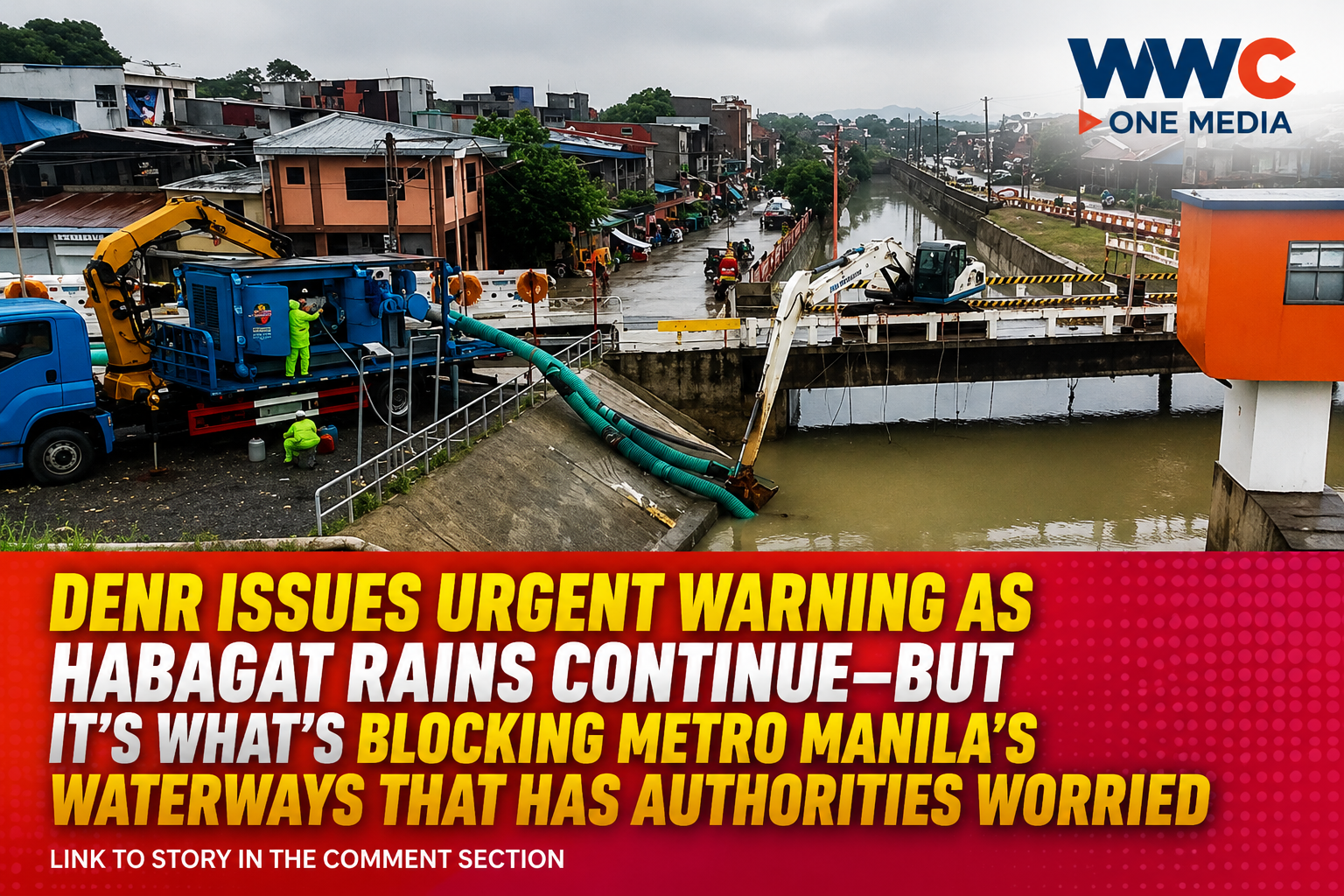
The Department of Environment and Natural Resources (DENR) is calling on local government units (LGUs) to step up solid waste management efforts as persistent rains from the southwest monsoon, or Habagat, continue to affect Metro Manila and other parts of the Philippines.
DENR Secretary Juan Miguel Cuna stressed the need to keep waterways, drainage channels and other water passages free of garbage, warning that waste accumulating in these areas can obstruct water flow and worsen flooding during periods of heavy rain.
“Habagat is a natural phenomenon, but the waste that ends up in waterways is something that can be prevented,” Cuna said in a statement, according to GMA News.
The DENR has intensified cleanup activities in waterways and coastal areas in the National Capital Region following days of heavy rainfall and flooding. The department is also monitoring the solid waste management plans and facilities of LGUs as part of their responsibilities under the Ecological Solid Waste Management Act of 2000, or Republic Act No. 9003.
Garbage becomes a growing concern during heavy rains
The problem has become particularly visible in Metro Manila, where large amounts of waste have been recovered from waterways following the recent rains.
GMA News previously reported that around 300 tons of garbage were cleared from the Baclaran estero after heavy rains, highlighting the scale of the waste problem facing some waterways in the capital.
The DENR-NCR has likewise conducted cleanup operations in several waterways, including areas where garbage and water hyacinth accumulated after the prolonged rains.
The issue is not new. DENR records from earlier Manila Bay rehabilitation operations have repeatedly shown that large quantities of solid waste can accumulate in waterways and coastal areas, particularly during periods of heavy rainfall.
Authorities push stronger enforcement
The call for better waste management comes as Metro Manila authorities also move toward tougher penalties for improper garbage disposal.
The Metro Manila Council has approved a unified penalty framework that would raise the fine for littering and improper waste disposal to ₱5,000 in the region's cities, while the penalty for Pateros would be ₱2,500.
However, the higher penalties require corresponding local ordinances before they can take effect in each jurisdiction.
The move reflects growing concern that improperly discarded waste can enter drainage systems, creeks and rivers, potentially restricting the movement of floodwater.
A 2026 report by the Daily Tribune also cited an MMDA official who said the agency retrieves thousands of metric tons of garbage from Metro Manila pumping stations and waterways each year, illustrating the continuing burden placed on the capital's flood-management system.
Habagat continues to test Metro Manila's flood defenses
The waste-management warning comes amid a broader flooding situation brought about by persistent rains.
Earlier in August, the Philippine News Agency reported that hundreds of thousands of people across several regions had been affected by the combined effects of the enhanced Habagat and tropical cyclones Luis and Maymay. Government agencies were placed on heightened alert as flooding and other hazards affected communities.
The national government has also been pursuing several measures to reduce flooding, including dredging waterways, improving drainage infrastructure, and keeping pumping stations operational.
This means garbage is only one part of a much larger flood-management challenge. Heavy rainfall can overwhelm drainage systems, while urban development, limited water absorption areas, river capacity and infrastructure conditions can also contribute to flooding.
Still, keeping waterways clear is one factor authorities can address immediately.
As Cuna put it, every piece of waste kept out of waterways represents one less potential obstruction to drainage and one less source of pollution reaching rivers, coastal areas and the sea.
For residents, the message from authorities is straightforward: proper waste disposal becomes even more critical when heavy rains are expected. For LGUs, the challenge is to ensure that collection, segregation, disposal and enforcement systems continue functioning before garbage has a chance to reach the waterways.
And with Habagat rains continuing to test Metro Manila's flood defenses, the question is no longer simply how much rain the capital can handle—but how prepared its waterways are to handle it.