
DSWD Has More Than ₱1 Billion Left in Quick Response Fund as Philippines Braces for Future Calamities

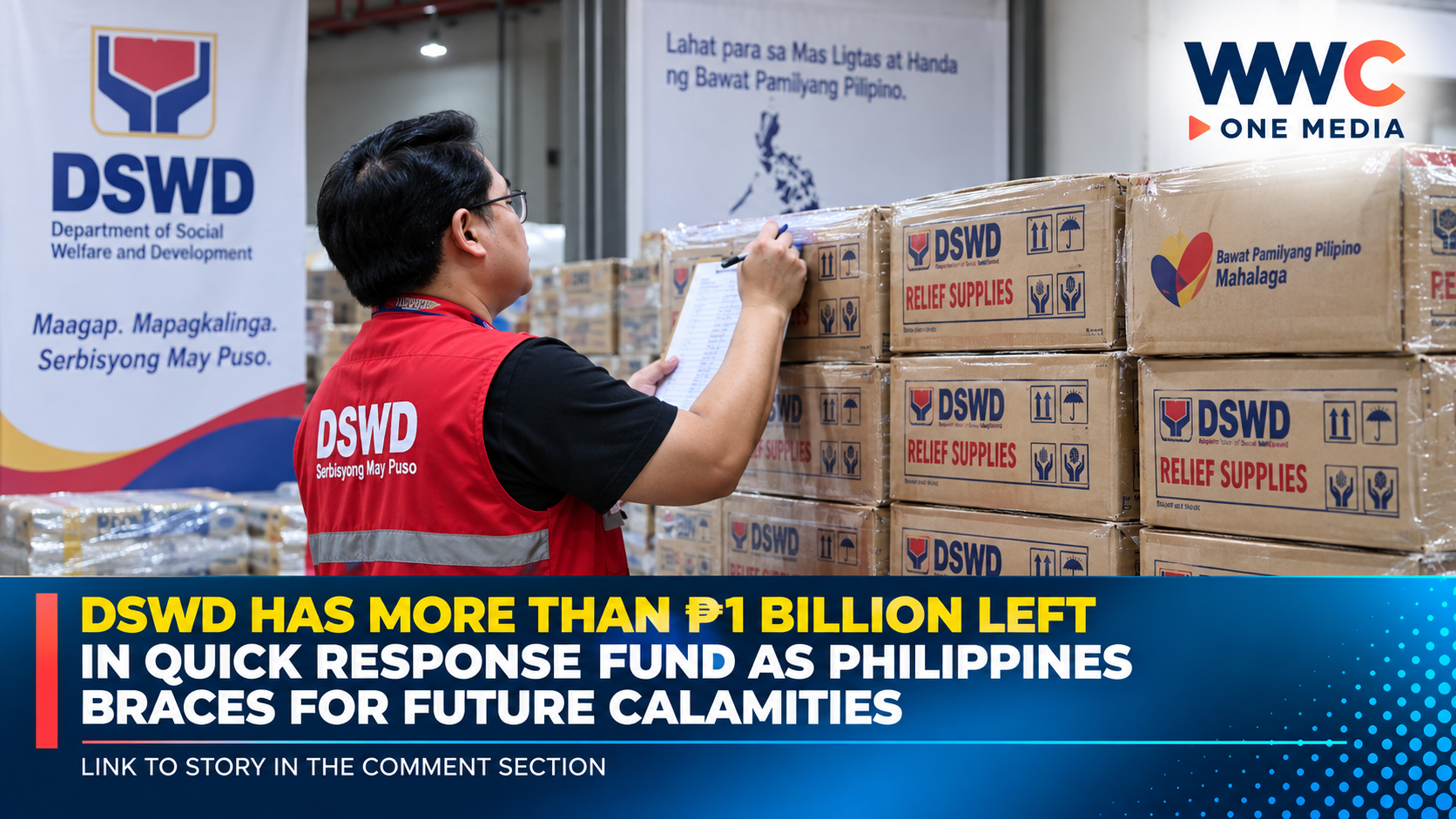
MANILA — The Department of Social Welfare and Development (DSWD) still has more than ₱1 billion in its Quick Response Fund (QRF) for future calamities, even after a series of major relief operations across the Philippines, a senior agency official said Monday.
The latest figure comes as the country continues to face recurring weather disturbances during the rainy season, putting renewed attention on whether government agencies have enough resources to respond quickly when disasters strike.
DSWD Assistant Secretary Irene Dumlao said the agency has more than ₱1.02 billion remaining in its QRF, according to the Philippine News Agency. The fund is intended to support immediate relief and rehabilitation needs following disasters and other emergencies.
The remaining funds come after DSWD deployed substantial assistance to communities affected by recent tropical cyclones and the southwest monsoon.
₱3 billion QRF was set for DSWD in 2026
The amount currently available is only part of a much larger disaster-response allocation.
Under the 2026 General Appropriations Act, DSWD was provided with a ₱3-billion Quick Response Fund, up from the ₱1.25 billion provided under the 2026 expenditure proposal before the budget was increased.
The QRF is a standby fund intended for relief and rehabilitation programs, including the pre-positioning of goods and equipment, following natural or human-induced calamities, epidemics, crises and catastrophes.
The law also places restrictions on how the fund can be used. It is not a general-purpose disaster-prevention fund and cannot simply be spent on unrelated activities.
That distinction is crucial: the money is designed to respond to disasters, rather than finance every form of disaster-prevention activity.
Why more than ₱1 billion remains significant
The Philippines is one of the world's most disaster-prone countries, regularly experiencing tropical cyclones, flooding, landslides, earthquakes and volcanic activity.
For DSWD, maintaining an available QRF balance means the agency can continue responding when another disaster strikes without waiting for an entirely new budget authorization.
That becomes especially important during periods when several disasters occur in rapid succession.
In August alone, DSWD reported deploying more than ₱1.1 billion worth of humanitarian assistance to communities affected by Tropical Cyclones Luis and Maymay and the southwest monsoon. The assistance included more than 1.7 million family food packs, ready-to-eat food, non-food items and other forms of assistance.
DSWD has also built a massive relief stockpile
The agency's financial reserves are only one part of its disaster-response capacity.
Earlier in August, DSWD said it had prepared its largest disaster-relief stockpile to date, with nearly 5 million family food packs positioned around the country and approximately ₱1.61 billion in standby funds available for rapid deployment at that point in the disaster cycle.
DSWD has emphasized that food packs are continually being repacked and positioned across its warehouses so supplies can move closer to affected communities as quickly as possible.
In a June preparedness update, the agency reported having more than 4.79 million family food packs in major hubs, spokes and last-mile warehouses, alongside other food and non-food items and standby funds worth a combined ₱5.551 billion.
That stockpile is intended to shorten the time between a disaster and the arrival of basic assistance.
Relief spending has been heavy
The need for rapid response has been evident throughout 2026.
DSWD has repeatedly activated its disaster-response machinery as storms, flooding and monsoon rains have affected communities across the country.
The agency has also had to coordinate with local governments to deliver assistance to areas where roads became difficult to pass and residents were unable or unwilling to leave their homes because of flooding.
That sustained deployment explains why replenishing the QRF has become an important issue.
ABS-CBN News reported in late August that DSWD was replenishing its ₱3-billion QRF for 2026, following the agency's disaster-response spending.
The replenishment effort highlights the financial reality of disaster response: a fund that looks large on paper can decline quickly when multiple emergencies hit one after another.
Government has expanded disaster-response funding
The increase in DSWD's QRF is part of a wider expansion in government disaster-response resources.
The 2026 National Disaster Risk Reduction and Management Fund includes QRF allocations for several agencies, including ₱3 billion for DepEd, ₱1 billion each for the Department of Agriculture, Office of Civil Defense and DPWH, and ₱1.25 billion in the initial expenditure proposal for DSWD, with the final DSWD General Appropriations Act allocation rising to ₱3 billion.
The government's broader calamity fund can also provide additional financing to agency QRFs when their balances fall to specified levels, subject to the required approvals and rules.
This gives the government another potential funding mechanism when prolonged or successive disasters put pressure on agency reserves.
Disaster preparedness is moving beyond relief goods
The administration has also been investing in systems intended to detect hazards before they become disasters.
In August, President Ferdinand Marcos Jr. ordered the release of ₱1 billion to strengthen Project NOAH, the University of the Philippines-led disaster risk-reduction program.
The funding is intended to support artificial intelligence, real-time hazard monitoring and predictive flood forecasting.
The goal is to improve not just the government's ability to respond after disasters, but also its ability to identify risks earlier.
That is particularly important for flooding, where earlier warnings can give communities more time to evacuate and protect property.
The real test is what happens after the next storm
Having more than ₱1 billion remaining in the QRF provides DSWD with an important financial buffer, but it does not mean the agency has unlimited resources.
The Philippines can experience multiple storms and other emergencies within a relatively short period, and relief requirements can escalate rapidly when large populations are displaced.
The government's challenge is therefore twofold: maintain enough immediately available funding and supplies while ensuring that assistance reaches affected families quickly and efficiently.
For DSWD, the remaining ₱1.02 billion could provide critical breathing room.
But the question hanging over the country's disaster-response system is how quickly that balance could shrink if another major calamity strikes.
With the rainy season continuing and the Philippines remaining highly exposed to natural hazards, the next emergency—not the size of today's balance—will ultimately determine whether the country's disaster-response preparations are enough.