
EEI Put ₱400 Million Into Dennis Uy’s Emerald Bay Rescue — But the Casino Deal Collapsed Before a Final Agreement Was Signed

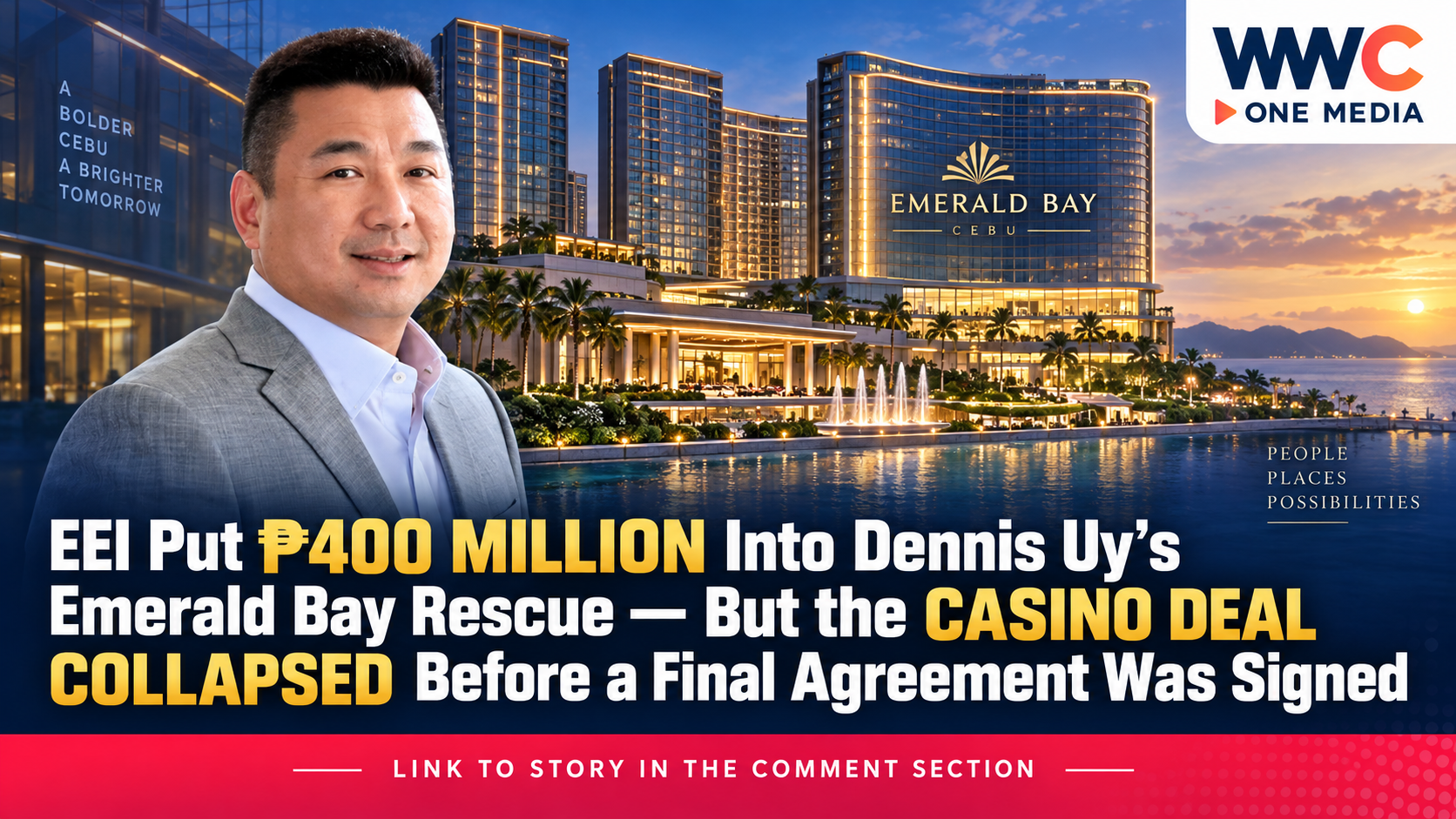
MANILA, Philippines — What began as another possible lifeline for Dennis Uy’s unfinished Emerald Bay casino has ended with the resort stripped of both its property and gaming license — while hundreds of millions of pesos advanced during rescue negotiations remain under scrutiny.
New financial disclosures from PH Resorts Group Holdings Inc. show that construction giant EEI Corp. advanced a total of ₱400 million as discussions progressed over a possible partnership to finish the long-stalled integrated resort in Mactan, Cebu.
The figure is larger than the ₱300 million advance previously reported.
According to PH Resorts’ latest filing, ₱100 million was advanced through parent company Udenna Corp. in 2024, followed by another ₱300 million in January 2025, bringing the total associated with the proposed transaction to ₱400 million.
But the partnership never reached the finish line.
PH Resorts said negotiations with EEI “have not ripened to the execution of definitive agreements,” and the planned partnership will no longer proceed following the collapse of the Emerald Bay project’s original structure.
EEI emerged as the latest potential rescue
EEI entered discussions with PH Resorts in December 2024, with the parties exploring an arrangement under which the construction company could help finance, build and ultimately complete Emerald Bay.
The project had been envisioned as one of Cebu’s major integrated resort developments, combining a luxury hotel, restaurants, entertainment facilities and a large casino complex on a prime beachfront site in Mactan.
But by the time EEI arrived, Emerald Bay had already endured years of construction delays, heavy debt and unsuccessful attempts to attract a strategic investor.
Before EEI, PH Resorts had pursued deals involving Bloomberry Resorts Corp., controlled by billionaire Enrique Razon Jr.; AppleOne Properties; and Tiger Resort, Leisure and Entertainment Inc., the operator of Okada Manila.
None produced the long-term investor needed to complete Emerald Bay.
Where did the money go?
PH Resorts’ disclosures indicate that money advanced during the EEI negotiations was used in part to meet lease and interest obligations to China Banking Corp., or Chinabank.
That detail is crucial because Chinabank had already become central to Emerald Bay’s survival.
In 2023, PH Resorts transferred the Mactan property to Chinabank as part of a debt restructuring arrangement. The transaction allowed PH Resorts to continue leasing the site while retaining an option to buy it back.
GMA News reported that the transaction was connected to the settlement of a ₱3.1-billion loan, while PH Resorts was given more than a year to find financing and redeem the property.
The rescue never came in time.
PH Resorts’ repurchase option expired on March 31, 2025.
Chinabank chairman Hans Sy subsequently confirmed that the bank would move toward selling the property after PH Resorts failed to exercise the option.
The result was a devastating accounting blow.
PH Resorts removed approximately ₱13.65 billion worth of Mactan property and improvements from its books after losing control of the site. Related liabilities were also derecognized.
Without control of the land, the original Emerald Bay rescue proposition became dramatically more difficult.
Then PAGCOR pulled the casino license
Any remaining path for the original project narrowed further in December 2025.
The Philippine Amusement and Gaming Corp. revoked the provisional gaming license issued for the Emerald Bay integrated resort.
PH Resorts confirmed through a stock exchange disclosure that subsidiaries LapuLapu Leisure Inc. and LapuLapu Land Corp. had received notice of PAGCOR's decision.
Because Emerald Bay had never begun commercial casino operations, PH Resorts said the license revocation was not expected to create an additional material impact on its existing financial position.
Operationally, however, the decision effectively closed another critical door: the company no longer controlled the property and no longer possessed the provisional gaming authority around which the project had been planned.
That also formally ended the possibility of the proposed EEI partnership proceeding in its original form.
The ₱300-million refund question
EEI had already begun trying to recover part of the money.
In December 2025, the construction company told InsiderPH that it had initiated the refund process for the ₱300 million advanced in January 2025 under the relevant agreement.
At the time, EEI said there was no firm timetable for repayment, although it hoped the process could be completed in early 2026.
The newer disclosure now reveals the additional ₱100-million advance made in 2024.
However, the available public information reviewed does not clearly establish whether that earlier ₱100 million is included in EEI's previously announced refund claim, whether it has already been settled, or how much of the overall ₱400 million remains recoverable.
That distinction matters.
It would therefore be premature to describe the entire ₱400 million as an unpaid refund claim unless EEI or PH Resorts provides another disclosure confirming that status.
Emerald Bay had already lost several potential white knights
EEI was hardly the first major company to test a rescue of Dennis Uy’s casino project.
Bloomberry signed a term sheet in 2022 involving possible investments in PH Resorts' gaming assets. The deal was terminated in 2023 after due diligence.
Bloomberry had advanced ₱1 billion, which PH Resorts eventually repaid in full. The final ₱76 million installment was returned in July 2025, almost three years after the original negotiations began.
Then came the Okada Manila group.
Tiger Resort agreed to pursue a transaction involving Emerald Bay but terminated the agreement in July 2024. The Inquirer reported that the proposed deal would have given Tiger Resort a majority stake in subsidiaries associated with the project.
PH Resorts had received ₱327.6 million from the Okada group, but unlike Bloomberry’s advance, that payment was characterized as non-refundable.
EEI subsequently emerged as another potential white knight.
It, too, walked away without a definitive rescue agreement.
PH Resorts still faces a deeply strained balance sheet
The failed Emerald Bay project left PH Resorts with a dramatically smaller asset base.
For the first half of 2026, PH Resorts reported approximately ₱2.79 billion in total assets against ₱8.74 billion in liabilities, resulting in a stockholders’ equity deficit of about ₱5.95 billion.
Its first-half net loss narrowed sharply to around ₱80.7 million, compared with roughly ₱6.75 billion a year earlier. But the enormous year-on-year difference largely reflects the extraordinary accounting losses booked in 2025 when the company lost control of the Emerald Bay property.
Revenue also remained modest, with first-half gross revenue of about ₱13.34 million.
Those figures underline why recovering significant advances could remain an important issue for creditors and counterparties.
Now Dennis Uy is preparing an even bigger PH Resorts reset
The story has since moved beyond Emerald Bay.
In a separate September 7, 2026 PSE disclosure, PH Resorts revealed a sweeping proposed restructuring that would transfer its entire ownership of PH Travel and Leisure Holdings Corp. back to parent Udenna.
PH Travel holds substantially all of PH Resorts' consolidated operating assets, properties and related liabilities, including subsidiaries connected with Emerald Bay and the Donatela resort in Bohol.
Under the proposal, Udenna would acquire PH Travel through the settlement of advances owed by PH Resorts to its parent.
PH Resorts said the restructuring is intended to relieve the listed company of its subsidiaries’ liabilities and reposition it as a “streamlined listed holding company with a strengthened financial profile.”
The transaction is not yet final. Its valuation, payment structure and definitive terms remain subject to negotiations, legal, tax and accounting reviews, shareholder approval and any required regulatory clearances.
That means Emerald Bay's collapse may ultimately become part of a much larger corporate overhaul.
The bigger question
For years, Emerald Bay repeatedly attracted heavyweight companies willing to examine a rescue — Bloomberry, AppleOne, Okada and finally EEI.
But each effort failed to produce the strategic investor needed to complete the casino.
This time, the latest disclosure adds another layer to the story: EEI had put a combined ₱400 million into the proposed rescue process before the project ultimately lost its land and gaming license.
What remains unresolved is how the financial aftermath will be divided.
EEI publicly sought the return of its ₱300-million January 2025 advance. The newer disclosure reveals another ₱100 million had gone in earlier. PH Resorts, meanwhile, is attempting to restructure a balance sheet where liabilities remain several times larger than assets.
Emerald Bay may no longer be Dennis Uy’s casino rescue story.
The next story is who ultimately recovers what from its collapse.
WWC ONE MEDIA M.J.E