
Family Waited 10 Days for the Worst — Then a Chinese Worker Was Found Alive Inside a Nepal Tunnel

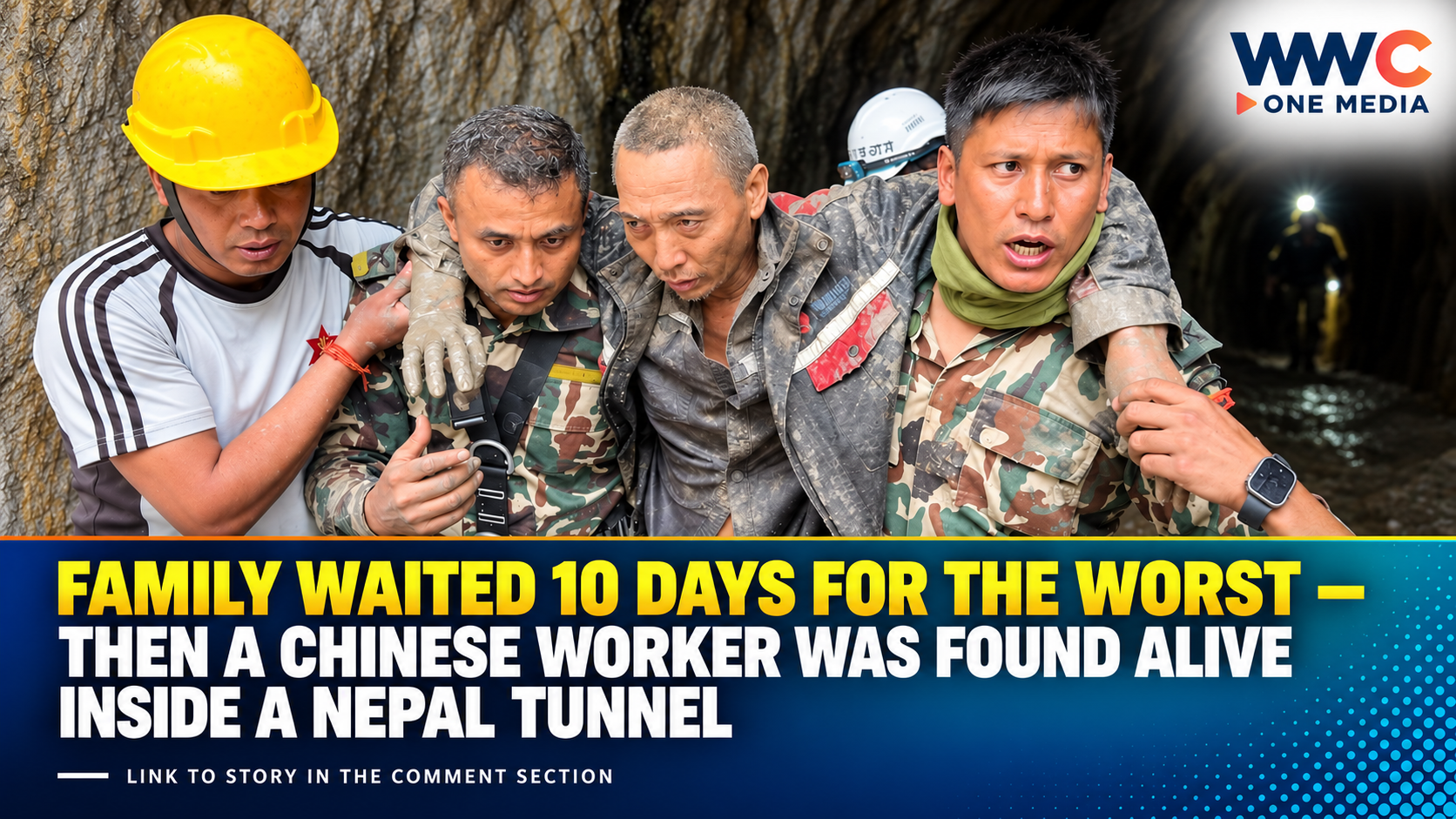
KATHMANDU, Nepal — After 10 agonizing days of uncertainty, a family in China finally received the news they had been desperately hoping for: Lu Haitao was alive.
The Chinese worker had been trapped inside a hydropower tunnel in Nepal after catastrophic floods devastated communities near the Nepal-China border, killing more than 1,300 people and leaving thousands more missing.
For Lu's family, who had spent days fearing the worst and searching for information about his fate, the rescue was nothing short of extraordinary.
But his survival has also raised a haunting question for rescuers:
Could there still be more people alive beneath the mud, debris and damaged tunnels?
Chinese Worker Found Alive After Days Underground
Lu Haitao was rescued from a 225-meter tunnel at a hydropower project in Nepal 10 days after catastrophic flooding struck the country on August 26.
According to Associated Press reporting carried by The Korea Times, Lu became one of several workers rescued from hydropower facilities where floodwaters and debris trapped or buried workers underground.
He was taken to a hospital and was reported to be in stable condition following the rescue.
The discovery came after two Nepali workers were also pulled alive from a tunnel the previous day, briefly renewing hopes that other missing workers could still be found.
Lu's rescue was especially emotional for his relatives in China, who had endured days of uncertainty with little direct information about whether he had survived.
His family reportedly followed news reports and relied on translated information as they waited for updates from Nepal.
For days, there was no certainty.
Then came the photograph.
After seeing news images confirming that Lu had been rescued, his family finally knew the nightmare was over.
A First Overseas Job Turns Into a Fight for Survival
Lu, who reportedly worked as a farmer and carpenter before traveling overseas, had gone to Nepal in February for his first job outside China.
What was supposed to be a new chapter in his life quickly turned into a battle for survival.
Trapped underground after the flood disaster, Lu reportedly began losing hope before rescue teams eventually reached him.
His survival now stands out as one of the most remarkable rescue stories to emerge from one of the Himalayan region's deadliest disasters in years.
But while his family is celebrating, thousands of other families are still waiting.
And many still do not know whether their loved ones are alive.
Nepal's Hydropower Tunnels Become the Center of a Massive Rescue Operation
The flood disaster severely damaged multiple hydropower projects in Nepal's mountainous north.
Rescue teams have focused heavily on tunnels where hundreds of workers were believed to have been trapped or remained unaccounted for.
Recent AP reporting said approximately 900 workers were missing across around a dozen hydropower sites, with about 500 feared trapped in tunnels during earlier stages of the rescue operation.
The difficult terrain, damaged roads, mud-filled tunnels and destroyed infrastructure have made rescue operations extremely dangerous and slow.
Experts have also warned that Nepal has limited experience and equipment for large-scale tunnel rescue operations, creating additional challenges for emergency teams.
International Teams Join the Search
The scale of the disaster has triggered an international rescue and humanitarian response.
Teams and specialists from several countries, including South Korea, India, China and the United States, have been involved in search and rescue efforts.
South Korea deployed a 44-member Korea Disaster Relief Team with rescue equipment and search dogs to support operations in Nepal.
The mission has particular significance for South Korea because nine South Koreans were reported missing after the flooding struck the Upper Trishuli-1 hydropower project construction area.
Six of the missing Koreans were employees of Doosan Enerbility, while three were connected to Korea South-East Power Co.
What Caused the Nepal Flood Disaster?
The devastating floods struck the Nepal-China border region on August 26 after what authorities and experts have described as a major glacial and rock collapse, unleashing enormous volumes of water and debris downstream.
Entire communities were damaged or swept away.
Homes, roads, bridges and hydropower facilities were buried under mud and debris, while remote mountain communities became difficult to reach.
Reuters reported that Nepal had been pushing for improved access to upstream data and earlier warnings from China even before the catastrophe, highlighting growing concerns about climate-related risks and increasingly dangerous conditions in the Himalayas.
More Than 1,300 Dead — Thousands Still Missing
The human cost of the disaster continues to grow.
Recent reports have placed the death toll in Nepal above 1,300, while thousands of people remain missing across Nepal and affected areas near China's Tibet region.
The numbers have changed repeatedly as authorities recover more bodies, locate survivors and update missing-person lists.
Rescuers have also continued searching for foreign nationals, workers and local residents who disappeared during the disaster.
The destruction has been so extensive that authorities now face not only an enormous rescue operation but also the challenge of rebuilding thousands of damaged homes and restoring roads, telecommunications and other critical infrastructure.
A Miracle That Offers Hope — But Time Is Running Out
Lu Haitao's rescue has given families of the missing something they desperately needed: hope.
Finding someone alive 10 days after a catastrophic flood is rare.
Finding multiple survivors in separate operations has made the latest rescues even more remarkable.
But rescue experts warn that the chances of finding additional survivors generally decrease as more time passes.
For Lu's family in China, the wait is finally over.
For thousands of others, it continues.
And beneath the mud, wreckage and damaged tunnels of Nepal's flood zone, rescuers are still searching for an answer to the question families across several countries are asking:
Is anyone else still alive?