
Father Wins Right to Choose Son’s Primary School — But What the Singapore Judge Said About “Prestige” Could Matter to Thousands of Parents

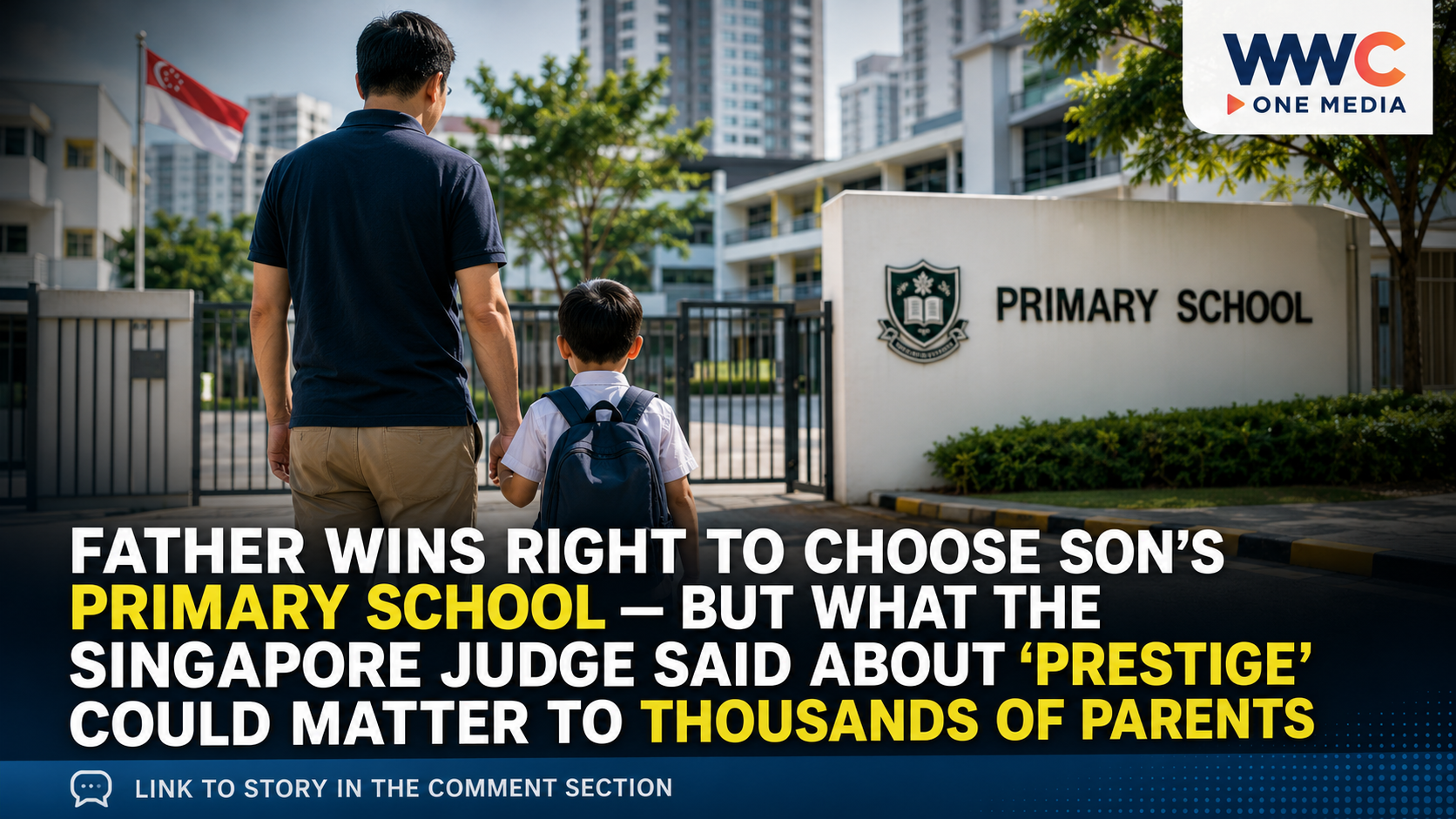
SINGAPORE — September 3, 2026 — A divorced father has won the authority to choose which primary school his young son will attend after a disagreement with his former wife escalated into a Family Justice Courts battle — but the most significant part of the ruling may be what the judge said should not determine a child’s school.
District Judge Goh Zhuo Neng ruled that the father should have sole authority to register the boy for Primary 1, placing particular weight on travel time, early-morning routines and the practical burden on the child, rather than the perceived prestige of competing schools.
The boy is due to enter primary school in 2027. His parents married in 2019, began divorce proceedings in 2022 and later agreed to joint custody and shared care and control. Under their arrangement, the child spends part of each week with each parent.
A School Dispute That Ended Up in Court
Both parents wanted their son registered at a primary school of their choice.
The father filed his application on June 30, 2026, while the mother filed hers on July 10. By the time the applications were heard on July 23, Phase 2A of the Primary 1 registration exercise had already passed, leaving Phase 2C and Phase 2C Supplementary among the remaining options relevant to the dispute.
On July 23, the judge ordered that the father be allowed to decide where the boy would be registered. If a place could not be secured at his preferred school, the father was authorised to register the child at another school where a place was available.
The court also awarded the father S$1,000 in costs.
The mother filed an appeal on August 5, meaning the dispute may not yet be over.
Why the Father’s Choice Won
The decisive issue was surprisingly practical.
Both parents proposed schools located no more than about five minutes from their respective homes. The problem was that the parents themselves lived approximately 30 to 40 minutes apart.
That meant whichever nearby school was chosen, the child could face roughly a 30-minute journey when staying with the other parent.
The mother also proposed another school that was seven to 10 minutes from the boy’s current preschool, apparently helping preserve some continuity.
But the judge concluded that maintaining that arrangement was not enough to outweigh the realities of primary-school life.
Primary school begins earlier and follows a less flexible schedule than preschool. The proposed alternative was also around 20 minutes from both parents’ homes.
Giving the father authority over the school choice meant the boy could spend three mornings each week without having to wake as early for a longer journey. The father would also be responsible for preparing him for three full school days, compared with two full days for the mother under the existing arrangement.
The judge stressed that this calculation was specific to the circumstances of this family, particularly because most of the other factors were neutral. Neither parent could claim to be the primary caregiver because the child spent roughly equal time with both.
Court Warns Against Turning School Choice Into a Prestige Contest
Perhaps the broader takeaway from the ruling concerned Singapore’s highly competitive school-selection culture.
Judge Goh identified several factors courts may examine when separated parents cannot agree on Primary 1 registration, including:
- the child’s distance from the school;
- which parent carries more caregiving responsibility;
- availability of places;
- alumni connections where they affect admission chances;
- the parents’ conduct; and
- ultimately, what best serves the child’s welfare.
But he cautioned against placing excessive emphasis on a school’s reputation.
Arguments over which school supposedly offers greater prestige or a superior curriculum can become a “ranking exercise” that distracts from more important issues affecting the individual child, the judgment said.
That distinction is significant because Singapore’s Ministry of Education itself advises parents that choosing a primary school requires balancing a child’s needs with family preferences.
MOE’s current registration guidance also confirms that home-to-school distance can affect admission priority, while Primary 1 registration for Singapore Citizens and permanent residents runs through multiple phases from Phase 1 through Phase 2C Supplementary.
Distance Is About More Than Convenience
The court noted that primary-school assemblies commonly begin around 7.30am, making additional travelling time particularly significant for young children.
Distance can also influence admission prospects because proximity to the school is used in determining priority in certain situations when places are contested.
In other words, where a child lives is not merely a matter of convenience. It can affect both the chances of admission and the child’s everyday routine for years after entering Primary 1.
The Parents’ Conduct Also Came Under Scrutiny
The mother argued that the father had been unwilling to engage productively when she raised the schooling issue.
But Judge Goh found that his behaviour did not justify giving the mother control over the decision.
The court compared the dispute with an earlier case, VPN v VPO [2026] SGFC 6, where another father’s conduct during Primary 1 discussions was considered problematic. In that earlier case, the court cited delayed responses and combative behaviour as factors relevant to co-parenting.
In the present dispute, however, Judge Goh said the father may not have been willing to compromise completely, but his conduct was essentially neutral. He had also been the first parent to bring the issue before the court so that it could be resolved.
Why the Court Could Intervene
The existing custody arrangement did not specifically address Primary 1 registration.
Under Section 128 of Singapore’s Women’s Charter, a court may vary or rescind a custody or care-and-control order where there has been a material change in circumstances.
The parents did not dispute that their son reaching Primary 1 registration age amounted to such a change, allowing the court to decide which parent should receive authority over the school registration.
The Bigger Question Is Still Unresolved
For now, the father has the authority to choose.
But the case leaves a wider message for separated parents facing major educational decisions: the school with the strongest reputation may not automatically be the school a court considers best for a child.
Daily travel, sleep, caregiving arrangements, admission realities and the parents’ ability to cooperate can carry greater weight.
And with the mother appealing the ruling, an even bigger question remains: will the appeal court endorse this child-first, practicality-over-prestige approach — or redraw the boundaries of who gets the final say when divorced parents cannot agree on a school?
WWC ONE MEDIA MJE