
Former ENHYPEN Star Evan Survived Cancer as a Child — Now the Real Meaning Behind ‘Death of Me’ Is Coming to Light

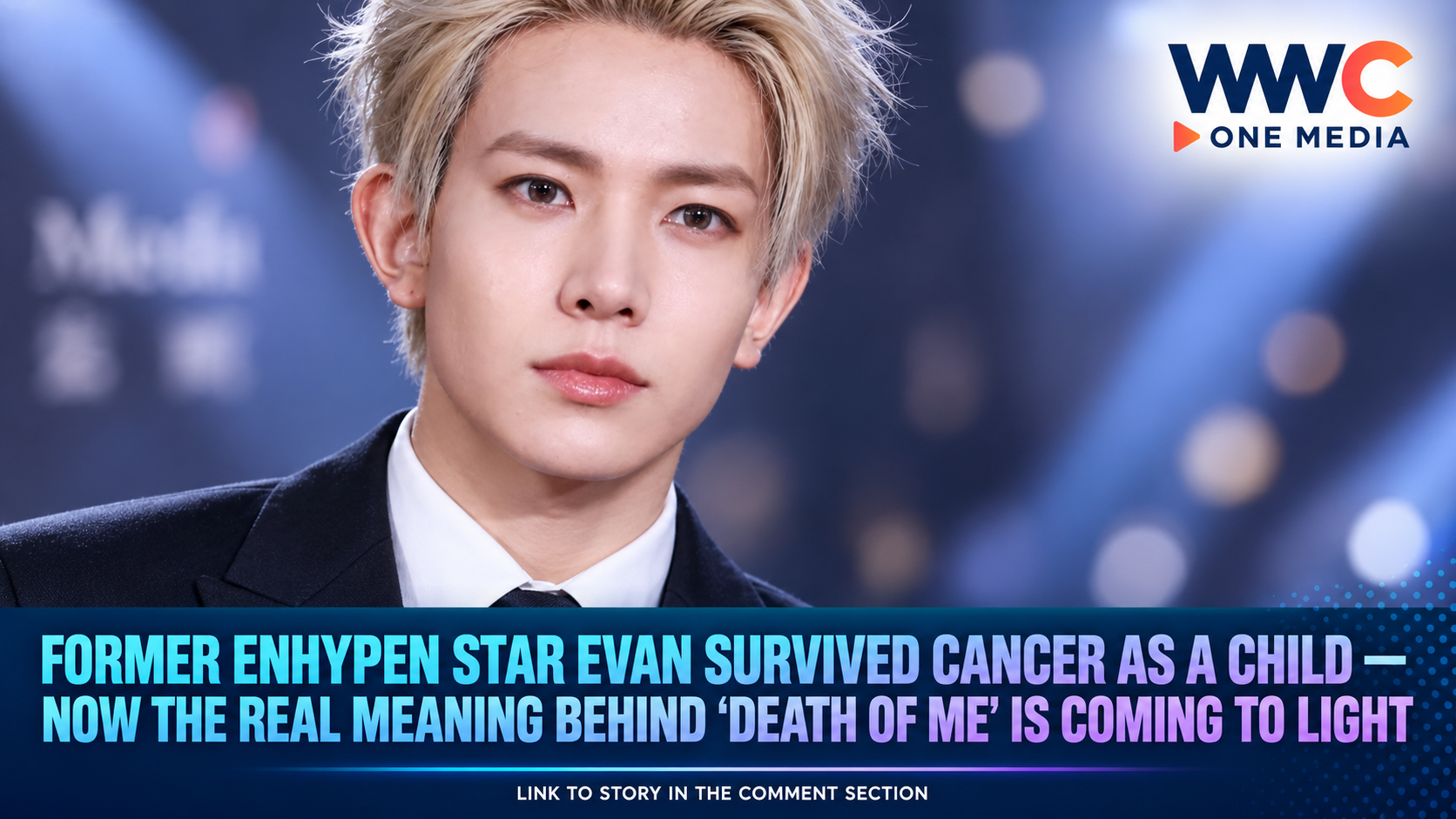
South Korean singer Evan, formerly known as Heeseung of K-pop group ENHYPEN, has disclosed one of the most painful chapters of his life: he was diagnosed with malignant lymphoma while still in elementary school.
The revelation came in a Weverse Magazine interview published as Evan begins a new chapter as a solo artist.
He said he had never publicly discussed the diagnosis since becoming a singer. Evan was in fourth grade when persistent coughing and an alarming episode while playing soccer led doctors to discover he had cancer.
What followed was a childhood shaped not only by treatment, but also by fear, loss and a determination to survive.
And now, years later, that experience has quietly become part of the music carrying him into his first major solo era.
It Started With a Cough — Then He Could Barely Breathe
Evan told Weverse Magazine that he initially assumed his repeated coughing was nothing more than a cold.
Then something happened while he was playing soccer.
After taking only a few steps, he suddenly struggled to breathe.
A hospital examination ultimately led to the malignant lymphoma diagnosis. Evan was still only a fourth-grade student at the time.
CNA Lifestyle, GMA News and People have separately reported his account, confirming that this is the first time the singer has publicly detailed his childhood cancer experience.
Malignant lymphoma affects the lymphatic system and is generally classified among blood cancers.
For a child who had already dreamed of becoming a singer since the age of six, however, music temporarily became secondary to something far more fundamental:
Surviving.
His Mother Became His Source of Strength
Evan said treatment was difficult, but seeing his mother constantly caring for him made him determined to appear strong for her.
Hospital life also contained moments that foreshadowed the career he would eventually build.
During events held for patients, Evan said he would play guitar and even host talent shows.
Those moments offered glimpses of the performer he would later become.
But the hospital also exposed him to something devastating for a child.
Evan said he watched friends he had made during treatment die.
He remembered desperately wanting to survive and return home.
That experience would eventually become important to the meaning of his solo music — although fans would not understand the connection until years later.
Surviving Cancer Wasn't the End of the Struggle
Evan eventually completed treatment and returned to ordinary life.
But returning to school brought a different challenge.
He said he had far less energy than before and that his hair was still growing back following chemotherapy. Other children teased him about his appearance.
Rather than fighting back, he said he endured the comments because he wanted to fit in.
By middle school, Evan said his personality had changed.
The energetic, outgoing child he remembered himself being had become more introverted.
Talking about that period now remains painful.
That detail adds another layer to an artist whose career has largely unfolded under intense public scrutiny — first as one of ENHYPEN's most recognisable members and now as a solo performer trying to establish an identity of his own.
Then Fans Heard ‘Death of Me’ — Without Knowing the Full Story
The connection between Evan's childhood and his new music became clearer with the release of his first mini album, DEATH OF ME, on September 7.
Belift Lab describes the project as an album about taking control of intertwined emotions and continuing forward. Evan participated extensively in its production.
The eight-track record includes:
Not Enough, Noise, Death of Me, Ride or Die, Twilight, Immature, Overflow and Going Home.
But the title track carries a meaning that listeners could not fully understand before Evan's disclosure.
Speaking to Weverse Magazine, he explained that the song's declaration that this is not the end comes from his own experience of having once been extremely close to death.
That turns what could easily sound like a conventional pop anthem about resilience into something autobiographical.
For Evan, “Death of Me” is not merely a metaphor.
It draws from an experience he actually lived through.
‘Noise’ Carries the Other Half of the Message
Another song on the album, Noise, is similarly tied to perseverance.
Evan said he wanted the beginning of his career under the name EVAN to communicate the idea that difficult periods eventually give way to better days.
He told Weverse Magazine that regardless of how low life took him, he repeatedly learned that it was not necessarily the end.
At his album showcase in Seoul, Evan expanded on why he finally decided to reveal the childhood illness.
According to The Korea Times, he said the eight tracks share an underlying theme of hope and that his childhood illness naturally belonged within that story.
He also said the experience had profoundly affected the way he thinks and what he values.
His stated hope is that the story may provide some comfort to children currently experiencing cancer themselves.
A Crucial Accuracy Point: His Cancer Was Not Presented as the Reason He Left ENHYPEN
The timing of Evan's disclosure — shortly after launching his solo career — makes it tempting to connect his childhood illness directly with his decision to leave ENHYPEN.
That would go beyond what he has publicly said.
Evan has not said that surviving childhood cancer was the reason he left ENHYPEN.
Belift Lab announced his departure from the group on March 10, 2026, saying that extensive discussions had made clear that Heeseung had his own distinct musical vision. The company said the decision was reached through mutual discussion and that he would remain with Belift Lab as a solo artist.
At his September solo showcase, Evan gave a similar explanation.
He said he had experienced a long period of uncertainty about the type of music he wanted to make, shared his work with the company and eventually decided to pursue the solo path after considerable thought.
That distinction matters.
His cancer experience clearly influences his worldview and his new album.
But available reporting does not establish it as the cause of his departure from ENHYPEN.
From Heeseung to Evan
Heeseung debuted with ENHYPEN in 2020 after appearing on the survival programme I-Land.
He became known for his vocals, performance ability and versatility before his exit from the group shocked parts of the fandom in March 2026.
Weeks later, he formally introduced himself as Evan.
Belift Lab said the stage name represents another dimension of Lee Hee-seung's identity and reflects a musical direction shaped by his own style and emotional perspective.
Evan himself said it was a name he had cherished since childhood.
He released his first solo single earlier in the year and has since performed at events including KCON LA.
His solo transition culminated this week with DEATH OF ME, his first mini album.
The Korea Times reported that it is also the first project in which Evan took an extensive role across the album's overall production rather than functioning primarily as a performer.
His ENHYPEN Exit Was Painful for Fans
Evan's departure from ENHYPEN triggered unusually intense reactions.
Some fans demanded his return, while others supported both his solo career and ENHYPEN's continuation as a six-member group.
The reaction became so heated that protests targeted HYBE and Belift Lab, and fan disagreements spilled into online discussions surrounding the remaining members.
At his solo showcase this week, Evan acknowledged that pain.
He said he understood how hurt and worried some fans had been and promised to repay their support through his music and the path he takes from here.
His cancer disclosure therefore comes at a pivotal moment.
He is no longer simply “Heeseung after ENHYPEN.”
He is trying to establish who Evan is — through material drawn much more directly from his own experiences.
‘DEATH OF ME’ Suddenly Has a Different Meaning
Before this disclosure, DEATH OF ME could be understood primarily as the statement of an artist separating from one of K-pop's biggest groups and betting on himself.
Now there is another layer.
A child who once struggled to breathe after several steps on a soccer field survived cancer.
He watched other young patients around him die.
He underwent chemotherapy.
He returned to school with reduced energy and regrowing hair.
He endured ridicule.
He became more withdrawn.
Years later, he debuted in a globally successful K-pop group.
And now, at 24, he has chosen one of the darkest phrases imaginable — “Death of Me” — as the name of a record centered largely on survival and hope.
That contrast is what makes the disclosure more significant than another celebrity revelation.
The album's message existed before the public knew the history behind it.
Now listeners finally know where at least part of that resilience came from.
For Evan, the title is not about surrender.
It is about everything that failed to end him.
WWC ONE MEDIA M.J.E