InLife Is Offering Filipinos Up to ₱125 Million in Health Coverage As Philippine Medical Costs Surge

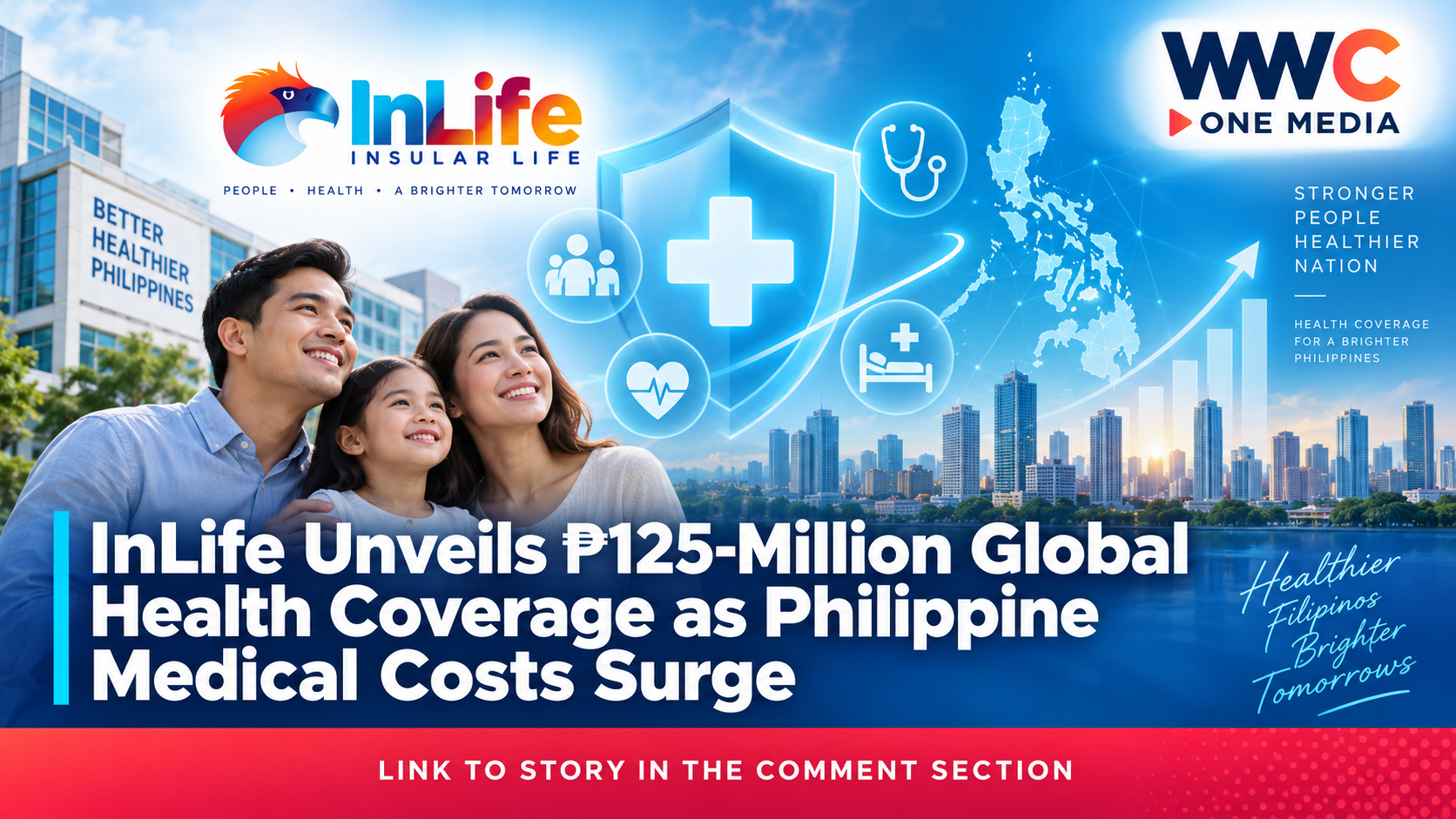
MANILA, Philippines — Insular Life, or InLife, is rolling out a premium health insurance product offering as much as ₱125 million in annual coverage, giving qualified policyholders access to medical care in the Philippines and abroad at a time when healthcare expenses are rising far faster than ordinary inflation.
Called InLife Global Care, the plan combines inpatient, outpatient and preventive-care benefits with access to accredited healthcare providers locally and overseas.
But the headline-grabbing ₱125-million figure tells only part of the story.
The more important backdrop may be what is happening to Philippine healthcare costs—and how much Filipino households still have to pay from their own pockets.
InLife Global Care provides up to ₱125 million in annual medical coverage, rather than a ₱125-million insurance payout automatically available in every situation. Benefits remain subject to the particular policy's terms, limits, conditions and exclusions.
What does the ₱125-million plan actually cover?
According to information released about the product, InLife Global Care includes coverage for major hospitalization, serious illnesses and cancer treatment, while also offering outpatient benefits such as consultations and diagnostic procedures.
The product also incorporates preventive-care benefits and cashless-service options through participating healthcare providers.
For emergencies occurring outside a policyholder's designated area of coverage, the plan can provide benefits of up to ₱12.5 million, again subject to the policy's terms, conditions, limits and exclusions.
That distinction matters.
The ₱125 million advertised by InLife is not the premium customers pay, nor should it be interpreted as an unconditional lump-sum benefit. It represents the plan's maximum annual coverage level under applicable policy rules.
One feature could matter even more than the ₱125 million
InLife is also emphasizing the policy's unusually long potential coverage period.
Global Care may be renewed annually until age 99, an important feature for consumers concerned about losing private medical coverage as they grow older.
The product additionally comes with a built-in life insurance benefit providing protection until age 70, provided the policy remains active.
That long renewal horizon could become particularly relevant in a country where healthcare spending is climbing quickly and chronic illnesses become more common with age.
Why launch this product now?
The numbers help explain the timing.
Official Philippine Statistics Authority data show that the country's Total Health Expenditure reached ₱1.87 trillion in 2025, jumping 15.1% from ₱1.63 trillion in 2024. Health spending was equivalent to about 6.7% of Philippine GDP.
There is also an important technical distinction often lost in coverage of the issue.
The PSA reported that household out-of-pocket payments represented 41.2% of Current Health Expenditure, not strictly 41.2% of the entire ₱1.87-trillion Total Health Expenditure figure.
Current Health Expenditure amounted to about ₱1.73 trillion, with households directly paying approximately ₱714.63 billion. Government and compulsory contributory schemes accounted for 46.5%, while voluntary healthcare payment schemes contributed 12.3%.
That means that despite PhilHealth, HMOs, private insurance and other financing arrangements, Filipino families are still directly carrying a substantial portion of the country's healthcare bill.
Medical costs could climb another 16.1%
And those costs aren't expected to stabilize quickly.
WTW's 2026 Global Medical Trends Survey projects a 16.1% gross medical trend for the Philippines in 2026—among the highest rates in Asia-Pacific and above the regional projection of 14%.
For comparison, WTW's figures showed Philippine medical trend at 17% in 2024 and 14.3% in 2025 before the projected acceleration to 16.1% this year.
That 16.1% figure should also be described carefully: it is a projected medical-cost trend, not a guarantee that every hospital bill or healthcare service will rise exactly 16.1%.
WTW has linked the regional increase to factors including new medical technologies, higher pharmaceutical costs, utilization patterns and fraud, waste and abuse.
This isn't really aimed at the mass market
Despite the broad concern over rising healthcare costs, Global Care is not positioned as a low-cost mass-market insurance product.
InLife describes it primarily as an additional layer of protection for executives, entrepreneurs, senior professionals, business owners, affluent households and Filipinos with international lifestyles or family connections overseas.
That positioning makes sense given the product's international treatment component and very high annual coverage ceiling.
It is also designed to complement, rather than necessarily replace, ordinary HMO protection.
A typical HMO may handle routine hospitalization, consultations and other covered medical services within prescribed limits and provider networks. A high-limit international health policy can potentially provide another financial layer when major illnesses, expensive procedures or treatment abroad push costs beyond ordinary coverage.
The bigger issue: health insurance is becoming wealth protection
That is where InLife's new product reflects a broader change in how high-value medical insurance is being marketed.
For affluent households, a serious illness does not merely threaten the ability to pay a hospital bill.
It can force families to liquidate investments, draw heavily from savings, interrupt businesses or redirect money intended for retirement, education or estate planning.
InLife Chief Product and Innovation Officer Jose Eduardo Ang said the company wants policyholders to have greater choice and resources when serious medical situations arise.
That proposition becomes more compelling when medical expenses rise in double digits while Filipino households continue funding hundreds of billions of pesos in healthcare directly.
But ₱125 million shouldn't be the only number buyers examine
A huge coverage ceiling makes an effective headline.
Yet consumers comparing high-limit health plans should look beyond the maximum benefit.
The practical value of a policy ultimately depends on matters such as premiums, deductibles or co-payments where applicable, geographical coverage, provider networks, pre-existing-condition rules, benefit sublimits, waiting periods, exclusions and renewal conditions.
Public reports on Global Care repeatedly emphasize its maximum coverage, international access, cashless options and renewability, but buyers should still review the complete policy contract and benefit schedule before treating the ₱125-million ceiling as equivalent to unrestricted coverage.
That may ultimately be the most important takeaway from InLife's latest launch.
₱125 million sounds enormous. But in a healthcare market where costs are projected to rise by more than 16% in a single year, the real competition may no longer be over who offers the biggest insurance number—it may be over who can keep Filipinos adequately covered as medical bills keep climbing.
WWC ONE MEDIA M.J.E