
Iran School Destroyed in War’s First Days Becomes Memorial for Children Killed in Strike

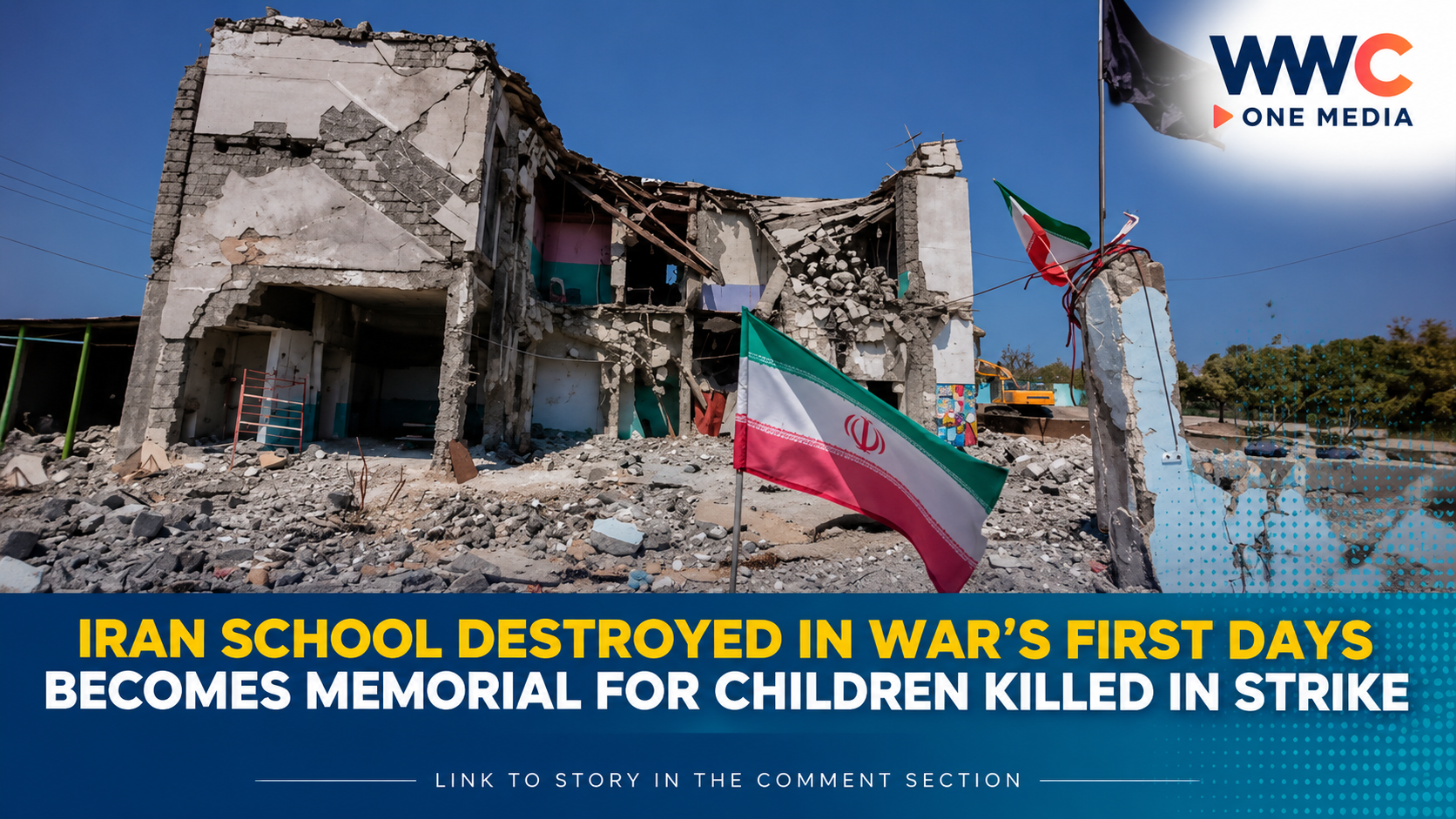
MINAB, IRAN — A school in southern Iran that was destroyed during the opening days of the war has become a somber memorial for the children who died there.
The Shajareh Tayyebeh school in Minab, in Iran’s Hormozgan province, once welcomed students through a bright blue entrance decorated with oversized pencils, an Iranian map and portraits of figures from science and literature.
Today, the same entrance leads visitors toward photographs of children who were killed in the strike on Feb. 28, 2026.
The classrooms remain damaged, with desks buried beneath debris and sections of the ceiling collapsed. Families and local residents have transformed parts of the site into a makeshift memorial, preserving photographs of the children and their memories.
A School Frozen in Time
An Associated Press visit to the site found classrooms that appeared to remain frozen in the moments after the attack.
The building has been left badly damaged, with debris covering portions of what had once been ordinary classrooms.
Photographs displayed at the site show the children before their deaths — smiling at birthdays and family occasions — followed by black memorial banners carrying their faces.
For families, the school has become more than a destroyed building.
It is now a place where the children they lost can be remembered.
Iranian officials have said that more than 100 students were killed in the strike. Other reporting has put the toll at around 120 children.
Responsibility for the Strike Remains Disputed
The attack occurred on the first day of the war involving the United States, Israel and Iran.
Iran has attributed the strike to the United States.
The Trump administration, however, has not directly accepted responsibility for the attack or publicly released the Pentagon's findings concerning the incident.
An Associated Press investigation nevertheless found evidence indicating that at least one U.S. missile struck the school.
That distinction is important: evidence linking a U.S. weapon to the destruction does not mean that every aspect of the circumstances or targeting decision has been publicly established.
The lack of a publicly released U.S. investigation has continued to fuel questions surrounding the incident.
Families Are Still Missing Answers
Months after the attack, grief remains deeply embedded in Minab.
A section of the city's cemetery has been dedicated to those killed at the school.
Families and visitors walk among the graves, where artificial grass and rows of burial markers have created a dedicated area for the victims.
Residents told the Associated Press that three bodies have still not been recovered.
For families, the inability to recover every victim has added another layer of uncertainty to an already devastating loss.
The Ruins Could Become a Permanent War Memorial
Local officials have discussed preserving the destroyed school rather than demolishing what remains.
Hormozgan Governor Mohammad Ashouri Taziani has said the building would be turned into a war museum and memorial, allowing the site to serve as a historical record of what happened.
The proposal would preserve the physical remains of the school alongside photographs and other memorial material.
Such a decision would make the building a permanent reminder not only of the children who died, but also of the civilian cost of the wider conflict.
Minab Has Faced More Violence
The school attack is no longer the only recent tragedy to affect Minab and communities along Iran's southern coast.
Attention returned to the region in the past week after a new round of U.S. strikes hit areas along the southern coastline.
One of the incidents involved a wedding in Kuhestak, where an explosion killed civilians and injured dozens.
Reuters reported that weapons experts analyzing verified imagery believed the wedding site was likely directly hit by a U.S. munition, while U.S. officials said the military was targeting military infrastructure in the area and was investigating the incident.
The renewed violence has brought fresh attention to the civilian communities living along Iran's southern coast.
For residents of Minab, the school memorial has therefore taken on an even heavier significance.
A Memorial Built Around Children's Memories
The memorial at the school focuses heavily on who the victims were before the war.
The photographs show children participating in everyday moments — celebrating birthdays, posing with relatives and simply growing up.
Those images stand in sharp contrast to the destroyed classrooms surrounding them.
That contrast is central to the memorial's message.
The victims were not soldiers or military commanders. They were children attending school when the strike occurred.
Their photographs now serve as a record of lives that continued in family albums even after the building where they studied was destroyed.
Calls to Preserve the Site
There have been calls for the school ruins to be preserved as a historical record.
Turning the site into a museum would allow future visitors to see the physical consequences of the attack rather than relying solely on photographs or official accounts.
It could also become a place where families can remember relatives who were killed.
The decision reflects a broader question confronting communities affected by war: what should be done with places where large numbers of civilians died?
For Minab, the answer increasingly appears to be preservation.
The Human Cost of the War
The school in Minab has become a symbol of the conflict's impact on civilians.
Its blue entrance still carries the imagery of education and childhood.
But behind it are ruined classrooms, memorial photographs and graves.
The transformation from school to memorial illustrates how quickly ordinary civilian spaces can be changed by war.
Months after the attack, the damage remains visible — and so does the grief of the families who lost their children.
As fighting continues to affect communities across Iran, the school stands as a reminder that the consequences of military operations extend far beyond their intended targets.
The children who once walked through its blue gate will never return to the classroom. What remains is a memorial — and a community determined not to let their names disappear.
WWC ONE MEDIA J.M.D