Iran War Hinders Multiple Korea-U.S. Projects as Seoul-Washington Tensions Grow

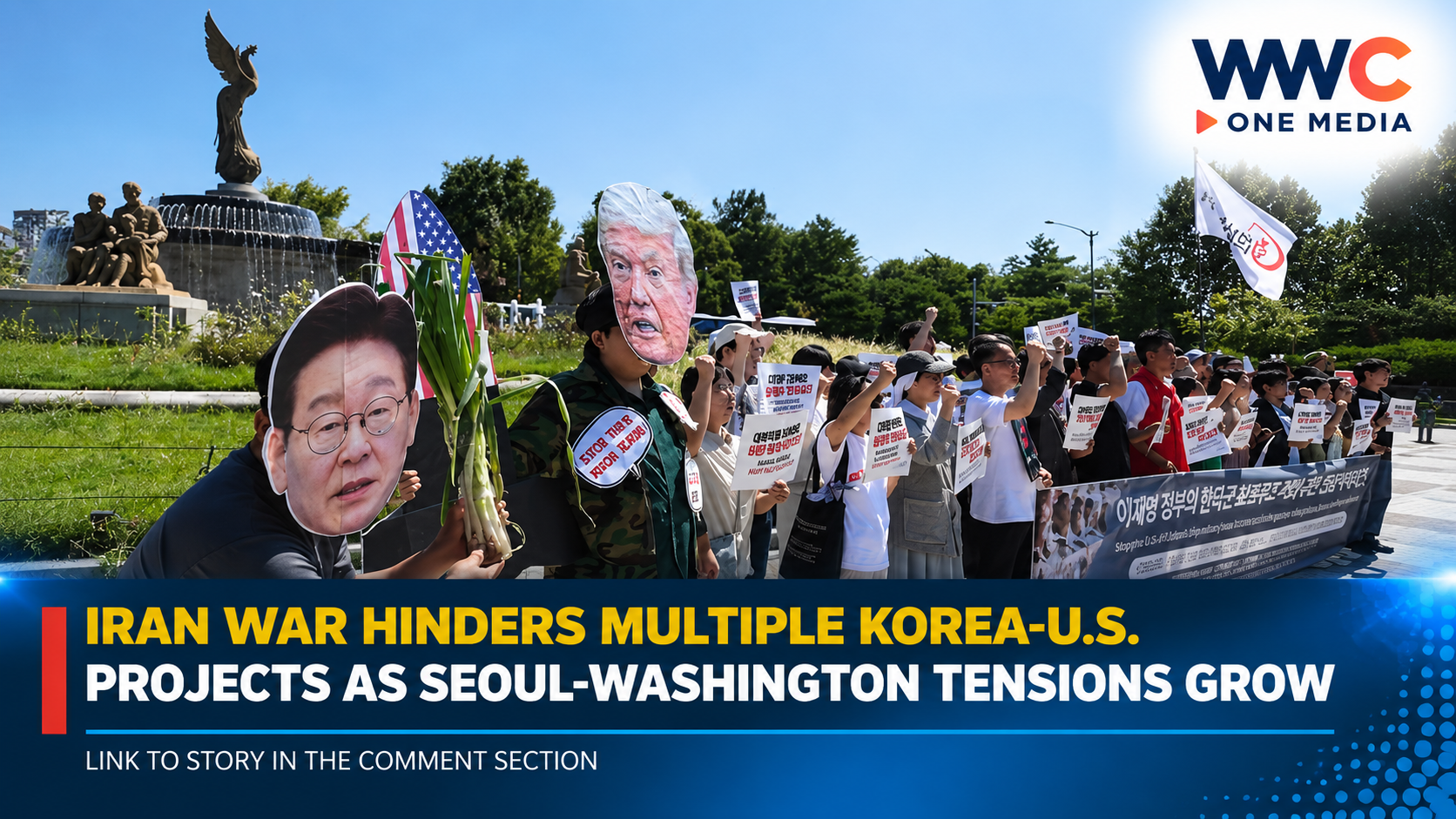
SEOUL — The prolonged war between the United States and Iran has spilled beyond the Middle East, disrupting the timetable for several major South Korea-U.S. projects and security negotiations while adding new pressure to an already complicated alliance.
Among the initiatives affected are discussions involving South Korea's planned nuclear-powered submarines, nuclear-energy cooperation and expanded shipbuilding collaboration with Washington.
The delays have come as the United States devotes significant diplomatic and military attention to the Iran conflict, while Seoul and Washington simultaneously struggle to finalize a massive $350 billion South Korean investment commitment in the United States.
Iran war becomes a “black hole” for Korea-U.S. talks
Seoul Economic Daily reported in March that the Iran war had effectively become a “black hole” for South Korea's diplomatic and security agenda.
Formal discussions covering nuclear energy, nuclear-powered submarines and shipbuilding were initially expected to begin early in 2026. But the outbreak of war on Feb. 28 contributed to further postponements after the planned U.S. negotiating team's visit was delayed.
The delay was particularly significant for South Korea's nuclear-powered submarine ambitions.
President Lee Jae Myung and U.S. President Donald Trump had agreed in 2025 to cooperate on Seoul's effort to acquire nuclear-powered submarines. Follow-up discussions, however, were pushed back amid the Iran war and disagreements over other bilateral issues.
Nuclear submarine project faces a complicated path
South Korea's nuclear-powered submarine plan is among the most strategically important projects caught in the diplomatic slowdown.
The issue involves more than simply building submarines. Seoul needs to resolve questions surrounding nuclear fuel, technology, safeguards and the legal framework governing nuclear cooperation with Washington.
Under the existing U.S.-South Korea nuclear cooperation framework, Seoul faces restrictions concerning uranium enrichment and spent-fuel reprocessing, making U.S. approval and potentially congressional involvement critical to the submarine program.
The Iran war raised fears that Washington's attention would remain focused on the Middle East at the expense of longer-term Korean security initiatives.
Still, the project has not been abandoned.
In April, U.S. Rep. Ami Bera, a senior member of the House Foreign Affairs Committee, told Korea JoongAng Daily that the Trump administration had given Congress an assurance that the Korean nuclear-submarine initiative remained on track despite the war.
That distinction is crucial: the war has contributed to delays, but there is no evidence that Washington has formally canceled the project.
Talks eventually resumed—but months behind schedule
By late May, Seoul and Washington moved to launch formal negotiations covering the security agreements reached during their leaders' summit.
The talks were expected to cover:
- South Korea's nuclear-powered submarine program
- Nuclear-fuel and nuclear-energy cooperation
- Uranium enrichment and spent-fuel reprocessing
- Expanded Korea-U.S. shipbuilding cooperation
KBS reported that the initial meeting had been delayed following the outbreak of the Iran war, as well as amid concerns in Washington over Seoul's slow implementation of its U.S. investment pledge.
The restart of talks offered some relief, but it did not eliminate the broader uncertainty surrounding the projects.
The $350-billion investment pledge adds another layer
The Iran conflict is also affecting the political environment surrounding South Korea's promised $350 billion investment in the United States.
Under the trade agreement reached between Seoul and Washington, South Korea committed to invest $350 billion in U.S. projects.
Of that amount, $150 billion is earmarked for shipbuilding cooperation, while another $200 billion is intended for other strategic investments.
But the remaining investment projects have taken longer to finalize.
South Korean Foreign Minister Cho Hyun said in August that Seoul had received a U.S. proposal outlining possible projects but had been unable to move faster because it needed to consider commercial viability and legal procedures, among other unexpected issues.
That delay has become a source of frustration in Washington.
Trump links investment, Iran and the alliance
The investment dispute has increasingly become intertwined with security relations.
In August, Trump ordered a substantial reduction in U.S. participation in joint military exercises with South Korea. The move came as Washington was pressing Seoul over both its investment commitments and its response to the Iran war.
Reuters reported that Foreign Minister Cho viewed Trump's message as applying pressure on Seoul over several unresolved issues, including the Iran conflict and the investment agreement.
The annual South Korea-U.S. military exercises were subsequently shortened, with the two countries announcing that the exercise would be reduced to five days from 11 days and that some field training would be scaled back.
That development raised concerns that economic negotiations, military cooperation and the Iran conflict were becoming increasingly interconnected.
Shipbuilding could become the biggest economic test
Ironically, one sector potentially affected by the geopolitical turmoil is also one of the areas where Seoul and Washington have the strongest incentive to cooperate: shipbuilding.
South Korea's shipbuilding industry is widely regarded as a major potential partner in Washington's effort to rebuild U.S. shipbuilding capacity.
The $150 billion shipbuilding component of the Korean investment commitment is intended to deepen industrial cooperation between the two countries.
A Korea-U.S. Shipbuilding Partnership Center was established in Washington, but U.S. officials have publicly demanded tangible results rather than simply additional memorandums and meetings.
Korea JoongAng Daily reported that U.S. Commerce Secretary Howard Lutnick had pressed Seoul to turn its investment commitments into actual capital deployment, facility modernization, workforce training and expanded ship production.
The war is also putting pressure on U.S. military resources
The consequences of the Iran war extend beyond diplomatic scheduling.
Earlier in the conflict, U.S. officials and analysts considered whether American military assets stationed in South Korea—including some air-defense systems—might be redeployed temporarily to the Middle East.
The possibility raised concerns in Seoul about maintaining adequate deterrence against North Korea while the United States is heavily engaged elsewhere.
At the same time, the prolonged conflict has placed significant financial and operational pressure on the U.S. military.
The Guardian reported in August that the war has strained the U.S. Navy's budget, while Reuters has reported that the prolonged conflict has depleted U.S. strategic petroleum reserves and increased concerns about the sustainability of the war effort.
Those pressures could affect Washington's ability to move quickly on projects that require substantial government attention, funding and congressional approval.
Seoul faces pressure from both sides
South Korea is now caught between competing demands.
Washington wants Seoul to accelerate its investment commitments, support efforts to secure the Strait of Hormuz and contribute more to broader U.S. strategic objectives.
Seoul, meanwhile, has been cautious about becoming directly involved in the Iran conflict while trying to protect its own economic and security interests.
Yonhap reported earlier that Seoul had refrained from committing to military involvement in the U.S. effort to reopen the Strait of Hormuz, even as Trump repeatedly urged allies to contribute.
The issue has become particularly sensitive because South Korea depends heavily on energy imports and has major commercial interests in the Middle East.
A wider test for the Korea-U.S. alliance
The delays are therefore about more than individual projects.
They highlight the growing difficulty of managing an alliance in which security, trade, investment, energy and industrial policy are increasingly intertwined.
South Korean media have warned that Trump's transactional approach to alliances could make negotiations more complicated, particularly when Seoul and Washington disagree over the pace of investment or Seoul's role in the Iran war.
At the same time, both countries have powerful reasons to keep the partnership moving.
Washington needs South Korea's world-class shipbuilding capacity and industrial expertise, while Seoul relies on the U.S. alliance for security and wants greater access to the American market and advanced defense technologies.
What happens next?
The biggest question is whether the Iran war will continue to delay the implementation of the projects—or whether Washington and Seoul can separate their long-term strategic cooperation from immediate disagreements over the conflict.
The nuclear-submarine initiative remains alive, shipbuilding cooperation is moving forward, and the $350 billion investment framework is still being negotiated.
But the timetable remains uncertain.
For South Korea, the stakes are enormous.
The country is not simply negotiating a shipbuilding deal or a submarine project. It is trying to redefine its economic and security relationship with Washington while a major war is consuming American attention thousands of kilometers away.
And as the Iran conflict drags on, the question facing Seoul is no longer just when these Korea-U.S. projects will move forward—but what price South Korea may have to pay to keep them on track.