
It Has a Pool, Restaurant and Dementia Garden—Singapore’s New Senior Living Model Could Change How the Wealthy Grow Old

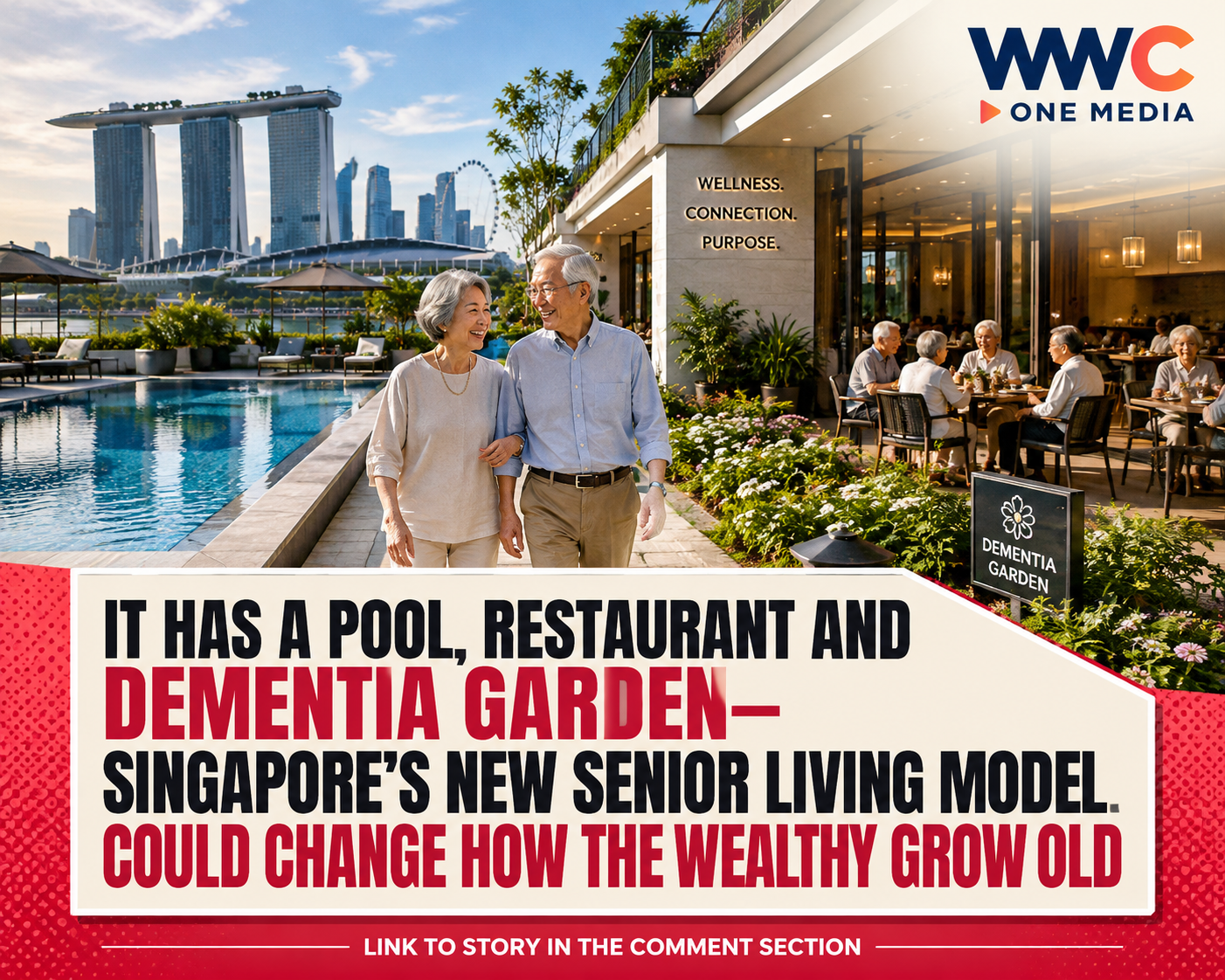
SINGAPORE — A swimming pool, karaoke lounge, mahjong room, restaurant and private apartments may sound more like the features of an upscale condominium than an eldercare facility.
But that is exactly the model behind Perennial Living, Singapore’s first private assisted living development, which officially began operations on August 18, 2026, offering seniors a new option between living independently at home and moving into a traditional nursing home.
Located at 28 Parry Avenue, the sprawling 195,000 sq ft development includes 200 assisted living apartments and 100 nursing suites, combining residential accommodation with healthcare, rehabilitation, wellness and hospitality services under one roof.
The project reportedly cost about S$260 million, positioning it firmly at the premium end of Singapore’s rapidly evolving eldercare market.
Senior Living Designed to Feel Less Like an Institution
The assisted living apartments range from about 302 sq ft to 569 sq ft, with options including studios, one-bedroom apartments and two-bedroom suites.
Inside, residents can expect features such as floor-to-ceiling windows, kitchenettes and, in most units, private lift access.
But beneath the residential design is a layer of technology intended to protect older residents.
Apartments are equipped with features including fall detection systems, motion-sensor lighting, emergency response systems, bedside vital-sign monitoring and facial-recognition access.
The concept targets seniors who are still relatively independent but may need daily supervision or medical assistance.
Residents receive health checks, while additional nursing, rehabilitation and medical support can be added depending on their condition.
Crucially, seniors whose health deteriorates can move into higher levels of care within the same development rather than relocating to a completely different facility.
But the Price Puts It Beyond the Reach of Many Families
That level of care does not come cheaply.
Basic assisted living packages start at around S$8,000 per month, while nursing suite packages begin at approximately S$7,600 a month. Prices can rise depending on unit size, floor, layout and orientation.
The Straits Times reported that some larger two-bedroom assisted living suites can cost more than S$13,000 per month.
The assisted living package includes accommodation, meals, housekeeping, linen services and access to fitness, communal, social and wellness facilities.
Residents must generally be at least 65 years old, while The Straits Times reported a minimum three-month stay for assisted living residents.
Perennial Holdings executive chairman and CEO Pua Seck Guan has acknowledged that the development is aimed primarily at the upper-middle-income private eldercare segment, rather than trying to compete directly with Singapore’s heavily subsidised public care system.
A Swimming Pool, Karaoke Lounge and Restaurant Are Part of the Package
Perennial Living is attempting to distinguish itself from conventional nursing institutions through lifestyle amenities.
Residents have access to a swimming pool, gym, karaoke lounge, mahjong room and multipurpose activity spaces.
There is also The Olive, an all-day restaurant offering buffet meals and à la carte dishes, with food options designed around the nutritional requirements of older residents.
More than 38,000 sq ft of outdoor terraces overlook a neighbouring park, while residents can participate in activities including art, music, handicrafts, cognitive games, strength training and hydrotherapy.
Medical Care Without Leaving the Development
Perhaps more significant than the luxury amenities is the healthcare infrastructure located inside the complex.
The Perennial Wellness centre includes general practitioners, specialists, diagnostic imaging, physiotherapy, occupational therapy, speech therapy and traditional Chinese medicine services.
It also contains a 460 sq ft hydrotherapy pool, along with specialised rehabilitation equipment.
Perennial says residents can receive chronic disease management, rehabilitation and other medical support while remaining within the development.
That approach reflects a wider shift in eldercare toward helping seniors “age in place” while increasing care gradually as their needs become more complex.
Singapore’s Ministry of Health describes nursing homes as facilities primarily intended for frail seniors who require significant help with daily living activities or ongoing nursing care.
Perennial Living is attempting to occupy the space before that stage.
Dementia Care Is a Major Part of the Development
One of the project's most distinctive features is its focus on dementia.
Two assisted living blocks containing 40 apartments have been designated for residents with mild to moderate dementia.
Around 30 per cent of nursing-suite beds are expected to be reserved for residents with severe dementia.
Dementia care comes at an additional cost.
Memory care support for assisted living residents starts at approximately S$1,200 extra per month, while nursing-suite dementia care starts from an additional S$1,500 monthly.
Perennial has also created a therapeutic memory garden containing unusual recreated everyday spaces.
They include heritage buses, a vintage-style hair salon, telephone booths and a functioning post box.
The idea is to provide recognisable environments that can stimulate memories while allowing residents to move around relatively independently.
Perennial says residents with dementia can also receive personalised treatment plans, cognitive stimulation and other non-pharmacological interventions.
Singapore’s Ageing Population Is Driving a Bigger Eldercare Shift
The opening comes as Singapore continues expanding services for an ageing population.
The government is simultaneously pursuing a different strategy through Age Well SG, which seeks to help more seniors remain within their own neighbourhoods instead of moving into institutional care.
In May 2026, the Ministry of Health announced additional Age Well Neighbourhoods in Bedok, Bukit Panjang and Tiong Bahru-Redhill, joining Toa Payoh, with more than 110,000 seniors expected to benefit across the four areas.
The government programme includes expanded Active Ageing Centres, home personal care, community health services and senior-friendly infrastructure designed to allow elderly residents to live independently for longer.
That means Singapore is effectively seeing two eldercare models develop simultaneously: publicly supported ageing within neighbourhoods and higher-end private developments offering residential care combined with hospitality and medical services.
The Biggest Challenge May Not Be Building It—But Convincing Seniors to Move In
For Perennial, however, the success of the model is far from guaranteed.
Close to 30 prospective residents had shown what the company described as very strong interest around the time operations began.
Perennial expects occupancy to reach around 30 per cent within the first year, before potentially climbing toward 80 per cent later.
Yet one obstacle is uniquely Singaporean: home ownership.
Many older Singaporeans already own their homes and may be reluctant to move unless assisted living offers something substantially better.
Pua said the development is therefore primarily targeting seniors who already require some level of support, including wheelchair users, people with chronic illnesses, frail seniors, people living with dementia and older residents whose children live overseas.
Another challenge is manpower.
Perennial plans to progressively build a workforce of about 150 employees, recruiting from healthcare and hospitality backgrounds. The development is targeting roughly one care worker for every eight assisted-living residents, with higher staffing levels in dementia and nursing-care areas.
Could Singapore Become the Launchpad for a Regional Senior-Living Business?
The significance of Perennial Living may eventually extend beyond Singapore.
Perennial already has a large eldercare footprint in China, and Pua told CNA that the company sees the Singapore development as a possible showcase for expansion across Southeast Asia.
The company has about 38,000 eldercare beds in its portfolio, including projects under development, according to CNA.
Potential partners elsewhere in the region have already approached Perennial about converting existing facilities into similar eldercare developments, Pua said.
For now, however, the real experiment is happening on Parry Avenue.
Singapore has built its first private assisted living development with the amenities of a premium residence, medical services approaching those of a healthcare facility and dedicated spaces for dementia care.
The bigger question is whether enough Singapore families believe that combination is worth S$8,000 a month or more.
If they do, Perennial Living may prove to be more than an expensive new retirement home.
It could become a blueprint for an entirely new private eldercare industry across ageing Southeast Asia.