
Japan’s Robots Are Leaving the Factory Floor—What They’re Doing Next Could Change Work Forever

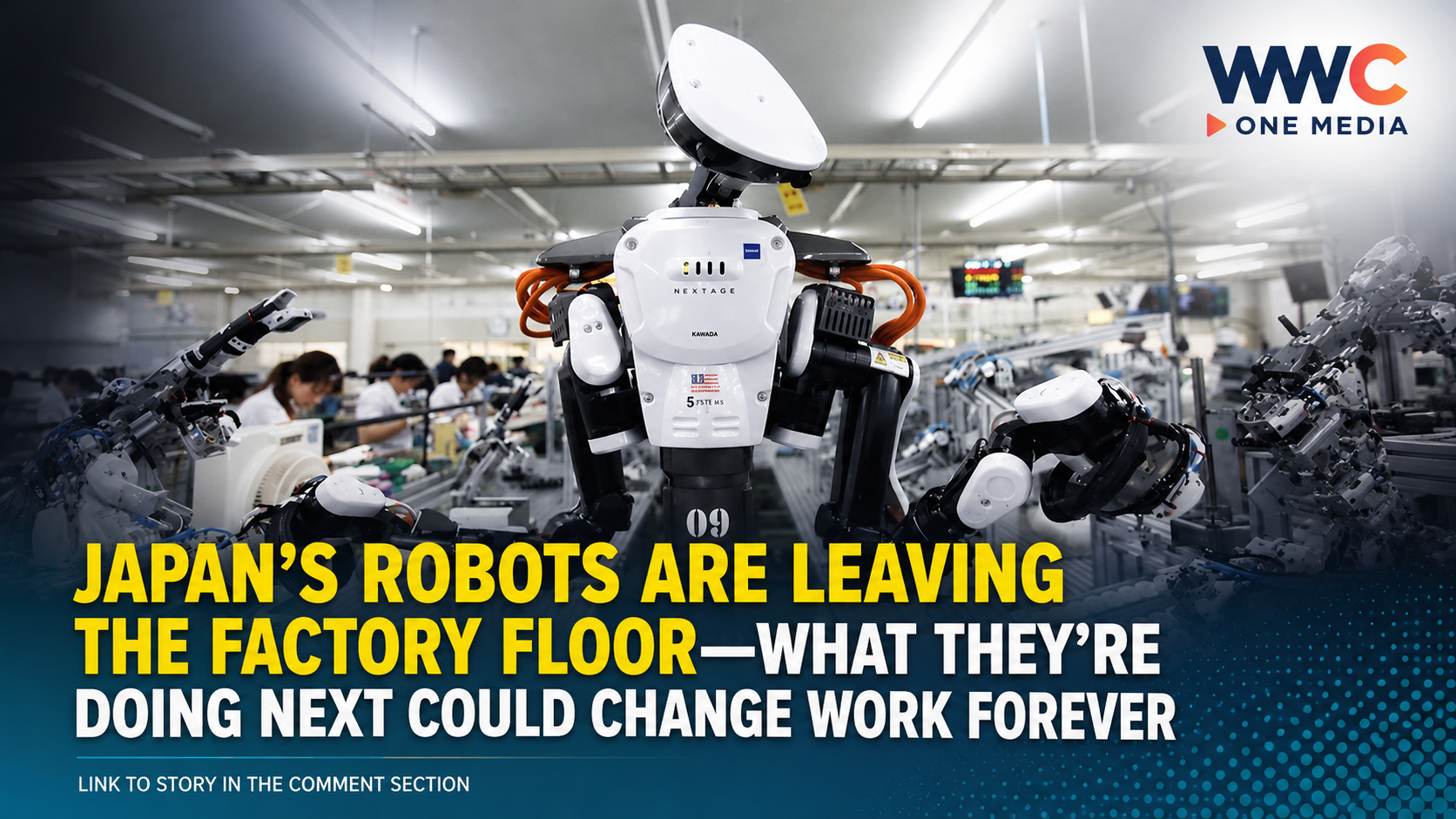
TOKYO — Japan’s robotics industry is entering a new phase.
For decades, Japanese robots were closely associated with factory floors, performing highly repetitive manufacturing tasks with extraordinary speed and precision. Now, developers are pushing humanoid and advanced robotic systems into environments that are far less predictable—from forestry and tree-cutting operations to delicate laboratory work.
The shift reflects a bigger ambition: make robots useful beyond controlled industrial environments and turn Japan’s long experience in precision robotics into an advantage in the emerging physical-AI race.
A recent report by Nikkei Asia highlights how Japanese developers are exploring applications that go well beyond traditional manufacturing, including machines capable of handling demanding physical tasks and robots designed for research environments.
From factory automation to the real world
Traditional industrial robots excel when their surroundings are predictable. A factory can be designed around the machine, with fixed positions, controlled lighting and repetitive movements.
Forests are the opposite.
Trees vary in size and shape. Ground conditions change. Obstacles are unpredictable. Weather and visibility can also affect operations.
That makes forestry a particularly challenging test for robotics.
Researchers in Japan have already been developing robotic systems for forestry applications. Waseda University's Sugano Laboratory, for example, has worked on robotic manipulators designed to assist with safely cutting and felling trees, as well as a tree-climbing robot called “Woody” for high-altitude branch pruning.
Other Japanese researchers have explored aerial robots capable of autonomously recognizing and measuring trees in forest environments—technology that could help create detailed forest data while reducing the need for people to perform dangerous or difficult surveying work.
The significance is bigger than simply replacing a chainsaw operator.
It demonstrates how robotics is moving toward physical AI—systems that combine artificial intelligence with machines capable of sensing, moving through and interacting with the physical world.
Robots are also entering laboratories
The same technological shift is appearing in scientific research.
Japan has a long history of developing robotic systems capable of performing extremely precise laboratory procedures. More recent efforts are combining robotics with AI and increasingly sophisticated manipulation capabilities.
In April 2026, GMO Internet Group opened a dedicated humanoid robotics research facility in Tokyo focused on areas including whole-body motion control, robot foundation models and robotics systems. The company describes its objective as accelerating the real-world deployment of next-generation robots.
The laboratory trend is important because scientific environments demand a different kind of robotic capability.
A machine must not simply repeat a movement. It may need to recognize objects, manipulate delicate equipment and adapt to changing conditions.
That is precisely the type of capability researchers hope physical AI will eventually provide.
Japan has a powerful reason to accelerate
Behind the technology race is a demographic problem.
Japan has one of the world's most rapidly aging populations and has struggled with chronic labor shortages. That is creating pressure to automate jobs that are physically demanding, difficult to staff or dangerous.
A Reuters survey published in May found that one-third of Japanese companies were already using, planning to use or considering AI-powered robots. Only about 4% of surveyed companies were already using them, however, underscoring that large-scale adoption remains at an early stage.
Japan's government is also looking at AI-equipped robots as part of its response to labor shortages and as a way to strengthen the country's position in robotics.
The goal is no longer simply to build robots that can manufacture products.
It is to build machines that can work in the same physical environments as humans.
Japan faces an increasingly crowded robotics race
Japan pioneered many important developments in robotics, but its traditional strength in industrial machines is being challenged by rapidly expanding competitors.
China, in particular, has dramatically increased its robotics production and deployment. The Financial Times reported this week that China installed about 295,000 industrial robots in 2024, representing roughly 54% of global installations that year.
Meanwhile, Chinese companies are also making aggressive moves in humanoid robotics.
The result is a new competitive landscape in which Japan's engineering expertise alone may not be enough.
Japan must demonstrate that its robots can move from impressive prototypes and factory automation into commercially useful systems operating in messy, unpredictable environments.
That explains the growing interest in applications such as forestry, logistics, laboratories, healthcare and infrastructure maintenance.
The humanoid advantage—and its limits
Humanoid robots have one obvious potential advantage: humans have built the world around human bodies.
Stairs, doors, tools, workstations and vehicles are generally designed for people.
A humanoid robot could theoretically operate in these environments without requiring companies to completely redesign them.
But that does not mean humanoid robots are ready to replace humans across the workforce.
Current systems still face major challenges involving dexterity, reliability, battery life, navigation and the ability to deal with unexpected situations.
Recent demonstrations at the Humanoids Summit Tokyo showed robots performing increasingly sophisticated tasks, including delicate manipulation. But experts and industry observers continue to distinguish between impressive demonstrations and commercially scalable deployment.
Japan's challenge, therefore, is not merely to make robots look human.
It is to make them usefully capable, dependable and economically viable.
The bigger story
The expansion of Japanese robotics into forestry and laboratories signals a fundamental change in how the industry thinks about automation.
The factory was once the ideal environment for a robot because everything could be controlled.
The next generation of robots is being designed for the opposite reason: the world cannot always be controlled.
If machines can learn to safely navigate forests, manipulate delicate laboratory equipment, handle demanding logistics tasks or assist workers in difficult environments, the potential market for robotics becomes vastly larger.
Japan is betting that its decades of experience building precise machines can help it make that transition.
The question now is not whether robots can work.
They already can.
The bigger question is how far beyond the factory floor they can go—and how quickly.