
Juvenal Sansó’s Filipino Heart Takes Centre Stage in Major National Museum Retrospective

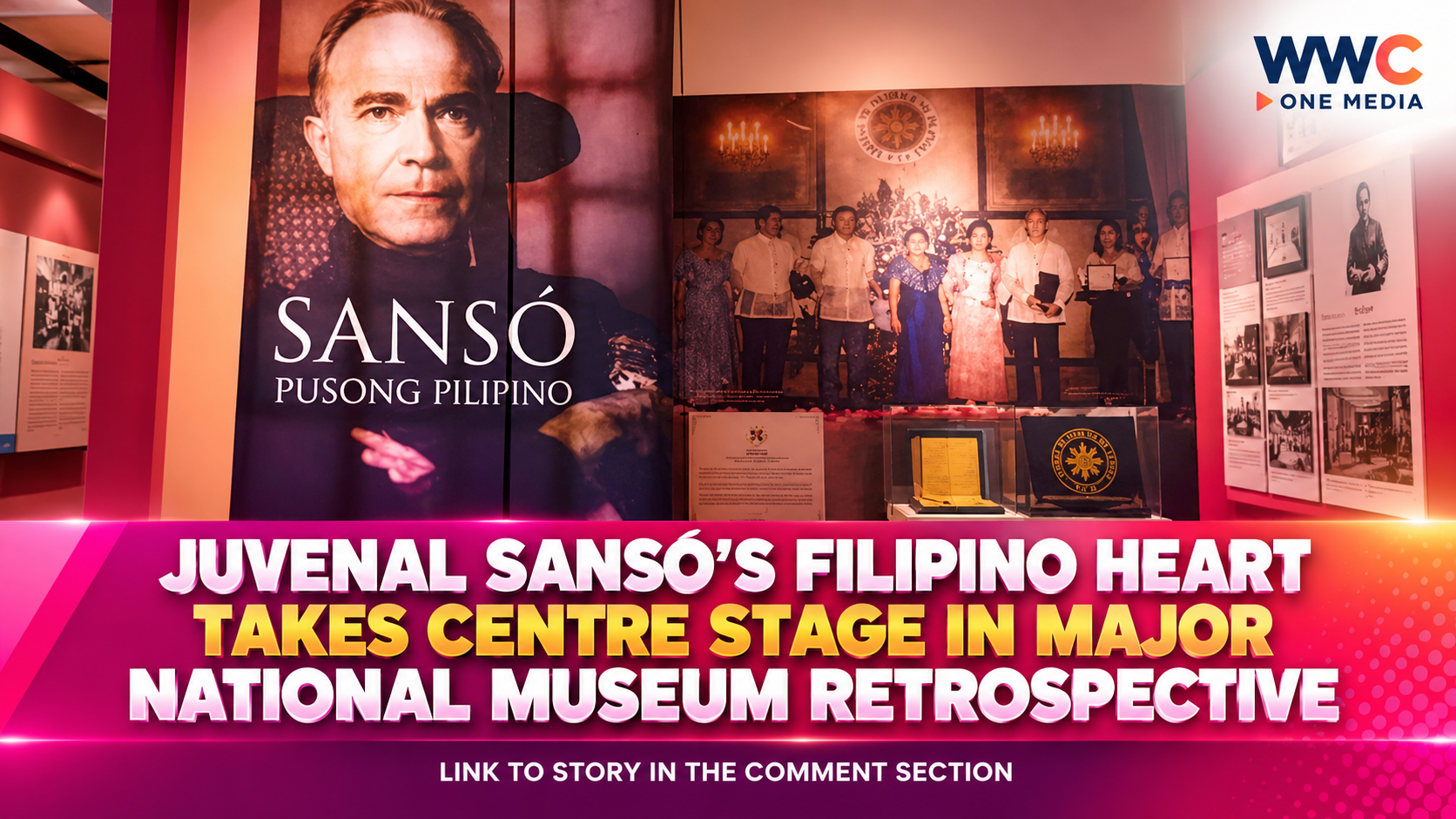
MANILA — Nearly seven decades of artistic work by Juvenal Sansó are being brought together in a major retrospective at the National Museum of Fine Arts, offering audiences a closer look at the Spanish-born artist’s extraordinary relationship with the Philippines.
Titled “Sansó: Pusong Pilipino – A Juvenal Sansó Retrospective,” the exhibition brings together works from the artist’s early years in the 1940s through his later Moderno series, tracing a career shaped by war, displacement, memory, nature and his enduring affection for the country he considered home.
The exhibition opened in August 2026 and is on view at Gallery XV, 3/F of the National Museum of Fine Arts, until February 28, 2027.
An artist who found home in the Philippines
Sansó was born in Reus, Spain, but came to Manila as a five-year-old child.
He grew up in the city and experienced the devastation of World War II, an experience that would leave a lasting imprint on his artistic imagination. He later studied at the University of the Philippines School of Fine Arts, where his early landscapes and observations of the Philippine environment became important parts of his artistic development.
His connection to the Philippines was therefore not simply a matter of birthplace or nationality.
It was shaped by childhood memories, friendships, education, hardship and decades of living and working in the country.
That complicated relationship between identity and belonging sits at the centre of the retrospective.
Nearly 100 works tell the story
The exhibition brings together close to 100 works, providing an unusually broad view of Sansó's career.
Visitors can see paintings and works connected to different stages of his development, including his early Philippine landscapes, the Baklad series and pieces from his later Moderno period.
The range demonstrates how dramatically Sansó's visual language evolved over the decades.
Yet recurring themes remain visible — particularly his fascination with nature, memory and the transformation of landscapes through colour and abstraction.
His Baklad works, inspired by traditional bamboo fish traps, are particularly connected to his observations of life around Manila and the country's coastal environment.
What makes Sansó “Pilipino”?
The exhibition's title deliberately raises a question that goes beyond artistic style.
Sansó did not have Filipino ancestry. Yet his relationship with the Philippines became so deeply embedded in his life and work that the organisers describe him as an artist with a distinctly Filipino heart.
Fundación Sansó director Ricky Francisco has argued that the Filipino character of Sansó's work should not be measured simply through bloodline or official recognition.
Instead, it can be found in the artist's experiences, his witness to tragedy and his sustained affection for the people and country that shaped his life.
That idea gives the retrospective a significance beyond a conventional survey of an artist's career.
It becomes an exploration of whether belonging can be created through lived experience rather than inherited identity.
War, exile and healing
Sansó's work also carries the traces of a life marked by upheaval.
The National Museum has highlighted war, exile, healing and everyday life as experiences that influenced his creative imagination.
His childhood in wartime Manila exposed him to destruction and uncertainty at an early age.
Those experiences later became part of the emotional vocabulary of his work, even when his paintings moved away from literal representations of events.
The result is an artistic career in which beauty and trauma frequently exist alongside one another.
A legacy that extends beyond his paintings
Sansó died on March 28, 2025, at the age of 95, but his influence continues through both his art and the foundation established in his name.
Fundación Sansó has also supported emerging Filipino artists through educational initiatives and scholarships.
One former scholar, artist Gwen Dionisio, described the foundation's support as a lasting expression of Sansó's affection for Filipinos and an opportunity to pass that inspiration to another generation.
That educational legacy is an important part of the retrospective's wider message.
Sansó's contribution is not being remembered solely through the works he produced, but also through the opportunities created for artists who came after him.
A national collection of memories
The exhibition also reflects the role of cultural institutions and private collectors in preserving Philippine artistic heritage.
National Museum of the Philippines officials acknowledged the donors who contributed selected Sansó works to the national collection, expressing hope that these gifts would inspire audiences and encourage further support for the country's cultural institutions.
The response to Sansó's work following his death also demonstrated how strongly his art continues to resonate with Filipino audiences.
For many viewers, the retrospective offers an opportunity to encounter different periods of his career side by side rather than seeing his work through isolated exhibitions.
More than a retrospective
“SANSÓ: Pusong Pilipino” ultimately asks audiences to reconsider what it means for an artist to belong to a country.
Sansó was born in Spain. But Manila was where he grew up, studied, witnessed war, developed as an artist and eventually chose to spend the later part of his life.
His story challenges the idea that national identity in art must always follow ancestry.
Instead, his paintings suggest that a country can become part of an artist through memory, experience, affection and decades of looking closely at its people and landscapes.
That may be the most fitting legacy for an exhibition titled Pusong Pilipino.
Juvenal Sansó may not have been Filipino by blood, but the retrospective makes a powerful case that the Philippines became Filipino in his heart — and that his art became part of the country's cultural memory in return.
WWC ONE MEDIA J.M.D