
Korea-U.S. Alliance Faces a Defining Test: Is Washington Asking Too Much—or Is Seoul Doing Too Little?

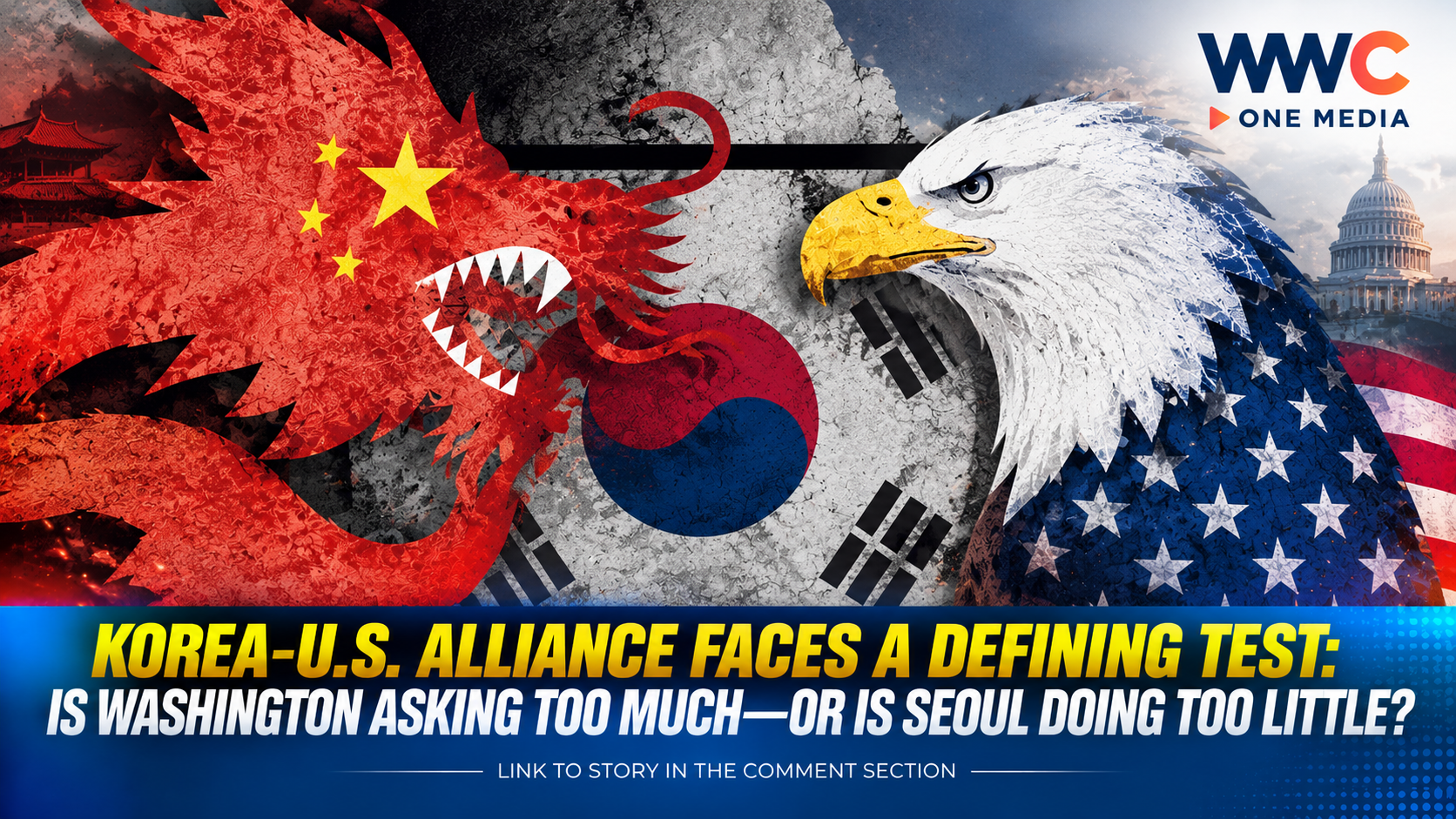
SEOUL, South Korea — The Korea-U.S. alliance has survived war, political upheaval, economic crises and generations of changing leaders.
But today, one of America's most important partnerships in Asia is facing a different kind of test.
It is no longer simply about whether Washington will defend South Korea or whether Seoul will stand behind the United States.
The harder question is becoming how much each side should be expected to contribute—and how those disagreements should be handled without damaging the trust that has held the alliance together for more than seven decades.
That is the central warning from retired Lt. Gen. Chun In-bum in a new Korea Times column, which argues that the alliance cannot survive indefinitely on either American pressure or Korean dependence.
His message is blunt: Washington needs to show greater respect, while Seoul needs to accept greater responsibility.
The alliance is bigger than money
Chun argues that the relationship should not be reduced to defense spending, trade balances, troop deployments or financial contributions.
The alliance was forged in the aftermath of the Korean War and has developed into a much broader strategic partnership involving military readiness, intelligence, technology, economic cooperation and shared democratic values.
The United States has maintained a military presence in South Korea for decades, while the two countries have developed extensive mechanisms for combined defense and deterrence.
U.S. and South Korean officials have previously described the relationship as a global comprehensive strategic alliance, emphasizing mutual respect, trust, shared values and cooperation beyond the Korean Peninsula.
That history, Chun argues, matters when disagreements become public.
Trump's pressure is testing the relationship
The current friction comes as President Donald Trump has taken a more transactional approach to America's alliances.
Washington has pressed Seoul to assume greater responsibility for its own defense while also expecting South Korea to contribute more broadly to regional security.
That pressure has become particularly visible in recent disputes involving military exercises and the U.S. campaign against Iran.
Trump ordered a substantial reduction in the annual Ulchi Freedom Shield exercises with South Korea, citing cost and the desire to avoid unnecessary provocation of North Korea. He also criticized Seoul over its reluctance to support the U.S. campaign against Iran.
For Seoul, that creates a delicate strategic calculation.
South Korea must maintain a credible deterrent against North Korea while also navigating Washington's evolving expectations about what an ally should contribute outside the Korean Peninsula.
Seoul now faces its own test
Chun's argument does not place all the blame on Washington.
He also warns South Korea against assuming that the United States should provide security while Seoul avoids difficult responsibilities.
That question has become increasingly relevant as South Korea's economic and military capabilities have expanded.
The South of 2026 is dramatically different from the impoverished country that emerged from the Korean War.
It is now a major global economy, a technological powerhouse and an increasingly significant defense exporter.
With greater power comes greater expectations.
President Lee Jae Myung has also emphasized that South Korea should assume greater responsibility for peace on the peninsula, including his goal of completing the transfer of wartime operational control before the end of his term in 2030.
That does not mean Seoul should automatically follow Washington into every conflict.
Instead, it raises a more fundamental issue: Can South Korea become more strategically independent while keeping the U.S. alliance as the foundation of its security?
The Iran question is exposing the alliance's limits
Few issues illustrate the tension better than the Strait of Hormuz.
South Korea is heavily dependent on energy supplies moving through the waterway. Reuters reported that the strait accounted for about 61% of South Korea's crude-oil imports and 54% of its naphtha imports in the previous year.
Seoul is therefore directly affected by instability in the region.
But supporting freedom of navigation does not automatically mean joining U.S. combat operations against Iran.
The South Korean presidential office said it was reviewing both military and nonmilitary options, while stressing that no deployment decision had been made and that domestic legal procedures, military readiness and possible National Assembly approval would have to be considered.
That distinction is crucial.
It demonstrates that alliance cooperation can involve shared interests without requiring identical policies.
Respect matters as much as burden-sharing
This is where Chun's argument becomes more politically sensitive.
He says Washington has legitimate reasons to demand more from Seoul.
But public criticism, threats and humiliation can damage an alliance even when the underlying demands are reasonable.
That concern is especially relevant in South Korea, where questions of sovereignty, national dignity and how disagreements are handled can carry enormous political weight.
The issue is not whether allies should disagree.
They will.
The issue is whether disagreements are resolved through negotiation or transformed into public pressure campaigns.
Chun argues that the United States should remember that an alliance is not a customer relationship in which South Korea simply purchases American protection.
America benefits from the alliance as well.
A strong partnership with Seoul provides the United States with military access, intelligence cooperation, regional reach, technological capabilities and a highly capable democratic partner in Northeast Asia.
In other words, the alliance is an asset to Washington—not simply a cost.
But Seoul cannot expect a free security guarantee
The argument cuts both ways.
South Korea's growing economic and military power makes it increasingly difficult to argue that the country should remain permanently dependent on American capabilities.
A mature alliance requires greater burden-sharing.
That could mean stronger South Korean defense capabilities, greater contributions to regional security, deeper cooperation in areas such as technology and intelligence, and a clearer willingness to protect shared interests when those interests genuinely overlap.
But burden-sharing does not mean automatic obedience.
South Korea remains a sovereign state with its own national interests.
That tension is already visible in discussions over the Strait of Hormuz, North Korea policy and the future of combined military exercises.
North Korea makes the stakes even higher
The alliance debate is unfolding as North Korea continues expanding its military capabilities.
On Monday, North Korean leader Kim Jong Un commissioned a second advanced naval destroyer while calling for a stronger nuclear deterrent. The development coincided with the start of the Freedom Edge exercise involving the United States, South Korea and Japan.
Pyongyang continues to reject Washington's calls for denuclearization and has criticized allied military exercises as hostile.
At the same time, President Lee has called for conditions that could eventually allow U.S.-North Korea dialogue to resume.
That creates another potential fault line.
Washington may prioritize deterrence and pressure.
Seoul may want deterrence while simultaneously keeping a diplomatic pathway open.
Neither approach necessarily destroys the alliance—but managing the difference will require considerably more consultation.
The alliance's next chapter cannot be transactional
The Korea-U.S. alliance has already survived disagreements far more serious than today's disputes.
Its resilience has come partly from the recognition that neither country can achieve all of its strategic goals alone.
For Washington, South Korea remains a critical partner in a region increasingly shaped by competition among the United States, China, Russia, North Korea and other powers.
For Seoul, the American security commitment remains a crucial pillar of deterrence against North Korea.
But the relationship is changing.
South Korea is more powerful than it was when the alliance was created.
America is asking allies to carry more of the security burden.
North Korea is becoming more capable.
And the strategic environment surrounding the Korean Peninsula is becoming more complicated.
That means the old formula cannot simply be repeated.
Washington cannot demand loyalty through public pressure. Seoul cannot demand protection without accepting responsibility.
The future of the alliance will depend on whether both sides can recognize that distinction.
Because after more than 70 years, the biggest threat to the Korea-U.S. alliance may not be a disagreement over money, military exercises or even Iran.
It may be the moment when one side starts believing the other no longer respects the partnership.