Lee Jae Myung Arrives in France as Macron Summit Draws Focus on Security, AI and Hormuz

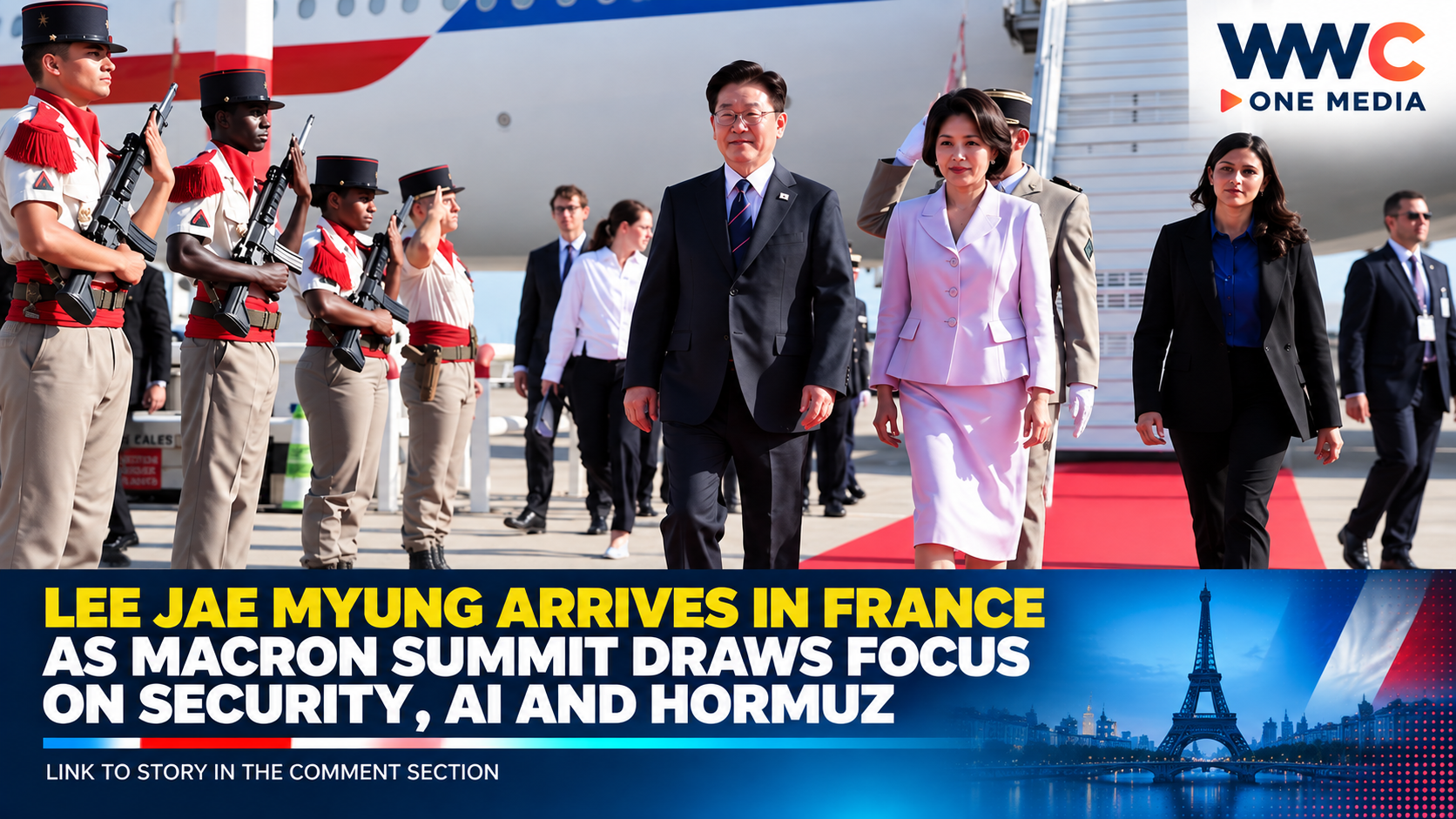
NICE, France — South Korean President Lee Jae Myung has arrived in France for a four-day state visit that could produce major developments in security, advanced technology, economic cooperation and cultural diplomacy, with a bilateral summit with French President Emmanuel Macron scheduled for Tuesday in Paris.
Lee arrived in Nice on Sunday, September 6, beginning a September 6–9 visit that comes just months after Macron's state visit to South Korea in April. The two countries are also marking 140 years of diplomatic relations this year.
But while the trip has a strong cultural and economic agenda, one sensitive security question could cast a shadow over the Paris talks: how far South Korea is prepared to go in supporting international efforts to keep shipping lanes through the Strait of Hormuz open.
Lee and Macron first turn to the global film industry
Lee's first major event in France is not a conventional diplomatic meeting.
On Monday, September 7, he and Macron are co-chairing the Lumière Summit in Saint-Paul-de-Vence, near Nice, bringing together political leaders, policymakers and major figures from the global film and audiovisual industries.
Around 150 participants have been invited, with discussions expected to focus on how the entertainment industry can respond to the rapid rise of artificial intelligence, competition from social media platforms and growing pressure on financing.
The summit also reflects an increasingly important part of the relationship between Seoul and Paris: the intersection of technology and cultural power.
South Korea has built enormous global influence through K-pop, film, television and other forms of K-content, while France remains one of the world's major cultural and cinematic powers.
The two governments have agreed to deepen cooperation in their cultural and creative industries, including in response to technological changes affecting how content is created and distributed.
The bigger meeting comes Tuesday in Paris
After the Lumière Summit, Lee will travel to Paris for the formal state-visit portion of his trip.
On Tuesday, he is scheduled to meet Macron for a private luncheon before holding expanded summit talks. Macron and his wife, Brigitte Macron, are also scheduled to host a dinner banquet for Lee and First Lady Kim Hye Kyung at the Élysée Palace.
The Paris discussions are expected to go well beyond ceremonial diplomacy.
Reuters reported that Seoul sees the visit as an opportunity to expand cooperation with France in security, the economy and people-to-people exchanges, while also pursuing closer collaboration in artificial intelligence, aerospace and biotechnology.
The two countries already elevated their relationship to a Global Strategic Partnership during Macron's April visit to Seoul. Their April joint statement outlined cooperation in defense, trade, critical minerals, AI, quantum computing, semiconductors, nuclear energy, space and biotechnology.
Strait of Hormuz could become the most sensitive issue
Behind the economic and cultural agenda is a much more difficult question.
South Korea is reviewing how it might contribute to international efforts to protect freedom of navigation through the Strait of Hormuz, a critical global energy route.
Britain and France have been leading multinational efforts connected to safe navigation in the area, while Seoul has been examining both military and non-military options.
However, South Korean officials have repeatedly emphasized that no final decision has been made on sending additional military assets or personnel.
That distinction is crucial.
Reports about possible South Korean participation should therefore not be interpreted as confirmation that Seoul has decided to deploy troops or military equipment.
Instead, the Macron-Lee meeting could become an important venue for discussing what level of assistance South Korea might ultimately provide.
Why Hormuz matters so much to Seoul
The issue is not simply about military alliances.
The Strait of Hormuz is one of the world's most important energy chokepoints, meaning instability there can quickly affect oil supplies, shipping costs and economies far beyond the Middle East.
For an energy-importing country such as South Korea, keeping major sea routes open is a significant economic concern.
The French and South Korean governments already committed in April to closer cooperation on international crises and reaffirmed the importance of freedom of navigation in major waterways, including the Strait of Hormuz, the Suez Canal and the Red Sea.
That earlier commitment provides a diplomatic foundation for the issue to come up again in Paris.
AI and advanced technology are another major priority
Security is only one piece of the agenda.
Seoul and Paris are also looking to deepen technological cooperation at a time when governments worldwide are competing for leadership in artificial intelligence and advanced industries.
The April strategic partnership specifically identified AI, quantum computing and semiconductors as areas with strong potential for joint development. The two sides also agreed to cooperate on AI-related biotechnology research.
Space is another emerging area.
France and South Korea have already established a framework for cooperation between France's CNES and Korea's KASA, covering areas including space exploration, sustainability, satellites and commercial applications.
The Paris talks could therefore reinforce a relationship that is becoming increasingly important not only diplomatically, but technologically and economically.
Business leaders will also have a seat at the table
Lee's French visit is also expected to include a major business component.
On September 8, he is scheduled to attend a business roundtable involving executives from approximately 20 South Korean and French companies.
That meeting could focus on expanding investment and cooperation in strategic industries as both countries seek to strengthen supply chains and develop advanced technologies.
The April joint statement already identified critical minerals and metals as an area for expanded cooperation, including potential joint projects across the value chain.
The relationship has moved beyond traditional diplomacy
The timing of Lee's visit is significant.
France and South Korea established diplomatic relations in 1886, making 2026 their 140th anniversary year. But the relationship is now expanding far beyond traditional diplomatic and cultural exchanges.
The April agreement between Lee and Macron elevated bilateral ties to a Global Strategic Partnership, with cooperation spanning defense, energy, technology, trade, climate, health, space and culture.
That means the Paris summit could serve as an early test of whether that upgraded partnership can deliver concrete results.
Lee's final day in France
Lee is scheduled to remain in France through September 9.
Before returning to South Korea, he is expected to meet Yaël Braun-Pivet, president of the French National Assembly's lower house, and Mathias Cormann, secretary-general of the Organisation for Economic Co-operation and Development.
The meetings will give Lee an opportunity to broaden discussions beyond the executive branch and strengthen Seoul's engagement with European institutions.
What to watch in Paris
The biggest question coming out of the visit may not be the ceremonial agreements or cultural announcements.
It may be whether Lee and Macron can translate their newly upgraded strategic partnership into specific cooperation on security, technology and economic resilience.
And with the Strait of Hormuz becoming an increasingly sensitive issue for Seoul, any signal about South Korea's possible contribution to international maritime security efforts could attract intense attention.
For now, Seoul says no final decision has been made.
But as Lee sits down with Macron in Paris, the question will be difficult to avoid:
How far is South Korea willing to go as its partnership with France—and its role in a rapidly changing international security environment—enters a new phase?