
London’s First AI Robotaxis Are Finally Here—But There’s Still a Human Behind the Wheel

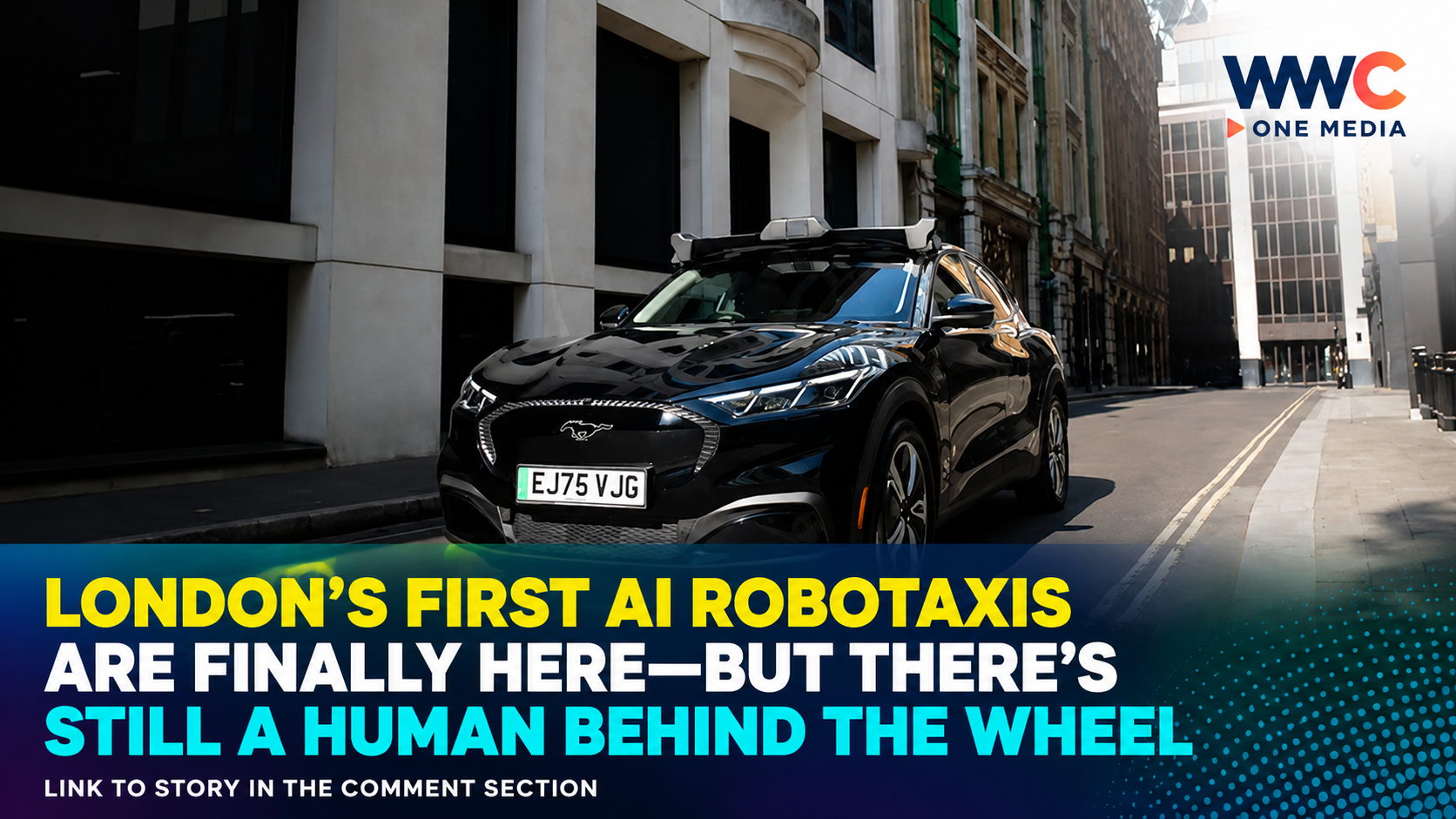
LONDON — The future of ride-hailing has arrived in London—but it is not completely driverless just yet.
Uber has launched its first autonomous rides in the British capital using self-driving technology developed by UK-based artificial intelligence startup Wayve, marking a major step in the race to bring robotaxis to European cities. London becomes the second European city where Uber offers autonomous rides, following Zagreb.
But there is an important catch: a licensed human operator will initially remain inside the vehicle, ready to monitor the system and intervene if necessary. The launch therefore represents supervised autonomous driving rather than a fully driverless taxi service.
How London’s new robotaxis work
The initial service uses Ford Mustang Mach-E electric vehicles equipped with Wayve’s AI driving technology. Uber customers booking eligible UberX, Uber Comfort or Uber Electric trips could be matched with one of the autonomous vehicles, with no additional charge for the robotaxi option.
The initial fleet is small, with fewer than 20 vehicles available at launch. Transport for London has previously granted 15 private-hire licences to Wayve-equipped Mustang Mach-Es, with a licensed private-hire driver required to remain in the vehicle during the current phase.
That human presence is more than a publicity feature. Under the current licensing framework, the qualified driver remains responsible for the vehicle and must be able to intervene when necessary. Full driverless operation requires additional regulatory approval.
Wayve is taking a different approach to self-driving
Wayve's technology is also notable because its autonomous-driving system does not rely on lidar, a laser-based sensing technology widely used by some competing robotaxi companies.
Instead, Wayve's AV2.0 system uses cameras and radar alongside an AI-based driving model designed to learn from experience and adapt to different roads, weather conditions and driving situations. The company says its approach is intended to move beyond the highly mapped and tightly controlled environments traditionally associated with autonomous vehicles.
That could become significant if the technology proves capable of scaling across different cities without requiring every road to be painstakingly mapped in advance.
London is becoming a major robotaxi battleground
Uber and Wayve are not entering an empty market.
Google-owned Waymo has been testing autonomous vehicles in London and has said it is targeting a commercial launch before the end of 2026. Meanwhile, Lyft is working with Chinese technology company Baidu on a separate robotaxi service planned for the London area.
The competition means London's roads are becoming an important test for competing approaches to autonomous transportation—from Wayve's AI-first technology to Waymo's more established robotaxi model.
Wayve's partnership with Uber also extends beyond London. The companies have been building a broader relationship aimed at deploying Wayve-powered autonomous vehicles across multiple markets. Wayve is also working with automakers including Nissan and Stellantis.
The biggest hurdle is still regulation
The arrival of autonomous rides does not mean London is ready for completely driverless taxis.
Recent reporting showed that regulatory guidance for fully driverless passenger services had been delayed. Under the UK's emerging framework, operators seeking to remove the human driver need to pass additional approval processes involving the Driver and Vehicle Standards Agency and other authorities.
That distinction is crucial.
London has now crossed the psychological and commercial threshold of allowing paying passengers to experience autonomous rides, but the city has not yet reached the stage where passengers can routinely summon a taxi with nobody sitting behind the wheel.
What this means for Uber—and its drivers
For Uber, the London launch is about more than futuristic transportation. The company has increasingly embraced partnerships with autonomous-vehicle companies instead of relying solely on developing its own self-driving technology.
The company has partnered with numerous autonomous-vehicle firms globally and has positioned robotaxis as a major part of its long-term mobility strategy. The Verge reported that Uber has said it plans to spend more than $10 billion over time on its autonomous-vehicle ambitions.
But the shift also raises difficult questions for London's professional drivers.
Driver groups have warned about the potential impact of autonomous vehicles on employment, including how drivers might be retrained or redeployed if robotaxis eventually become widespread.
For now, however, the human driver remains part of the equation.
The real test begins now
More than 100,000 Londoners had reportedly joined the waiting list for the autonomous service before launch, showing significant public curiosity about AI-powered transportation.
The bigger question is whether curiosity will turn into trust.
London is one of the world's most complicated driving environments, filled with pedestrians, cyclists, buses, narrow streets, roundabouts and unpredictable traffic. Wayve's ability to handle those conditions safely—and consistently—could determine whether today's supervised rides become tomorrow's truly driverless transportation network.
The robotaxi era has officially reached London. But the moment that could really transform the city's transport system is still waiting for regulatory approval: the day the human driver finally disappears.
WWC MEDIA ONE MJE