
Moonshot AI Quietly Files for Hong Kong IPO — But Its $3 Billion Target Is Only Part of the Kimi Story

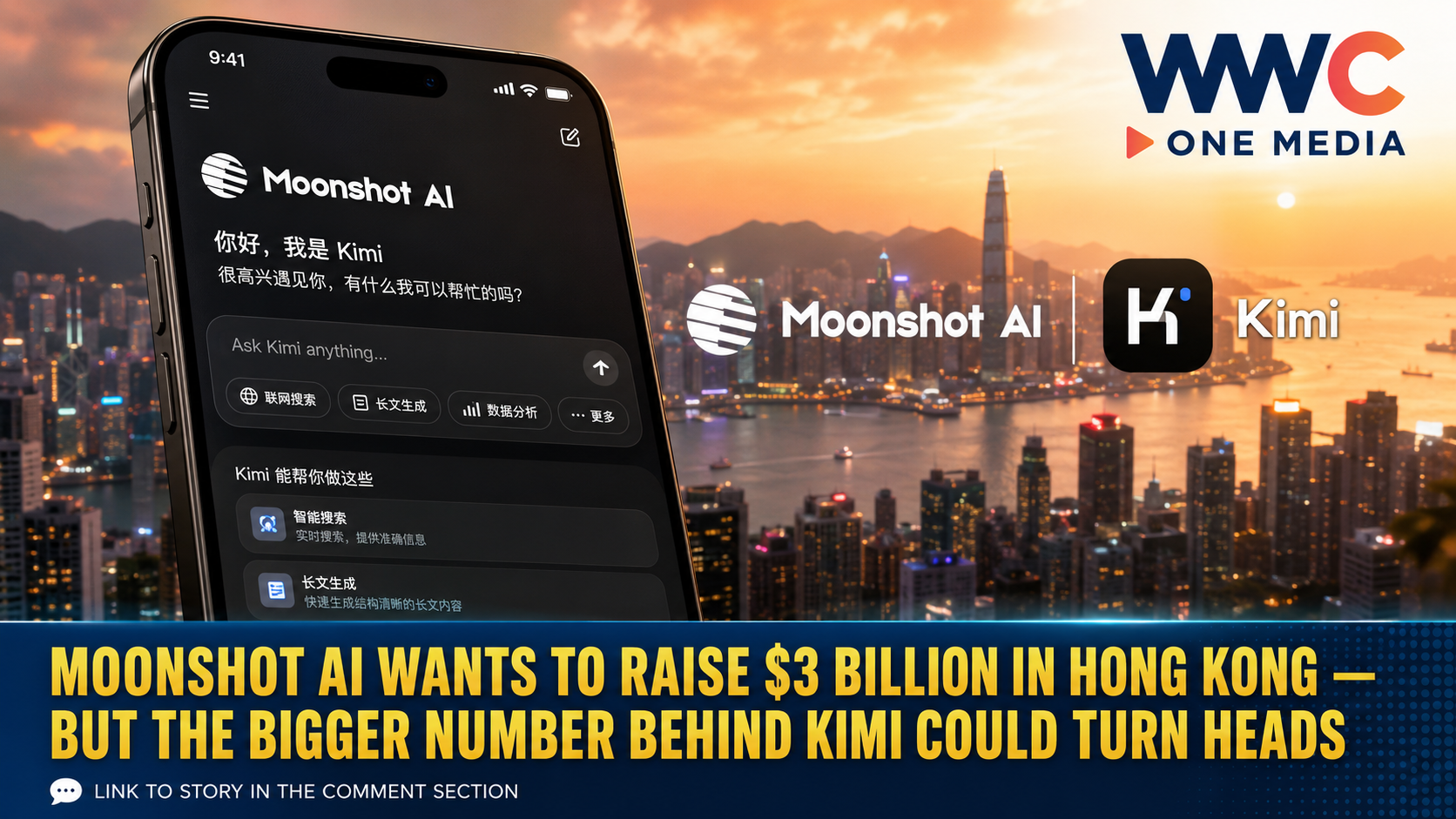
HONG KONG — Chinese artificial intelligence startup Moonshot AI, the company behind the increasingly prominent Kimi AI platform, has reportedly taken one of its biggest steps yet toward the public markets, confidentially filing for an initial public offering in Hong Kong that could raise around US$3 billion.
Three people familiar with the plans told Reuters that Moonshot had submitted the confidential filing, while one source said the company was targeting roughly $3 billion from the offering. Two other sources said Moonshot is being valued at approximately $50 billion in an ongoing financing round.
If completed near those terms, the IPO would mark an extraordinary rise for a company founded only in 2023 — and could turn Moonshot into one of the most closely watched public-market tests of investor enthusiasm for China's new generation of AI developers.
But the proposed listing is about more than another technology company raising cash.
It could offer investors one of their clearest opportunities yet to determine how much China's rapidly improving AI models are actually worth.
From AI Startup to Potential Multibillion-Dollar IPO
Moonshot was founded in 2023 by AI researcher Yang Zhilin, a Tsinghua University graduate who later completed his PhD at Carnegie Mellon University and previously worked with research teams at Meta and Google.
The Beijing company gained prominence through its Kimi family of large language models, placing it among a group of Chinese AI developers competing not only with domestic technology giants but increasingly with leading American model developers.
Investor interest followed quickly.
In May, Moonshot raised around $2 billion at a $20 billion valuation, according to TechCrunch, with investors including Meituan-linked Long-Z Investments, China Mobile, CPE Yuanfeng and Tsinghua Capital.
By July, Bloomberg reported that Moonshot had raised about $3.5 billion at a $35 billion valuation, significantly more than it had initially sought. Bloomberg subsequently reported that the company was considering another pre-IPO financing round that could value it as high as $50 billion.
Reuters' latest reporting now says that $50 billion level is being attached to an ongoing funding round as Moonshot pursues its Hong Kong flotation.
That means Moonshot's valuation trajectory has accelerated dramatically in a matter of months.
And one major reason is Kimi K3.
Kimi K3 Changed the Conversation
Moonshot unveiled Kimi K3 in July 2026, describing it as a 2.8-trillion-parameter system and the world's first open model in the roughly three-trillion-parameter class.
The model includes native vision capabilities, a context window of up to one million tokens and technology aimed at demanding tasks including long-horizon coding, reasoning and knowledge work. Moonshot itself acknowledges that K3's overall performance still trails some of the strongest proprietary AI systems, while arguing that it has reached frontier-level performance across a number of evaluations.
Reuters reported that the launch highlighted how rapidly China's open-model ecosystem has been narrowing the performance gap with major US competitors.
Demand became so intense that Moonshot temporarily stopped accepting new consumer subscriptions after requests pushed its computing infrastructure close to capacity. The company said the surge following Kimi K3's release created unprecedented computing pressure and forced it to prioritise resources for existing subscribers.
That bottleneck also revealed one of the biggest challenges behind Moonshot's IPO story.
Building a powerful AI model is expensive.
Serving millions of users with that model can be even more expensive.
An IPO could give Moonshot considerably more financial firepower to secure computing capacity, fund research and compete in an AI race where infrastructure spending is becoming almost as important as model performance.
Why Moonshot Had to Restructure Before Listing
Moonshot's path to Hong Kong was not simply a matter of submitting paperwork.
Reuters reported that the company had to unwind its offshore corporate structure and move to an onshore Chinese domicile before filing for the IPO. The company is reportedly working with investment banks including Goldman Sachs, China International Capital Corp and Deutsche Bank.
The Financial Times had previously reported that Moonshot was restructuring its ownership arrangements as it sought approval from Chinese authorities for an overseas listing. That included converting its corporate structure and working through questions surrounding how offshore investors could transfer their interests into an onshore company.
Those changes matter because Chinese authorities have increasingly scrutinised overseas listings involving companies controlling strategically important technologies.
Artificial intelligence sits near the top of that list.
As a result, even after a confidential filing, Moonshot's IPO is far from guaranteed.
Reuters cautioned that the timetable remains subject to regulatory approval and that the offering's financial terms could change depending on market conditions. Moonshot had not publicly confirmed the filing when Reuters published its report.
Hong Kong Is Becoming a Major Battlefield for China's AI Boom
Moonshot is also arriving at a particularly important moment for Hong Kong's capital markets.
Artificial intelligence, semiconductor and robotics companies have helped drive renewed Chinese IPO activity in 2026.
Associated Press reported that IPOs and secondary listings across Hong Kong and Shanghai had raised more than $54 billion in 2026, compared with about $46 billion during the previous year, as investors chased companies linked to AI, robotics and China's push for technological self-reliance.
Moonshot would therefore enter a market where enthusiasm is high — but where investors have already shown they are willing to punish valuations they believe have moved too far ahead of underlying businesses.
That could become the real test.
A $50 billion private-market valuation may demonstrate that investors believe Kimi can become one of China's foundational AI platforms.
Public investors, however, will eventually want something more concrete: revenue growth, sustainable margins, manageable computing costs and evidence that enormous spending on model development can translate into an enduring business.
The Bigger Question Behind Moonshot's $3 Billion IPO
Moonshot's confidential filing represents another milestone in the transformation of China's AI industry.
Only a few years ago, the central debate was whether Chinese developers could keep pace with America's most advanced AI laboratories.
Increasingly, that question is changing.
Companies such as Moonshot, Z.ai and MiniMax have demonstrated that Chinese developers can produce increasingly capable models while building large domestic user bases and attracting billions of dollars in investment.
The next question is harder:
Can they turn technological momentum into businesses capable of justifying tens of billions of dollars in market value?
Moonshot's proposed Hong Kong IPO may soon give public investors the chance to answer it.
And if the company really does attempt to raise around $3 billion at or near a $50 billion valuation, Wall Street and China's technology sector will be watching closely — because the outcome could influence how the next wave of Chinese AI companies is valued.
WWC ONE MEDIA MJE