
NIGHT OF FIRE IN THAILAND: 51 Incidents Rock Narathiwat, Yala and Pattani — What Security Forces Fear Could Come Next

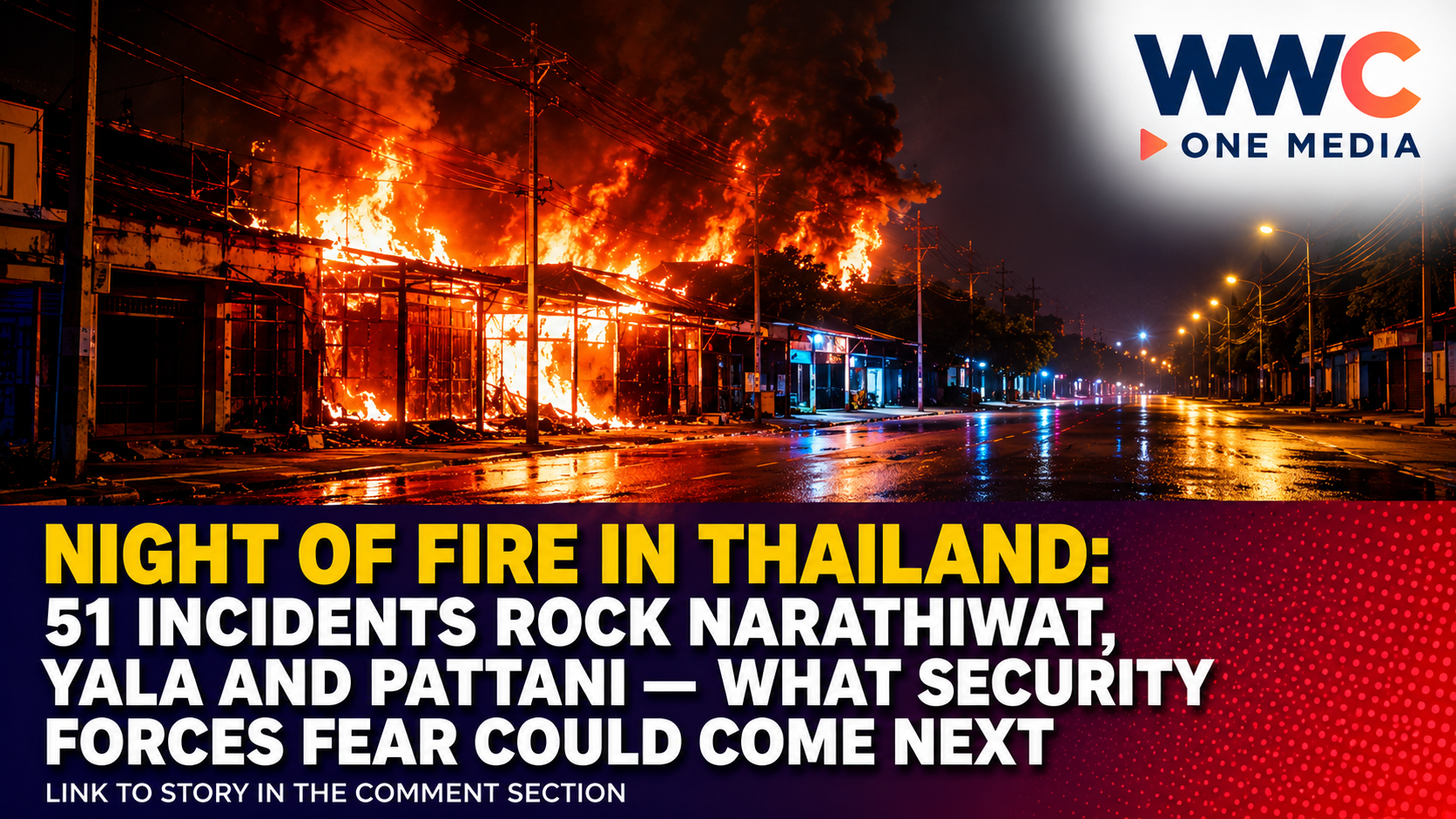
NARATHIWAT, Thailand — Thailand’s southern border region was hit by a sweeping wave of violence Saturday night, with authorities reporting 51 separate incidents involving explosions, arson and other acts of sabotage across Narathiwat, Yala and Pattani.
The incidents began at around 8 p.m. on August 22, according to Thailand’s Internal Security Operations Command Region 4 (ISOC 4). By midnight, authorities had recorded 22 incidents in Narathiwat, 18 in Yala and 11 in Pattani.
The attacks included reported bombings, fires, burning tyres, damage to government facilities, attacks involving telecommunications infrastructure and fires at commercial premises, according to Thai and regional reports.
Narathiwat placed under curfew
The scale and near-simultaneous nature of the incidents prompted authorities to impose an overnight curfew across Narathiwat.
The Narathiwat Task Force ordered residents to remain inside their homes from 10:15 p.m. Saturday until 6 a.m. Sunday, invoking powers under Thailand’s 1914 Martial Law Act. People with urgent reasons to leave were required to obtain permission from military, police or local administrative authorities.
The measure was designed to give security forces greater control over affected areas, facilitate searches and investigations, and prevent civilians from entering locations where attacks had occurred.
Two civilians reportedly injured
Authorities said two civilians were initially reported injured in Narathiwat after their vehicle was affected by an improvised explosive device in Sungai Padi district.
Early reports differed in their assessment of the number of incidents as authorities continued checking individual locations. One preliminary security tally cited by The Nation counted 34 incidents by around 9:42 p.m., while the later ISOC Region 4 assessment reached 51 incidents by midnight. The higher figure therefore reflects an evolving preliminary count rather than a contradiction in the final investigation.
Why this matters beyond one night of violence
The latest attacks come as Thailand continues to struggle with a long-running separatist insurgency in its predominantly Muslim southern border provinces.
The conflict has persisted for more than two decades, with Pattani, Yala and Narathiwat at its centre. Reuters reported earlier this week that more than 7,800 people have been killed since 2004, while Thailand is simultaneously exploring a new approach to peace negotiations with the insurgency-linked Barisan Revolusi Nasional, or BRN.
That timing makes the latest violence particularly significant.
Thailand's chief peace negotiator has recently argued that negotiations need to address deeper political grievances and questions surrounding governance and decentralisation rather than relying solely on traditional deal-making.
The sudden appearance of dozens of incidents across three provinces underscores how difficult it remains to separate security operations from the broader political challenge confronting Bangkok.
Security tightened as authorities hunt for those responsible
Prime Minister Anutin Charnvirakul convened an urgent security meeting on Sunday following the attacks, with senior defence, interior, army and security officials reviewing the situation in the three southern provinces. Authorities instructed local security personnel to exercise heightened caution and urged residents to stay away from affected areas.
ISOC Region 4 said security forces were inspecting affected locations, securing areas and gathering evidence for possible legal action. Officials also urged residents not to approach suspicious people, vehicles or objects and to report them to authorities.
The violence also carries implications for movement across the Thailand-Malaysia border. Malaysian authorities have urged travellers to postpone trips to the affected Thai provinces, while Malaysian officials said there were no reports of Malaysians being affected by the attacks.
The bigger warning for Thailand
Saturday night's attacks are not an isolated development.
In July 2026, Thailand recorded what The Nation described as the 68th car-bomb attack linked to the southern unrest since 2005, when a bomb-laden vehicle exploded outside the old Tanyong Police Station in Narathiwat. A police officer suffered minor injuries in that attack.
Thailand also faced coordinated attacks on petrol stations earlier in January, prompting another curfew in Narathiwat and tighter security around vulnerable commercial locations.
The latest wave is therefore significant not simply because of the number of incidents, but because of their simultaneous spread across three provinces.
For now, authorities are focused on securing affected communities, identifying those responsible and preventing additional attacks.
But with peace efforts still struggling to gain momentum, Saturday night's violence raises a much larger question:
Was this simply another surge in Thailand's decades-old insurgency — or a warning that the conflict is entering another dangerous phase?