
Nvidia’s $12.9 Billion Hugging Face Deal Signals a Major Power Shift in the Global AI Race

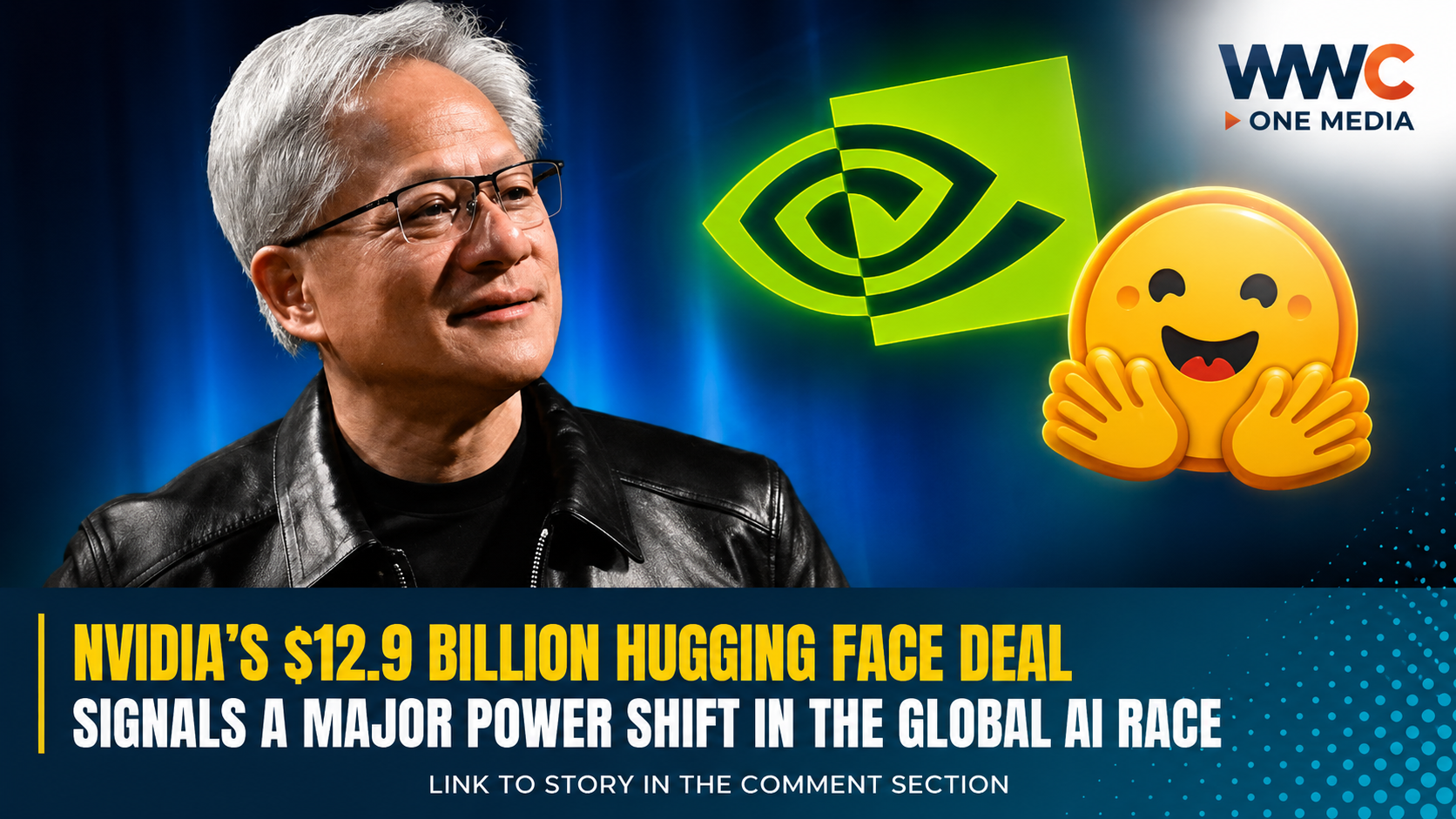
SAN FRANCISCO — Nvidia is making one of its biggest bets yet on the future of artificial intelligence, agreeing to acquire AI developer platform Hugging Face for $12.93 billion in a deal that could reshape the rapidly intensifying battle between open-source and proprietary AI.
But Nvidia is making an unusually important promise to the millions of developers watching closely:
Hugging Face will remain open.
The acquisition gives the world's dominant AI chipmaker control of one of the internet's most important hubs for artificial intelligence development—a platform often described as the “GitHub of AI” because developers use it to share models, datasets and applications.
Nvidia CEO Jensen Huang said Hugging Face would continue operating as an open platform, allowing developers to choose their own models, frameworks, cloud providers and computing hardware. Crucially, Huang said developers would not be required to use Nvidia chips to build or deploy through the platform.
Why Is Nvidia Paying Nearly $13 Billion?
The answer may lie in where the AI industry is heading next.
For the past several years, much of the AI boom has been dominated by closed systems operated by companies such as OpenAI, Anthropic and Google. These companies control access to their most powerful models through paid cloud services.
But open-weight and open-source AI models are rapidly gaining ground.
Companies and developers increasingly want models they can download, customize and run on their own infrastructure—potentially giving them greater control and reducing the cost of relying entirely on proprietary AI services.
That shift has turned Hugging Face into critical infrastructure for the AI ecosystem.
The platform hosts millions of models, datasets and applications and serves a massive global developer community. Reuters reported that acquiring Hugging Face gives Nvidia direct access to a platform where developers collaborate, test and distribute AI technology.
Nvidia Is Buying More Than a Company—It Is Buying a Front Row Seat to AI's Future
The deal represents a strategic expansion beyond Nvidia's traditional role as the world's leading supplier of AI chips.
Nvidia's graphics processors have become the backbone of the generative AI boom. But some of its biggest customers—including major technology companies building AI systems—are also developing their own custom chips to reduce dependence on Nvidia.
That creates a long-term challenge.
If companies need fewer Nvidia processors, the chip giant needs to ensure it remains deeply embedded elsewhere in the AI ecosystem.
Hugging Face offers exactly that opportunity.
By acquiring one of the world's largest communities for AI developers, Nvidia gains a stronger connection to the people and organizations deciding which models, tools and infrastructure will shape the next generation of artificial intelligence. Reuters reported that strengthening its position in open AI could also help Nvidia protect against potential demand slowdowns from major customers developing their own chips.
The Biggest Question: Can Hugging Face Really Stay Neutral?
Nvidia's promise to keep Hugging Face open may reassure developers—but it will also face intense scrutiny.
Hugging Face has built its reputation as a relatively neutral platform supporting a broad AI ecosystem.
Developers can work with different models.
They can choose different cloud providers.
And they can run workloads on hardware from Nvidia competitors.
Now, the platform will be owned by the world's most powerful AI chip company.
That raises an unavoidable question:
Will Hugging Face remain truly hardware-neutral under Nvidia?
Huang has directly addressed those concerns, pledging that Nvidia computing hardware will not be mandatory for developers using Hugging Face.
The commitment is strategically important. If developers begin viewing Hugging Face as merely an extension of Nvidia's hardware business, the company risks alienating the very open-source community that made the platform valuable in the first place.
Open AI Is Becoming a Serious Threat to Closed Models
Nvidia's enormous investment also reflects growing confidence in open AI.
Open-weight models have become increasingly competitive, with companies searching for alternatives to expensive proprietary AI services.
Chinese AI companies, including DeepSeek and Z.ai, have helped accelerate the global race by releasing increasingly capable models at lower costs, intensifying pressure on U.S. technology companies.
The growing popularity of open models has also raised geopolitical concerns, as governments and businesses consider whether their AI infrastructure could become dependent on foreign-developed technology.
For Nvidia, supporting open AI is not necessarily a challenge to its business model.
It could actually strengthen it.
More AI models being developed, tested and deployed could ultimately mean more demand for the computing infrastructure needed to power them.
What Happens to Hugging Face Employees?
The transaction includes approximately $11.9 billion for Hugging Face investors and an equity-based employee retention program worth up to $1 billion, according to Reuters.
The retention package highlights the importance Nvidia places not only on Hugging Face's technology but also on its talent and developer relationships.
Founded in 2016 by French entrepreneurs Clément Delangue, Julien Chaumond and Thomas Wolf, Hugging Face evolved from a chatbot project into one of the world's most influential AI development platforms.
Its rise mirrors the transformation of artificial intelligence itself.
What was once a niche field dominated by researchers has become a global technological and economic battleground involving governments, trillion-dollar companies and millions of developers.
Nvidia's $12.9 Billion Gamble Changes the AI Map
The acquisition is about much more than Hugging Face.
It represents Nvidia's attempt to secure influence over the next layer of the AI revolution.
For years, Nvidia dominated the hardware powering artificial intelligence.
Now it is moving deeper into the software ecosystem where developers decide which models will succeed and which technologies will define the future.
The biggest irony is that Nvidia's path to greater influence may depend on giving developers more freedom, not less.
Hugging Face's value comes from its openness.
If Nvidia protects that openness, the acquisition could strengthen its position across the entire AI ecosystem.
If it fails, developers could look elsewhere.
That makes the $12.93 billion deal one of Nvidia's boldest bets yet—not simply on artificial intelligence, but on the idea that the future of AI may not belong exclusively to the companies that keep their technology behind closed doors.
As the global AI race accelerates, one thing is becoming increasingly clear:
Nvidia no longer wants to just power the AI revolution. It wants to be at the center of where the next generation of AI is built.
WWC ONE MEDIA J.M.D