
PNP Says BARMM Polls Are ‘Under Control’ — But 108 Areas Are Still on the Security Watchlist

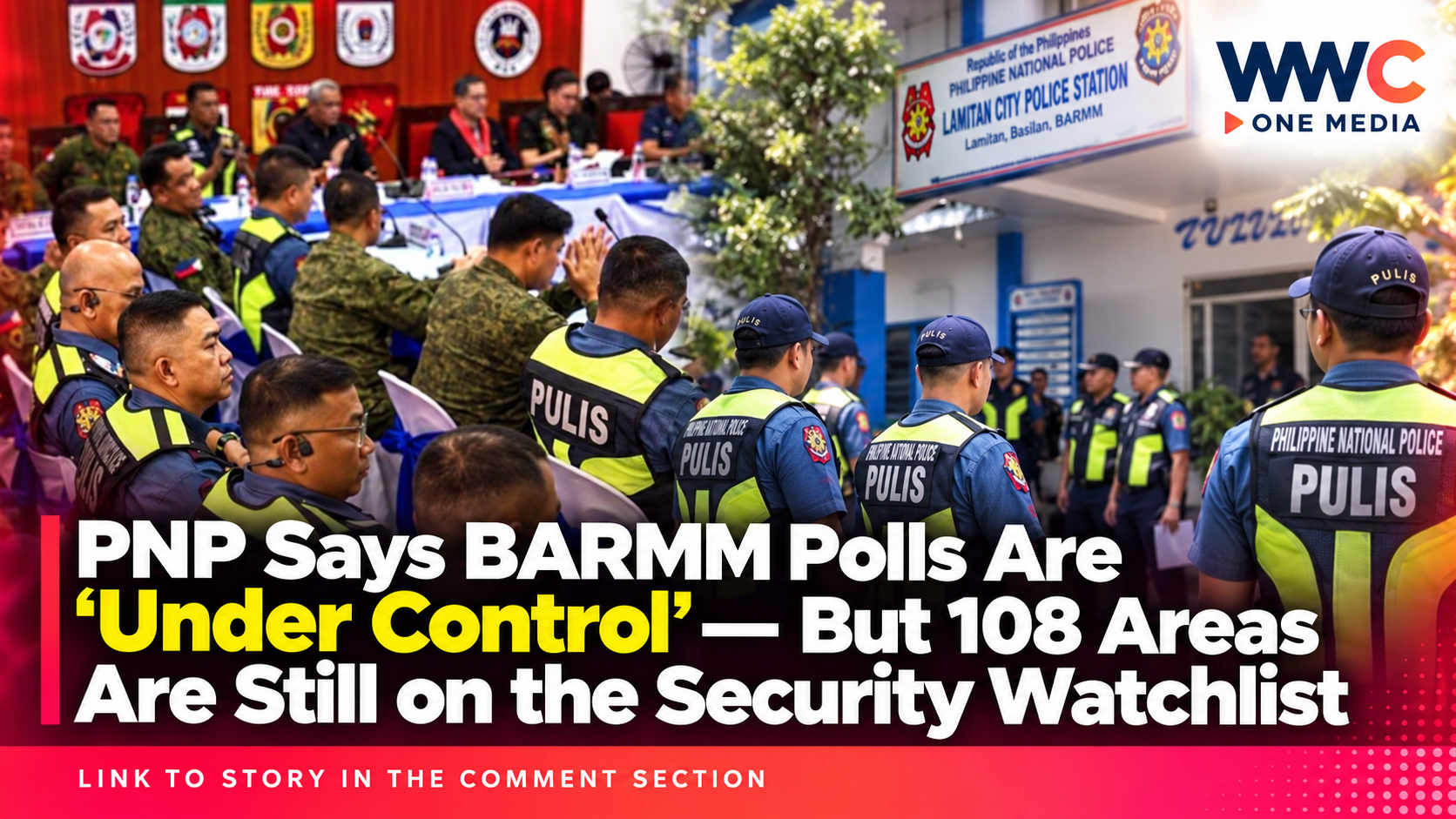
MANILA, Philippines — With just days remaining before the Bangsamoro Autonomous Region in Muslim Mindanao holds its first parliamentary elections, the Philippine National Police has intensified security operations across BARMM in an effort to prevent violence, enforce the election gun ban and assure millions of voters they can cast their ballots safely.
PNP chief Gen. Jose Melencio Nartatez Jr. said police units have been ordered to strengthen enforcement against loose firearms, increase visibility in sensitive areas and deepen coordination with the Armed Forces of the Philippines and other security agencies ahead of the historic September 14 vote.
“We will not allow violence or the proliferation of loose firearms to undermine the upcoming elections,” Nartatez said, stressing that authorities remain focused on preventing election-related violence in areas affected by political rivalries, clan disputes and other security concerns.
The heightened security posture comes as BARMM prepares for an election that could reshape political power in a region whose transition to parliamentary government grew out of decades of armed conflict and peace negotiations.
Around 2.39 million registered voters are expected to participate in the election, which will choose members of the Bangsamoro Parliament who will replace the appointed Bangsamoro Transition Authority. The elected parliament will ultimately determine the leadership of the autonomous regional government.
More than 100 areas remain under security watch
The scale of the security challenge is significant.
The Commission on Elections earlier identified 108 BARMM areas as election areas of concern, covering locations with varying levels of security risk. Of those, 27 had earlier been classified in the highest “red” category because of serious security concerns or a history of election-related violence.
Lanao del Sur alone accounted for 21 red-category areas when the PNP disclosed its regional assessment in August. Authorities have said the classifications remain subject to continuous monitoring and can be adjusted depending on developments on the ground.
Thousands of police officers have been mobilized for the polls. Earlier PNP figures showed more than 9,400 personnel deployed or earmarked for election security, including officers from outside BARMM and specialized police units.
The strategy is intended not only to secure polling centers but also to deter armed groups, protect election personnel and reduce the possibility that local political rivalries could escalate into violence.
Gun violence remains a major concern
Despite assurances from the PNP that the overall situation remains “under control,” incidents of gun violence continue to put election security under scrutiny.
The Philippine Daily Inquirer reported on September 8 that Police Regional Office-BARMM had recorded at least 43 gun-related incidents since the election gun ban took effect on July 16, resulting in 14 deaths and eight injuries. Maguindanao del Sur recorded the largest number of incidents, with 16.
The latest reported attack came in Paglat, Maguindanao del Sur, where two brothers were shot dead by unidentified gunmen on September 7 while the election gun ban was in force. Police said the motive remained under investigation.
Not all gun-related incidents have been formally classified as election-related violence, an important distinction as investigators determine motives behind individual attacks.
Security concerns intensified further after Bangsamoro Interim Chief Minister Abdulraof Macacua survived an ambush in Datu Odin Sinsuat, Maguindanao del Norte, on August 15.
A monitoring report cited by several news organizations identified political rivalries, clan feuds and land disputes as among the factors capable of triggering violence during the election period.
PNP insists situation remains manageable
Nartatez nevertheless maintained that authorities are capable of securing the election.
The PNP said its personnel are concentrating resources in communities with known political, clan and security concerns while maintaining police visibility around polling places and other critical locations.
The police chief also instructed officers to remain politically neutral and professional throughout the electoral process, stressing that voters, candidates and election workers must all receive protection regardless of political affiliation.
That neutrality could prove particularly important in an election where political competition is unfolding alongside longstanding family, clan and factional rivalries.
Ballots and voting machines moving into position
Security preparations are happening alongside a major logistical operation by the Commission on Elections.
Comelec said it was aiming to complete the distribution of ballots, automated counting machines and other election materials to municipalities by September 8, six days before election day.
Around 7,000 automated counting machines and related election equipment have been prepared for deployment, while authorities are expected to conduct final testing and sealing of the machines shortly before voting begins.
Comelec Chairman George Garcia has said the commission is hoping for voter turnout of at least 80 percent, citing strong interest among residents ahead of the unprecedented regional vote.
More than an ordinary regional election
The September 14 contest carries significance beyond determining who occupies seats in the Bangsamoro Parliament.
The vote represents another major stage in implementing the political settlement that followed the peace agreement between the Philippine government and the Moro Islamic Liberation Front.
Unlike the appointed transitional government that has administered BARMM in recent years, the incoming parliament will derive its mandate directly from voters.
MILF chairman Ahod Balawag “Al Haj Murad” Ebrahim has also called for international election observers, arguing that outside monitoring could strengthen confidence in the integrity of the historic vote. International and regional democracy organizations have already conducted pre-election assessments in BARMM.
Those assessments have raised concerns extending beyond physical security, including possible voter intimidation, vote buying, “flying voters” and other irregularities, particularly in remote communities.
For the PNP, Comelec and the Bangsamoro leadership, the challenge is therefore larger than preventing attacks on election day.
The real test will be whether BARMM can conduct a competitive parliamentary election in which millions of voters are able to choose their representatives without intimidation, armed interference or fear.
And with September 14 approaching, every checkpoint, police deployment and security operation is aimed at ensuring that in one of the most consequential elections in Bangsamoro history, the ballot — not the gun — decides who governs next.
WWC ONE MEDIA M.J.E