
PSA Finds No Civil Registry Records for 1,685 Names in OVP and DepEd Payee Lists

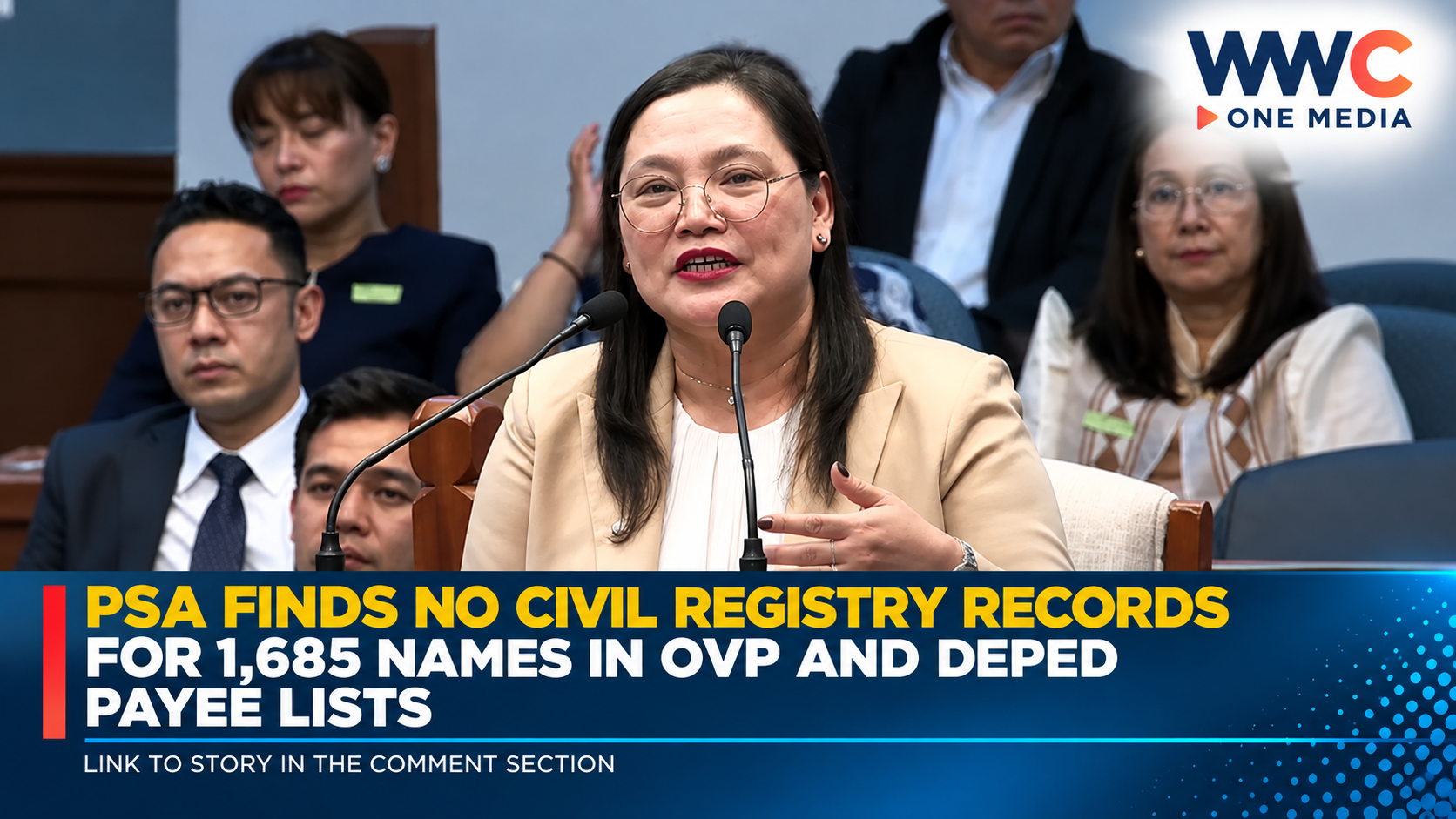
MANILA — A Philippine Statistics Authority verification has placed 1,685 names from confidential-fund payee lists of the Office of the Vice President and Department of Education under intense scrutiny, after the agency found no matching birth, marriage or death records for those names in its Civil Registry System.
The revelation came Monday, September 7, during the 22nd day of Vice President Sara Duterte's impeachment trial, as the House prosecution presented PSA Assistant National Statistician Marizza Grande as a witness.
According to the PSA testimony, the agency checked 2,669 names appearing in records connected to confidential-fund expenditures for 2022 and 2023.
Of those, 1,992 names came from the OVP list and 677 from DepEd.
The PSA found that 1,287 OVP names and 398 DepEd names—1,685 in total—had no matching birth, marriage or death record in its database.
The findings have become a major point of contention in the impeachment proceedings.
What exactly did the PSA check?
The PSA verification was not simply a visual comparison of names.
Prosecution lawyer Mae Divinagracia said the names were searched through the agency's Civil Registry System, covering three categories: birth, marriage and death records.
A name was classified as having no match when the PSA could not locate a corresponding record across those categories.
The House prosecution is using the results to challenge the credibility of acknowledgment receipts and other documents used to account for the confidential funds.
But there is an important distinction.
A name having no matching PSA record does not automatically prove that the person never existed.
The finding means the PSA could not locate a corresponding civil-registry record under the name and verification process used. Establishing whether a person was real, whether an identity was incorrectly recorded, or whether a payment was actually made to that person requires additional evidence.
That distinction is particularly important in a court proceeding where both sides are contesting the interpretation of the documents.
The numbers are raising bigger questions
The prosecution says the scale of the unmatched names raises questions about the acknowledgment receipts used to liquidate confidential-fund expenditures.
The House of Representatives, in its account of the testimony, said 1,287 of the 1,992 OVP names and 398 of the 677 DepEd names had no records across all three PSA categories.
That means the unmatched names represent a substantial portion of the lists examined.
The prosecution argues that the findings warrant closer examination of whether the individuals listed on the receipts were genuine recipients or sources of information supposedly used to justify confidential expenditures.
The defense, however, has challenged portions of the prosecution's questioning and interpretation of the PSA evidence.
Some names matched people who were already dead
The PSA testimony went beyond names with no records.
Grande also testified about single-match entries—cases where the PSA found one person in its database bearing the same name.
Among those single matches, 37 corresponded to people with death certificates, according to the House prosecution's presentation.
The breakdown was 32 names from the OVP list and five from DepEd.
Several examples were discussed during the hearing.
The prosecution identified a PSA record for Fortunato Salig, whose death certificate indicated he died in 2011.
Another single match, Emilio Sagan, corresponded to a person whose death was recorded in 2015.
A third, Rodolfo P. Traya, had a death certificate showing a 2021 date of death.
These findings are being presented by the prosecution as another reason to question the acknowledgment receipts.
But, again, a name match alone does not establish that the person named on a particular receipt was the same individual represented by the PSA record.
Then came the minors
Perhaps the most striking portion of the testimony involved names that matched birth records of minors.
The prosecution said 25 single-match names corresponded to minors—20 from the OVP list and five from DepEd.
Among the examples presented was a PSA record for Marlene Sunga, whose death certificate showed she died at only two months old in 1965.
Another OVP-listed name, Beatrice Cuenca, was linked to a birth record showing a January 2022 birth date.
A separate OVP name, Mikay de los Reyes, was linked to a birth record showing a January 2020 birth date.
The prosecution argues that such records raise questions about how the names could have appeared in acknowledgment receipts associated with confidential-fund activities.
The defense has objected to questions that, in its view, attempt to draw conclusions beyond what the PSA records themselves establish.
What does “single match” actually mean?
This is one of the most important details in understanding the PSA testimony.
Prosecution legal spokesperson Benjamin “Jay” Tolosa Jr. explained that a single match means the PSA found one person in its database with the same name as the name appearing on an acknowledgment receipt.
It does not automatically mean the PSA has established that the receipt and the civil-registry record refer to the same individual.
That distinction could become crucial as the impeachment proceedings continue.
The prosecution will have to connect the documentary evidence to the specific transactions and circumstances surrounding the confidential-fund expenditures.
The controversy centers on ₱612.5 million
The PSA evidence is being presented in connection with Article I of the impeachment case against Vice President Sara Duterte.
The House impeachment team alleges irregularities involving ₱612.5 million in confidential funds: ₱500 million associated with the OVP in 2022 and 2023 and ₱112.5 million associated with DepEd in 2023.
Duterte has denied wrongdoing, while the defense has challenged the prosecution's evidence and arguments during the proceedings.
The impeachment trial is ongoing, meaning the allegations remain contested.
The names are not the only controversy
The latest PSA testimony comes amid a much broader debate over confidential funds, liquidation documents and the government's ability to verify individuals identified as recipients or sources of information.
The Philippines has also been dealing with separate concerns over the integrity of civil-registration systems.
Earlier this year, the National Bureau of Investigation said it had uncovered suspected fraudulent birth registrations involving more than 50,000 potentially fraudulent birth records across more than 1,600 civil registry offices, although that matter is separate from the OVP and DepEd confidential-fund case.
That broader issue underscores why civil-registry verification can be complicated.
A missing record is not automatically proof of a fabricated identity, just as the existence of a record does not by itself prove that a particular financial transaction was legitimate.
What the PSA findings could mean for the impeachment case
The prosecution is attempting to use the PSA evidence to establish a pattern of questionable names in the records supporting confidential-fund liquidation.
The 1,685 names without birth, marriage or death records are therefore likely to remain a major focus of the proceedings.
But the ultimate significance of the evidence will depend on how the Senate impeachment court weighs it alongside other testimony, documents and arguments from both sides.
The defense will have an opportunity to challenge the methodology, relevance and interpretation of the PSA findings.
That makes the next phase of the trial particularly important.
A finding that raises questions—but is not the final verdict
The PSA testimony has produced one of the most dramatic moments of the impeachment proceedings so far.
1,685 names had no matching birth, marriage or death record in the PSA database.
Thirty-seven other listed names matched people with death certificates, while 25 matched birth records of minors.
For prosecutors, the figures strengthen allegations of irregular confidential-fund liquidation.
For the defense, the key question will be whether those database findings can be reliably connected to specific transactions and used to establish the allegations being made against the Vice President.
The Senate impeachment court—not the PSA, the prosecution or the headlines—will ultimately determine what evidentiary weight these findings deserve.
And as the trial moves forward, the biggest question is no longer simply who appeared on the lists—but whether the government can prove who actually received, provided or accounted for the money behind them.