
Shawn Loh Says He’ll Listen First on Healthcare Costs and School Stress — But the Toughest Decisions Are Still Ahead

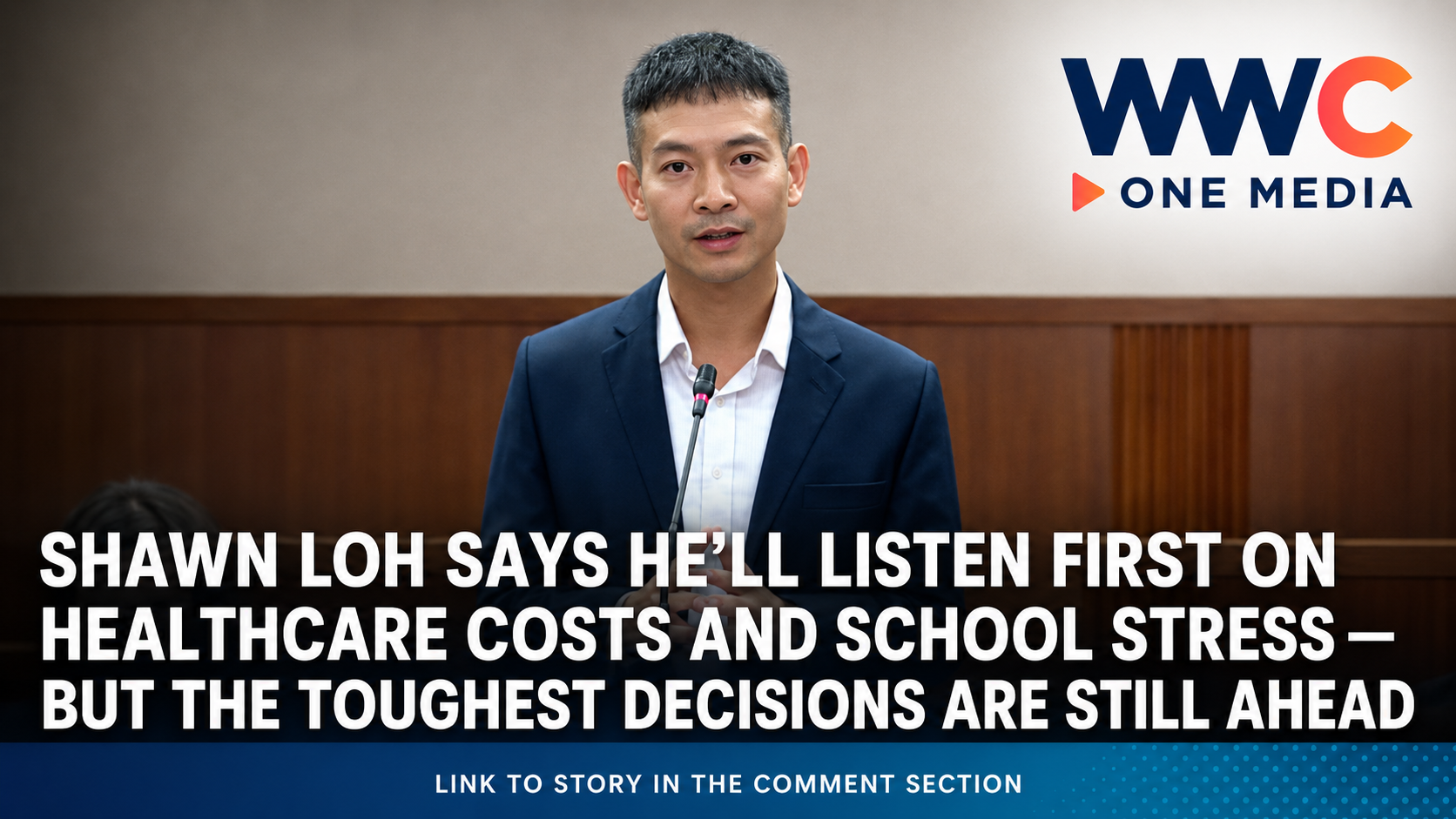
SINGAPORE — Incoming Minister of State Shawn Loh is not entering Singapore’s Education and Health ministries with a ready-made list of sweeping reforms. Instead, he says he wants to listen first.
But the issues already landing on his desk are anything but small.
Healthcare affordability for ageing Singaporeans. Academic pressure on children. Caregiving stress among middle-aged families. The impact of artificial intelligence on how students learn. And, looming behind them all, the difficult question of how Singapore keeps two massive public systems affordable, effective and sustainable at the same time.
Loh, the Jalan Besar GRC MP who will become Minister of State for both Education and Health on January 1, 2027, told CNA that he is deliberately holding back from prescribing solutions before hearing more from Singaporeans and the professionals responsible for delivering government policy.
His message is straightforward: listen before deciding — but do not confuse listening with avoiding difficult decisions.
That distinction could become increasingly important.
Healthcare Costs Are Already Coming Up at the Doorstep
Loh represents Whampoa, a ward where older residents live alongside younger families moving into newer Build-to-Order developments.
That mix gives him a street-level view of two demographic pressures Singapore is confronting simultaneously.
Some elderly residents, Loh told CNA, worry about healthcare expenses because their retirement savings have lasted less comfortably than expected. The uncertainty is not merely about today's medical bill, but about how many more years of treatment and care may still lie ahead.
The concern comes as Singapore's population rapidly ages.
The Ministry of Health said in March that more than 20 per cent of Singapore citizens are aged 65 and above, describing the country as a super-aged society and placing greater emphasis on keeping healthcare affordable while maintaining the long-term sustainability of the system.
The Straits Times has similarly highlighted the demographic transformation, noting that roughly a quarter of Singaporeans are expected to be 65 or older by 2030.
That means healthcare affordability is unlikely to be a temporary political concern.
It is becoming a structural one.
The government has continued adjusting subsidies, MediSave rules and support for outpatient and long-term care. Among the upcoming changes, MOH plans enhancements to MediSave support for chronic and preventive care from January 2027 — the same month Loh enters the ministry.
For the incoming Minister of State, therefore, the challenge will extend beyond simply making healthcare cheaper.
Singapore must balance affordability for patients with rising demand, an ageing population, manpower constraints and the financial sustainability of the healthcare system itself.
Then There Is Singapore’s Education Pressure Cooker
The second half of Loh's portfolio may be just as politically sensitive.
Parents he has met have raised concerns about excessive stress in Singapore's education system.
Loh acknowledged that some pressure can help children grow, but argued that unnecessary stress can eventually undermine something more important: a child's desire to learn.
That concern is increasingly relevant in an era when artificial intelligence can provide information almost instantly. Loh's argument is that curiosity and the willingness to continue learning may become more valuable than simply accumulating knowledge for examinations.
And the anxiety surrounding school performance is not anecdotal.
Psychologists interviewed by CNA earlier in 2026 reported seeing increases of as much as 20 per cent a year since 2021 in students seeking professional help for examination-related stress. Some practitioners said the pressure is becoming increasingly self-imposed rather than coming exclusively from parents.
The Straits Times has also reported that reducing unhealthy competition has become part of the wider national conversation about education.
At an Education Ministry engagement session in June, participants discussed Singapore's fixation on grades, alternative pathways for students and how the system could reduce unnecessary stress while continuing to maintain high standards. Education Minister Desmond Lee has also spoken about moving away from treating education simply as a competition.
That creates a difficult policy puzzle.
Singapore's education system is internationally recognised partly because it is rigorous.
But how much pressure is productive — and when does that pressure become counterproductive?
That may prove far harder to answer than simply removing an examination or changing a scoring system.
Loh Is Also Experiencing These Pressures as a Parent
Loh's interest in both portfolios is not purely institutional.
He is a father of four, with children currently spread across secondary school, primary school and childcare. He also has ageing parents.
That places him within what is increasingly becoming Singapore's “sandwich generation” — adults simultaneously raising children while preparing for, or already taking on, greater responsibility for elderly parents.
Loh told CNA this has given him first-hand exposure to both the education and healthcare systems as well as an understanding of the caregiving pressures facing people around his stage of life.
Singapore's ageing trend makes that issue increasingly consequential. The Straits Times reported in May that the share of informal caregivers among adults aged 67 and above had risen from 6 per cent in 2019 to 7.4 per cent in 2023-2024, illustrating how elderly Singaporeans themselves are increasingly caring for other seniors.
Why Is He Starting Only in January?
Loh's January 2027 start is later than several other appointments announced during Prime Minister Lawrence Wong's July Cabinet reshuffle.
The reason, according to Loh, was practical.
He asked Wong for additional time so he could oversee a leadership transition at Commonwealth Capital Group, the Singapore-based business where he serves as group managing director. CNA and Mothership reported that the delayed start was approved to allow him to complete that handover.
Before entering politics, Loh had also spent years in Singapore's public service.
His previous roles included work at the Ministry of Finance, Economic Development Board and Prime Minister's Office. He was also Singapore's Budget director for the 2024 and 2025 Budgets before moving back into the private sector.
Prime Minister Wong's July reshuffle brought Loh and fellow first-term MP Foo Cexiang into political office as part of a wider leadership renewal. Business Times and Mothership described the changes as another step in Singapore's transition towards a newer generation of political leaders.
Listening First — Then Comes the Hard Part
Perhaps the most revealing part of Loh's interview was not what policy he wants to introduce.
It was his acknowledgement that government sometimes has to act without perfect information.
He said he is prepared to support calculated risks rather than automatically preserve the status quo, and that being willing to make difficult trade-offs will be part of the job.
He also said Singaporeans should expect him to explain the reasoning behind decisions — including occasions when people disagree with them.
That could ultimately become the real test of his “listening approach”.
Listening is politically attractive when everyone agrees on the problem.
The challenge begins when the solutions create winners, losers, costs and compromises.
Singapore wants healthcare that remains affordable without becoming fiscally unsustainable. It wants an education system that continues producing strong outcomes without exhausting children and parents. It wants to support an ageing population without placing an impossible burden on younger workers and caregivers.
Those goals are easy to support individually.
Reconciling them is considerably harder.
And when Shawn Loh formally walks into the Education and Health ministries on January 1, the listening phase may only be the beginning.
WWC ONE MEDIA MJE