
Singapore’s Green Flight Charge Is Coming in 2027 — Here’s How Much Passengers Could Pay

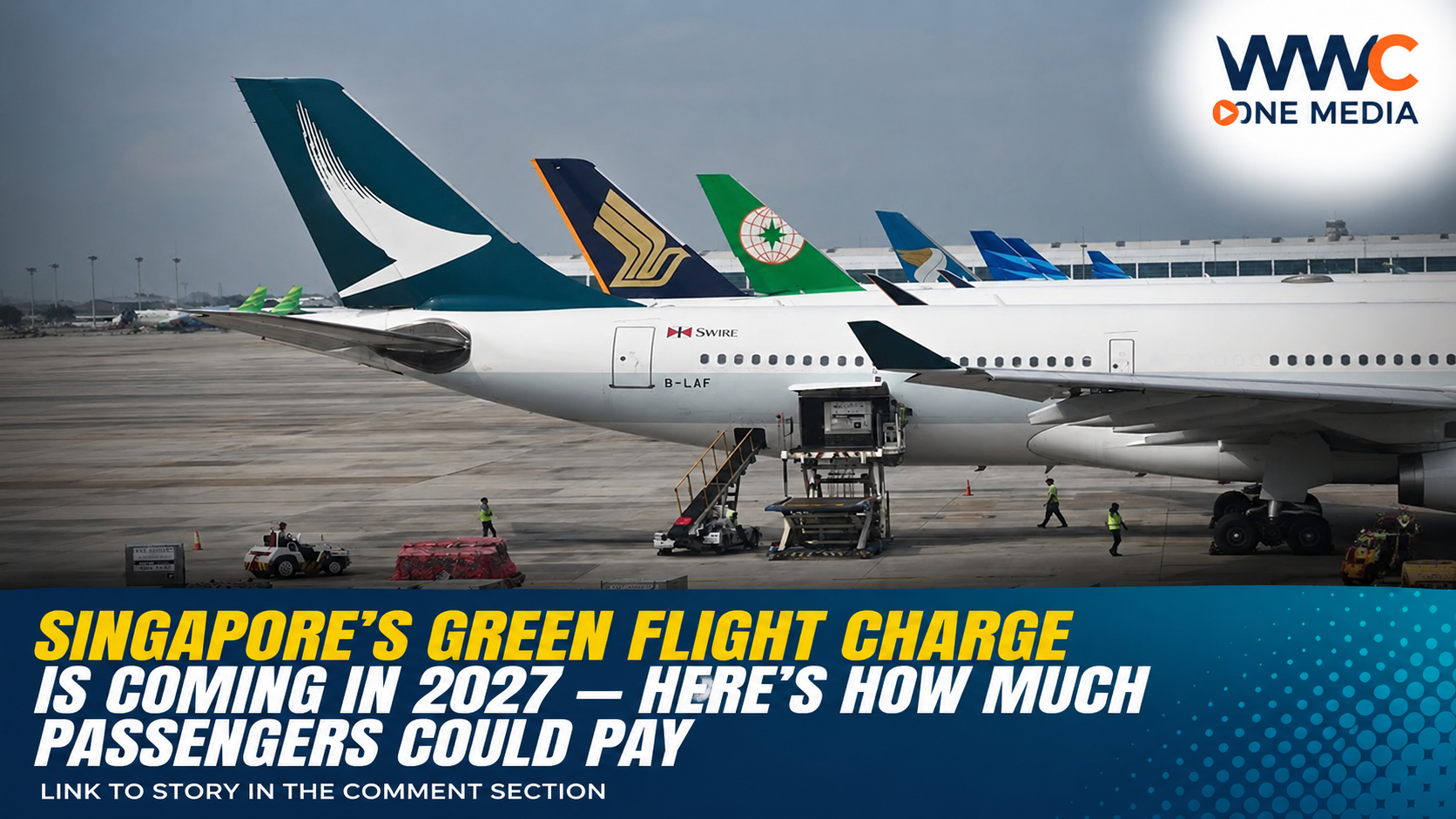
Singapore is moving ahead with a new Sustainable Aviation Fuel (SAF) levy that will add a separate charge to air tickets for passengers departing the country from January 2027, as the city-state pushes to cut aviation emissions while building a regional SAF industry.
The Civil Aviation Authority of Singapore (CAAS) confirmed on September 3 that the levy will apply to origin-destination passengers and general and business aviation flights departing Singapore from January 1, 2027. Tickets and services sold from October 1, 2026 will be subject to the charge.
The move means travellers booking flights out of Singapore from October could begin seeing the SAF levy listed separately in their fare breakdown.
How much will travellers pay?
The amount depends on the destination and cabin class.
| Destination band | Economy / Premium Economy | Business / First |
|---|---|---|
| Band I | S$1.00 | S$4.00 |
| Band II | S$2.80 | S$11.20 |
| Band III | S$6.40 | S$25.60 |
| Band IV | S$10.40 | S$41.60 |
The four bands broadly increase with travel distance, meaning longer flights generally carry a higher levy. The most expensive passenger charge will be S$41.60 for premium-cabin travel to Band IV destinations, which includes the Americas.
For flights involving multiple stops, the levy is based on the immediate destination after departure from Singapore.
Transit passengers are not subject to the levy.
Where will the money go?
The levy is not simply another airport or airline fee.
Under Singapore's SAF framework, the money will flow into a statutory SAF Fund, which will be used to purchase sustainable aviation fuel and associated environmental attributes, as well as cover related administrative costs.
Collection and procurement will be managed by the Singapore Sustainable Aviation Fuel Company (SAFCo), a non-profit entity wholly owned by CAAS.
SAFCo will aggregate demand and conduct centralized procurement, with the first levy-funded SAF procurement request for proposals expected by the end of 2026. The first batch of fuel is expected to be delivered in mid-2027.
Singapore is starting small — but has bigger ambitions
Singapore has set a 1% SAF uplift target for 2027, with plans to raise this to 3%–5% by 2030, depending on global developments and the availability of SAF.
SAF can be produced from sustainably sourced materials such as used cooking oil, biomass waste and other feedstocks. Unlike some future aviation technologies, it can be blended with conventional jet fuel and used in existing aircraft and fuel infrastructure. IATA estimates that SAF could eventually account for up to 65% of the emissions reductions needed for aviation to reach net zero by 2050.
But there is a major challenge: SAF remains far more expensive than conventional jet fuel and is still produced in very small quantities globally.
IATA estimates global SAF production will reach around 2.4 million tonnes in 2026, representing only about 0.8% of aviation fuel consumption. The industry association has warned that production needs to expand dramatically if aviation is to meet its long-term climate goals.
Air cargo gets more time
Singapore has also changed the timetable for the aviation industry.
The SAF levy for air cargo shipments has been postponed by one year following industry feedback.
It will now apply to services sold from October 1, 2027, for cargo flights departing Singapore from January 1, 2028.
CAAS said cargo operations are considerably more complicated than passenger operations because they involve airlines, freight forwarders, shippers and different commercial arrangements. The additional year will allow authorities and industry players to develop a more robust collection system.
Why the change matters
The SAF levy comes as Singapore seeks to maintain its position as a major international aviation hub while reducing the environmental impact of air travel.
The levy was originally supposed to begin earlier, but CAAS postponed implementation in March 2026 amid the impact of the Middle East conflict on airlines and passengers. The revised schedule pushed the passenger levy to January 2027.
The charge itself is relatively small compared with the total price of an international flight. But the policy represents a significant shift: passengers will increasingly become part of the financing mechanism for aviation's transition toward lower-carbon fuels.
The bigger question is whether the new system can help create enough demand and investment to bring SAF costs down — without making air travel significantly more expensive.
Singapore is betting that a relatively modest levy today can help build the fuel infrastructure needed for a much larger transformation tomorrow.
WWC ONE MEDIA J.M.D