
Singapore’s Haze Just Eased — But the Smoke Threatening the City May Not Be Over Yet

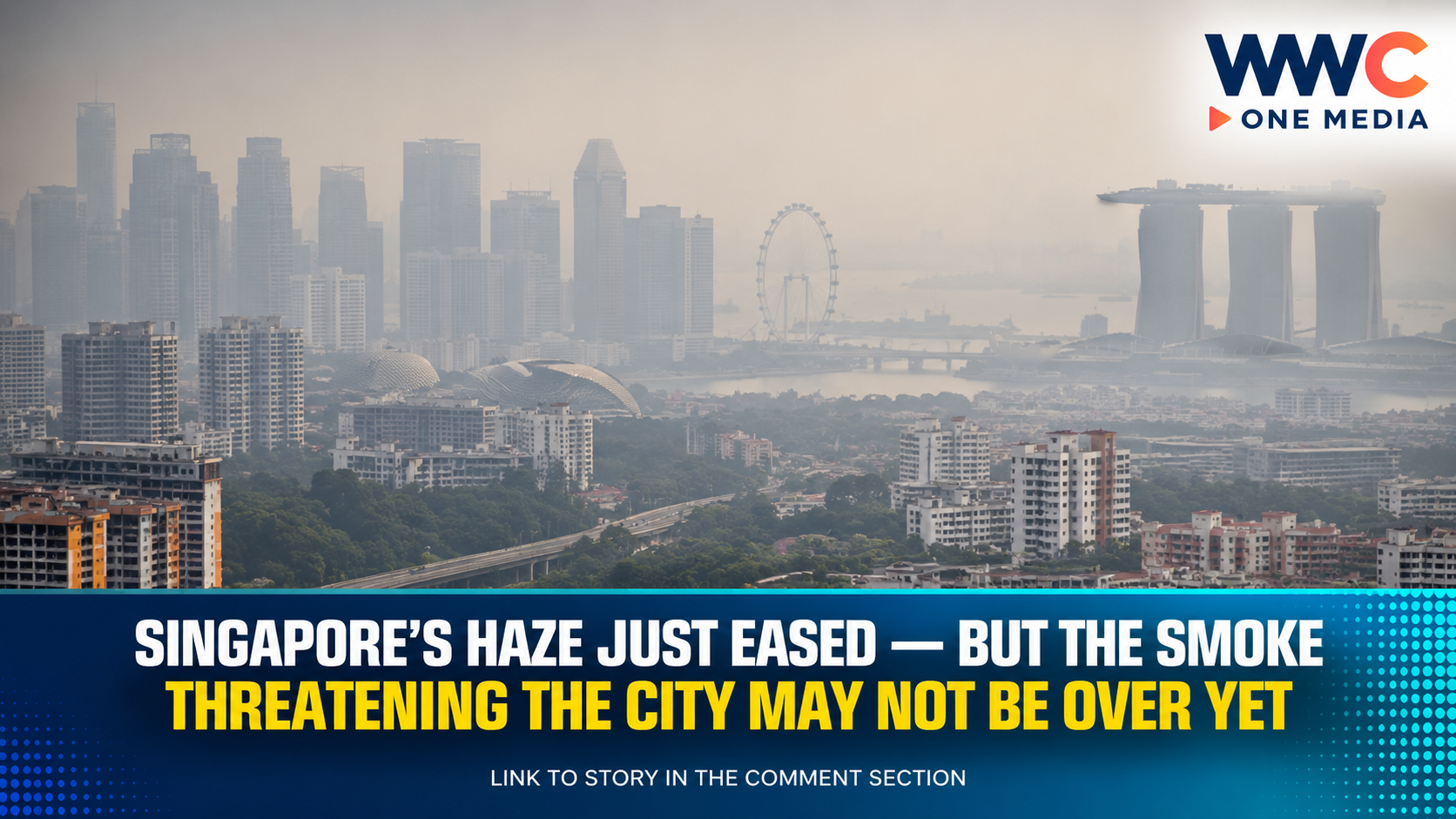
Singapore’s air quality improves after unhealthy haze levels — but regional fires remain a threat
Singapore's air quality has improved after several parts of the city-state briefly entered the unhealthy range, but authorities are warning that transboundary haze could persist as dry conditions continue across parts of Southeast Asia.
By Saturday night, all five regions of Singapore had returned to the moderate range. The central region's 24-hour Pollutant Standards Index (PSI) stood at 96 at 10pm, after reaching a high of 123 at 1am.
The improvement comes after a worrying start to the day.
At 6am on Saturday, the 24-hour PSI had reached 120 in central Singapore, 103 in the west and 102 in the east, putting all three areas in the unhealthy category.
The unhealthy readings followed Singapore's first haze-related breach of the PSI 101 threshold since October 2023.
What caused the haze?
Singapore's authorities have linked the deteriorating air quality to transboundary smoke from fires in Indonesia.
Singapore's Meteorological Service said smoke plumes from fires in southern and central Sumatra and parts of Kalimantan were observed drifting toward Singapore. With dry weather expected to continue, the country could remain vulnerable to haze if the fires persist and winds continue blowing from the south or southeast.
The ASEAN Specialised Meteorological Centre has also been monitoring elevated hotspot and smoke activity across the region.
The wider situation is serious. ABC News reported that Indonesian fire-monitoring data showed more than 202,000 hectares had burned across Indonesia between the start of 2026 and June, with almost 95,000 hectares recorded in July alone.
Singapore is not the only country being hit
The haze problem extends well beyond Singapore.
Malaysia has experienced significantly more severe conditions in parts of Borneo. Al Jazeera reported that authorities declared a state of emergency in Serian, Sarawak, after air pollution reached hazardous levels.
Other reports have documented smoke affecting parts of Malaysia, Indonesia and neighboring areas, highlighting how quickly regional fires can become a cross-border environmental problem.
Indonesia has also been battling extensive fires during an exceptionally dry period. Reuters reported that wildfires had spread toward the area surrounding Nusantara, Indonesia's new capital, with authorities deploying aircraft for water-bombing and cloud-seeding operations.
What does the PSI actually mean?
Singapore's 24-hour PSI is calculated using several pollutants, including PM2.5, PM10, ozone, sulphur dioxide, nitrogen dioxide and carbon monoxide.
A PSI reading of 101 to 200 is classified as unhealthy, while 201 to 300 is very unhealthy and readings above 300 are hazardous.
The most important pollutant during haze episodes is often PM2.5 — extremely fine particles capable of penetrating deep into the lungs.
Singapore's authorities therefore distinguish between the 24-hour PSI, which is useful for planning activities, and the 1-hour PM2.5 reading, which provides a more immediate picture of current exposure.
What Singapore is telling residents
Singapore's Haze Task Force has activated precautionary measures as authorities continue monitoring conditions.
The National Environment Agency advises people to reduce prolonged or strenuous outdoor activity when the PSI reaches unhealthy levels. Vulnerable groups — including children, older adults, pregnant women and people with chronic heart or lung conditions — are advised to take greater precautions.
The government has also advised people to stay hydrated and ensure necessary medication is readily available if they have chronic conditions.
Importantly, authorities say N95 masks are generally not required for short outdoor exposure such as commuting when air quality is not hazardous. Their use becomes more relevant during prolonged outdoor exposure at very high pollution levels, particularly for vulnerable people.
The good news — and the warning
For now, Singapore has avoided a prolonged spell of unhealthy air.
The latest readings show that conditions improved across all five regions, a significant change from the unhealthy readings recorded earlier Saturday.
But the underlying source of the problem has not disappeared.
The fires are still burning, dry weather is expected to continue, and prevailing winds could once again push smoke toward Singapore. Singapore's authorities have therefore continued issuing daily haze advisories to help residents plan outdoor activities.
That leaves Singapore facing an uncomfortable question:
Was Saturday's improvement the beginning of the end of this haze episode — or simply a temporary break before the smoke returns?
For now, the air is better.
But Southeast Asia's fires are still being watched closely.
WWC ONE MEDIA M.J.E