
Singapore’s New Green Flight Charge Is Coming in 2027 — But Air Cargo Just Got a One-Year Reprieve

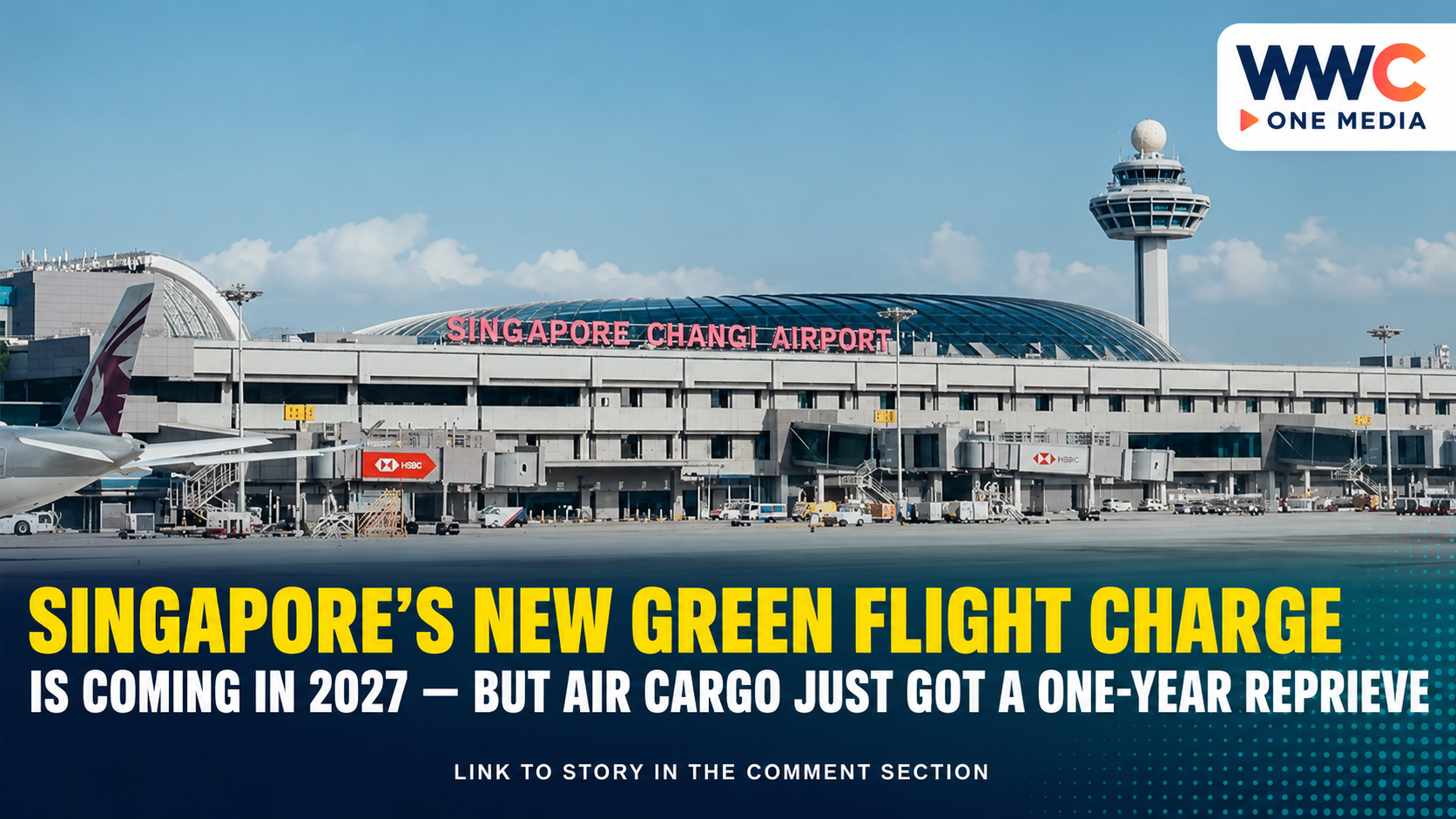
Singapore is pressing ahead with its sustainable aviation plans, but air-cargo operators have been given another year to prepare for a new green levy.
The Civil Aviation Authority of Singapore (CAAS) announced on September 3 that the Sustainable Aviation Fuel (SAF) levy for air cargo will be deferred by one year, following feedback from industry players. The cargo levy will now apply to services sold from October 1, 2027, for flights departing Singapore from January 1, 2028.
For passengers, however, the timeline remains unchanged.
✈️ Travellers will start paying from January 2027
Passengers departing Singapore will have to pay the SAF levy for tickets sold from October 1, 2026, when the corresponding flights depart Singapore from January 1, 2027.
The charge will appear as a separate line item on the fare breakdown, making it clear how much of the ticket price is being collected for the SAF programme. The same January 2027 start date applies to general and business aviation flights.
The passenger levy ranges from S$1 to S$41.60, depending on destination and cabin class:
| Destination band | Economy / Premium Economy | Business / First |
|---|---|---|
| Southeast Asia | S$1.00 | S$4.00 |
| Northeast Asia, South Asia, Australia & Papua New Guinea | S$2.80 | S$11.20 |
| Africa, Europe, Middle East & other Band III destinations | S$6.40 | S$25.60 |
| Americas | S$10.40 | S$41.60 |
For example, an economy passenger flying from Singapore to Bangkok would pay S$1, while a passenger travelling to Tokyo would pay S$2.80. A flight to London falls under Band III at S$6.40, while New York is in Band IV at S$10.40.
Passengers transiting through Singapore are not subject to the levy because the charge applies to origin-destination passengers departing Singapore.
📦 Why is cargo getting more time?
CAAS said cargo operations are considerably more complicated than passenger operations.
The cargo sector involves a wider network of players, including airlines, express operators, freight forwarders and shippers, with different commercial arrangements. The additional year will allow CAAS to work with industry stakeholders on a robust system for calculating, collecting and administering the levy.
This is particularly significant for Singapore, given the importance of Changi as a regional aviation and air-cargo hub.
The original plan had called for the SAF levy to cover both passengers and cargo. CAAS previously postponed the broader SAF levy rollout in March 2026 amid the impact of the Middle East conflict on airlines and passengers. At that time, the implementation was moved from tickets and services sold from April 2026 to October 2026, with flights departing from January 2027.
🌱 Where will the money go?
The SAF levy is designed to finance Singapore's transition toward greater use of sustainable aviation fuel.
Revenue collected will go into a statutory SAF Fund, which will be used to purchase SAF and related environmental attributes, as well as cover associated administrative costs.
CAAS has appointed the Singapore Sustainable Aviation Fuel Company (SAFCo) to handle levy collection and the procurement, management, accounting and allocation of SAF and its environmental attributes.
Singapore is targeting a 1% SAF uplift from 2027, with an ambition to increase the target to 3%–5% by 2030, depending on global developments and the availability of SAF.
⛽ Why SAF matters
Sustainable aviation fuel is designed as a lower-carbon alternative to conventional jet fuel and can be produced from sources such as waste-derived feedstocks.
CAAS says SAF can reduce carbon dioxide emissions by up to 80% compared with conventional aviation fuel, depending on the feedstock and production pathway. It can also be used within existing aviation infrastructure and aircraft systems, making it one of the key options for reducing aviation emissions.
Singapore's approach is based on a fixed-cost-envelope model, intended to give airlines and passengers greater cost certainty rather than allowing the levy to fluctuate directly with SAF prices. The Ministry of Transport previously said the levy quantum announced by CAAS would remain unchanged despite changes in fuel prices, with the SAF uplift adjusted if necessary.
🇸🇬 What happens next?
The immediate change is straightforward:
Passengers: SAF levy begins for flights departing Singapore from January 1, 2027, with tickets sold from October 1, 2026.
Air cargo: levy gets an additional year, beginning for services sold from October 1, 2027, covering flights departing from January 1, 2028.
The move gives Singapore's aviation industry more time to build the systems needed for cargo collection while keeping the passenger rollout on track.
The bigger question now is whether Singapore's SAF framework can scale quickly enough — and affordably enough — to meet the country's longer-term aviation decarbonisation ambitions.
WWC ONE MEDIA MJE