SSS Members Can Now Borrow Up to ₱20,000 Through UnionDigital — But Check What You’ll Actually Receive Before Accepting

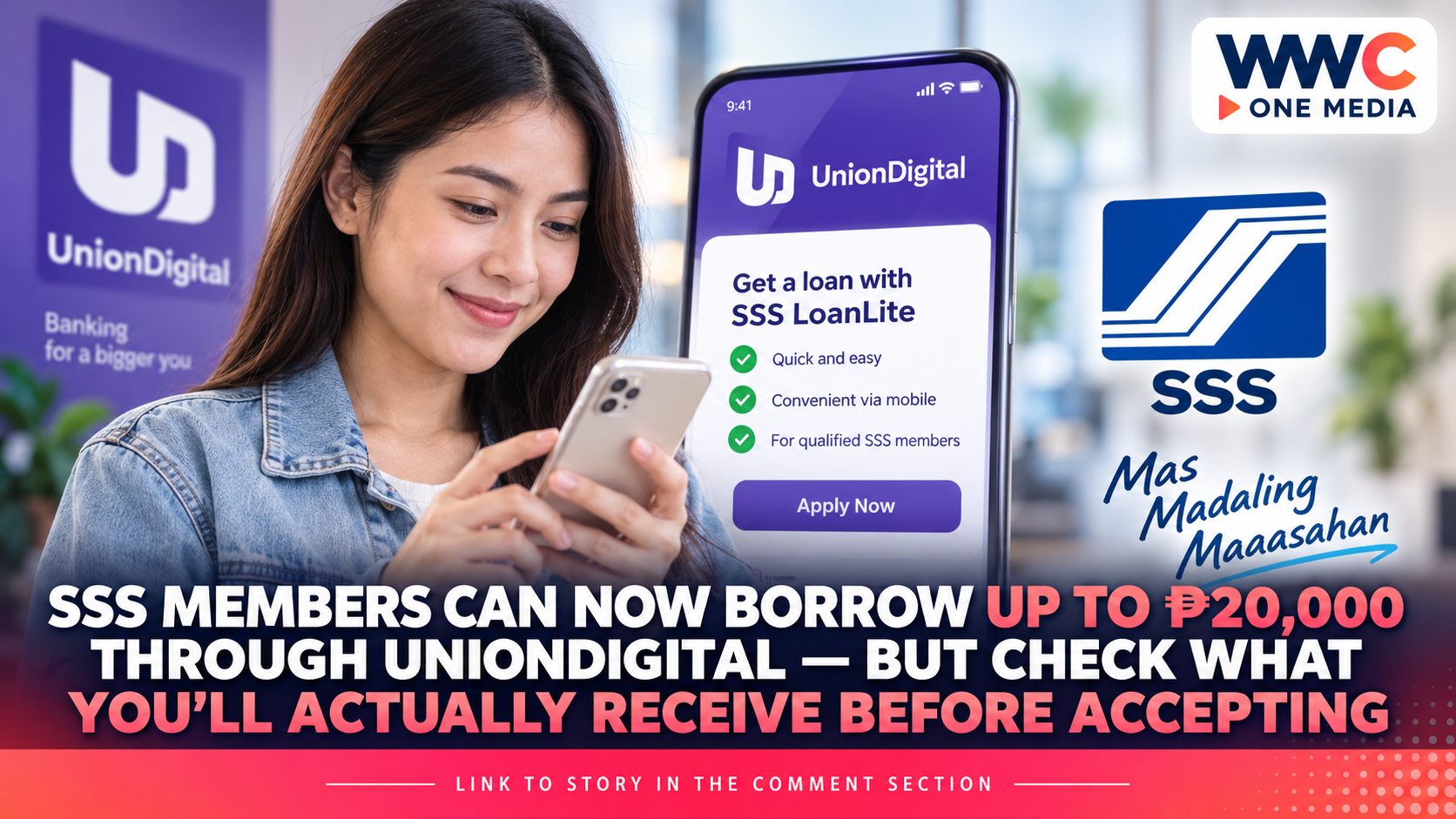
A new borrowing option has opened for millions of Social Security System members—but anyone tempted by the promise of quick digital cash should look closely at the amount, fees and repayment deadline before tapping “accept.”
UnionDigital Bank has become the first participating financial institution to make the SSS Micro Loan Program, known as SSS LoanLite, available through its mobile app, expanding access to short-term loans for qualified Filipino workers, self-employed members, voluntary contributors and overseas Filipino workers.
The rollout gives eligible members access to ₱1,000 to ₱20,000, depending on their SSS records and applicable program rules, with repayment terms as short as 15 days and as long as 90 days.
But the headline ₱20,000 figure is only the maximum.
Not every applicant will qualify for that amount—and the cash deposited into a borrower’s account can be lower than the approved principal because applicable interest and fees may be deducted from the proceeds.
UnionDigital becomes SSS LoanLite’s first digital rollout partner
UnionDigital Bank, the digital banking arm of Union Bank of the Philippines, is the first participating financial institution to activate LoanLite through its mobile application, according to both SSS and independent reports.
Other financial institutions identified for the program include RCBC, Land Bank of the Philippines and UnionBank, with their respective platforms expected to participate as their systems become ready.
The expansion is significant because it moves a government-linked lending facility deeper into mobile banking, allowing qualified members to apply without visiting an SSS branch or obtaining employer certification.
SSS describes LoanLite as a short-term facility intended for immediate needs including emergency expenses, medical costs, education, household necessities and small-business requirements.
How much can SSS members borrow?
Under the current program, qualified borrowers may receive loans ranging from:
₱1,000 to ₱20,000
The maximum amount available to an individual borrower is not automatically ₱20,000. GMA News reported that the amount depends in part on the member's latest Monthly Salary Credits and applicable SSS program guidelines.
Members may choose repayment periods of:
15 days, 30 days, 60 days or 90 days.
That makes LoanLite fundamentally different from a traditional multi-year consumer loan. It is designed as short-duration credit for relatively small and immediate expenses.
The interest rate—and the detail borrowers should not overlook
LoanLite carries an 8% annual interest rate, equivalent to roughly 0.67% per month, according to GMA News and InsiderPH.
But interest is not necessarily the only cost.
GMA News reported that participating financial institutions may impose a service fee of up to ₱200 per loan transaction, plus an add-on fee subject to the program limit. Applicable charges are deducted from the loan proceeds.
That means a borrower approved for a particular loan amount should not assume that the exact same amount will arrive as spendable cash.
UnionDigital borrowers are shown their approved loan amount, net proceeds and repayment schedule before accepting the offer, according to InsiderPH.
That disclosure may be the most important screen in the entire application process.
Borrowers should compare what they will actually receive against what they will have to repay—and check the due date carefully, particularly for a loan with a term of only 15 or 30 days.
Who can qualify for SSS LoanLite?
The program is available to eligible employed, self-employed, voluntary and OFW members.
SSS says applicants must be at least 18 years old when applying and below 65 at the end of the loan term.
They must also have at least 12 posted monthly SSS contributions, no past-due short-term member loan, no active restructured loan, no pending or settled final benefit claim such as retirement or permanent total disability, and no fraud record with SSS.
Applicants also need an account enrolled with a participating financial institution.
For UnionDigital applicants, access is through the bank's app, with approved net proceeds credited directly to a UD Save account.
How borrowers repay the loan
UnionDigital customers may fund their UD Save account before the payment date so the amount can be collected through automatic debit.
Payments may also be made using supported bank-transfer channels such as InstaPay or PESONet, according to InsiderPH.
SSS also says repayments under LoanLite may be handled through auto-debit arrangements, online bills payment, bank or e-wallet transfers and other channels supported by participating institutions.
Borrowers may apply for another LoanLite loan after fully paying an existing one.
Early repayment is also allowed, although SSS says borrowers should not expect an interest rebate simply because the debt is settled ahead of schedule.
Why SSS is pushing smaller digital loans
The program comes as SSS expands financial assistance and digital services amid inflation, energy costs and broader financial pressure on Filipino households.
As of July 2026, SSS reported 44.25 million covered members, including employees, self-employed workers, voluntary contributors and OFWs. The pension fund also reported ₱235.33 billion in member contributions and ₱205.56 billion in benefits released from January through July.
LoanLite represents a relatively small piece of that enormous social-security system, but its design targets a very different problem: the need for quick, small-value credit.
Instead of forcing borrowers seeking a few thousand pesos toward informal lenders or high-cost digital borrowing channels, SSS is attempting to provide a regulated alternative distributed through participating financial institutions.
Still, “accessible” should not be confused with “free.”
What SSS members should check before borrowing
The smartest way to evaluate LoanLite is not to focus only on the ₱20,000 maximum.
A borrower should look at the actual approved amount, net cash proceeds after deductions, total repayment obligation and exact due date.
This matters even more because the shortest loans mature quickly, and SSS warns that unpaid balances can continue accumulating applicable interest and penalties.
For members facing a genuine short-term emergency, LoanLite could offer another regulated source of financing without requiring a trip to a branch.
But the real value of the program will depend on whether borrowers use it for genuinely temporary cash needs—and whether they understand the full cost before accepting the money.
The ₱20,000 ceiling may grab attention. The more important number is the one displayed under “net proceeds”—and the date beside “payment due.”
WWC ONE MEDIA M.J.E