
Taipei Night-Market Dates: 6 Ways to Read Whether This Is Casual or a Family Introduction
Taipei night-market dates at Shilin or Raohe: six ways to tell casual from a family introduction — MRT, who pays, cousin, Line.

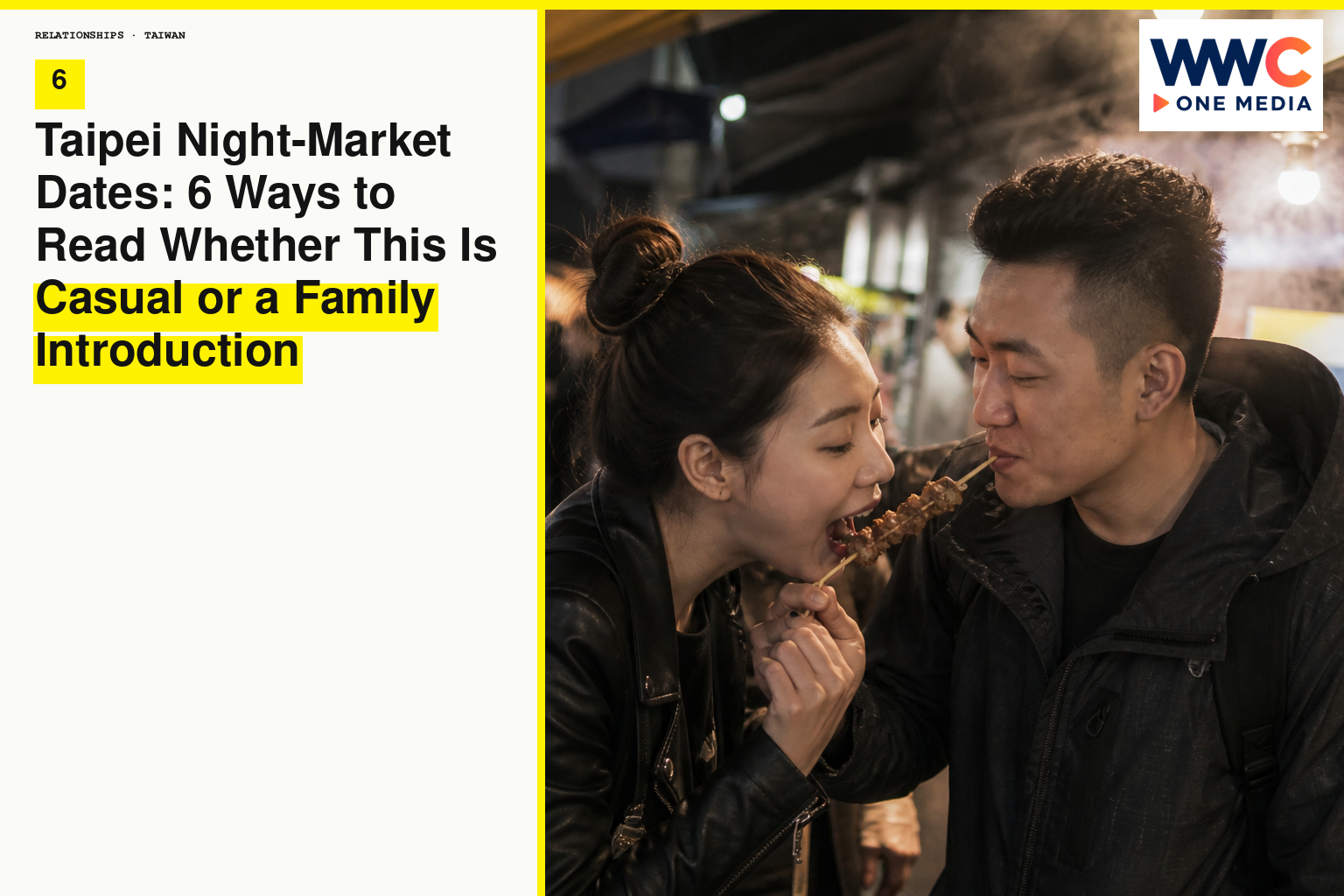
TAIPEI, Taiwan — A Taipei night-market date looks like street food and a cheap evening. It is also one of the easier places in this city to smuggle a screening. Shilin on a Saturday, Raohe under the Songshan temple lights, a Tuesday Ningxia with almost no tourists: same format, different job. You can walk the stalls for two hours and still not know whether you are a fun person with an appetite or a candidate being walked past someone who will report home.
Read the night with six checks, not with a vibe. The market they chose, who pays, the cousin who appears by accident, the MRT last train, Line stickers versus a real next plan, and whether this evening is being described to a parent as “a friend” or as a name. None of these are personality tests. They are logistics. Taipei night-market dates hide in logistics.
1. Which market they booked is already a sentence
Shilin Night Market, off Jiantan on the Tamsui–Xinyi line, is the loud option. Tourists, student packs, a maze that rewards people who like being seen without having to sit still. If they suggest Shilin and only Shilin, that can mean they want noise as cover. It can also mean they do not want a table conversation. A casual date loves a crowd. A family introduction sometimes loves a crowd too, because a relative can “bump into” you without looking like a sit-down interview.
Raohe Night Market, Songshan, under the temple and the covered stretch, is shorter, denser, easier to complete in a loop. You finish it. You either add a second stop or you go home. Couples who are actually dating often pick Raohe because it has a beginning and an end. Families who want a look sometimes pick it because you cannot disappear into a side alley for forty minutes.
Ningxia, in Datong, is the weekday local. Fewer costumes, more regulars, a walk that feels like a neighbourhood rather than a postcard. If they take you there on a Tuesday after work, pay attention. That is closer to their actual life than a Saturday Shilin selfie. A family introduction on a Tuesday at Ningxia is rarer. Relatives have jobs. If a relative still shows up on a Tuesday, that is not an accident.
Huaxi, the older snake-alley strip near Longshan Temple, is a different register. Some Taipei people treat it as a curiosity walk, not a date. If they take you there first, ask — gently, later — why. Curiosity is fine. Using a slightly grim tourist stretch as a test of whether you “can handle Taiwan” is not a date. It is a performance.
The tell is not which market is “better.” The tell is whether they named a reason. “Shilin because you said you have not been” is hosting. “Let’s just go, whatever” with no station, no time, no rain plan is low effort. “Raohe, then I want you to meet my cousin who lives near Songshan” is already the family introduction, even if they laugh when they say cousin.
Write the plan in Line before you leave your building. Station, exit if they know it, a time that is not “after dinner sometime.” Taipei night-market dates that stay casual can still be specific. Vagueness is not romance. Vagueness is how you end up waiting at the wrong Jiantan exit while they are already eating pepper buns with someone you have not been told about.
2. Who pays, and how they make the paying look accidental
Night markets are a stack of small bills. Pepper bun, sausage, a drink, a second drink, the thing you did not plan to try. That stack is useful. It lets people hide a policy inside a sequence of “I’ll get this one.”
Casual often looks like a messy split. You grab the first stall, they grab the second, someone forgets the third, nobody makes a speech. Family-introduction energy sometimes looks like they insist on paying everything, then watch how you receive it. Gratitude that is too large can read as gold-digging. Gratitude that is too small can read as rude. You are not in a drama. You are in a food lane. Say thank you, offer the next stall, and do not narrate a philosophy of gender.
The EasyCard is not a personality. If they tap for both of you on the MRT and then also try to cover every skewer, notice whether they will let you cover anything. A person who will not let you pay for a drink may be generous. They may also be building a story they will tell at home: I hosted, they were polite, they did not fight me at the till. That story is not evil. It is a report. You should know you are in a report.
Cash still matters at a lot of stalls. If you arrived from Manila or Singapore with only a card, say so on the way, not at the window. There are ATMs near the bigger markets. There is also the embarrassment of holding up a line while you fumble a translation app. Casual dates survive that. A family screening remembers it.
Do not keep a mental spreadsheet of every NT dollar and then present it at Songshan Station as a closing argument. Do keep a private sense of whether the night was hosted, shared, or extracted. Hosted: they planned, they paid more, they still let you contribute. Shared: the mess of small bills. Extracted: you paid for most of it and they called it “going with the flow.” Extraction is not a family introduction. It is a cheap evening on your card.
If a parent or an auntie is theoretically “nearby,” the paying can get theatrical. Suddenly there is a rule about who must treat the guest. You do not have to fight the rule in front of the stall. You can send a Line later: next time I want to get dinner, I will pick the place. That sentence is a boundary and a next plan. It does both jobs.
3. The cousin who appears “by accident”
This is the classic Taipei night-market date move, and it is not always malicious. Families in this city, as in a lot of APAC cities, use proximity. A cousin works near Raohe. An older sister “happens” to be at Shilin with a friend. A classmate from high school is suddenly at the same pepper-bun queue. You are introduced with a smile that lasts one beat too long.
Casual: they look surprised, they keep it short, they do not rearrange the whole night around the extra person. Family introduction: the extra person walks with you, asks what you do, asks where you are from, asks whether you “like Taiwan,” then disappears to send a message. You can feel the message without seeing the phone.
You are allowed to be warm and still not give a biography. Job title, city you came from, a food you like. That is enough for a sidewalk. A cousin is not HR. If they start stacking questions — visa, salary band, church, whether your parents know — you can laugh and say you will save the interview for a table. Then actually move. Standing still in a night-market lane while being interviewed is how you become a story in a family LINE group before you have decided you want to be one.
Scripts, short:
“Nice to meet you — we’re going to keep walking, catch you later.”
“I’m [name], visiting from [city] / living near [station]. We’re on a food crawl, not a meeting.”
“I don’t do life story at a stall. Coffee another day if you want.”
If your date looks panicked that you might be rude, that is data. They invited a screening and then outsourced the awkwardness to you. If they step in and protect the evening — we will find you later, we are eating — that is also data. The second person is dating you. The first person is managing a family.
Do not interrogate the cousin. Do not try to win them. Do not drink because someone handed you a cup and called it welcome. Night markets already have enough sugar and grease. You need your judgment.
If two extra people appear, you are not on a date. You are in a small parade. You can finish one loop, take the MRT, and go home. You do not owe a second market. You do not owe a karaoke add-on in Ximending because the cousin is “still in the area.”
4. MRT last train is a relationship tell, not a transport footnote
Taipei’s metro has a last train. People who live here know it in their bones the way Manila people know the last convenient bus and Hong Kong people know the last MTR. If your date treats last train as a joke, they either do not take the MRT or they assume you will take a taxi you have not budgeted.
Casual energy often ends at a station that is convenient for both, a little earlier than the last train, with a “text me when you’re home.” Family-introduction energy sometimes stretches. One more stall. One more drink in a side street. Then a scramble at Jiantan or Songshan, and a conversation on the platform about who lives farther — Gongguan, Beitou, Nangang, a walk-up near Zhongxiao Fuxing.
Watch who walks whom. If they ride with you past their stop and then reverse, that can be care. It can also be a way of seeing your building from the outside. You do not have to invite them up. A night-market date does not convert into a house tour because the last train is close.
If they live with family — many people in Taipei still do, in a way that Manila condos and Singapore HDBs have their own versions of — the last train is also a curfew conversation that nobody wants to call a curfew. “I should be back before my dad notices the door” is not childish. It is a household. Ask, without mockery, whether they need to be home. Plan the end of the market around that, not around your desire to look spontaneous.
EasyCard on your phone or a physical card: settle it before you are at the gate with a queue behind you. Rain: Taipei rain does not care about your outfit. A convenience store poncho is not a failure of romance. Missing the train because you were performing chill in a downpour is a failure of planning.
If the plan is “we will just taxi,” name who pays and which app. A family screening that puts you in a taxi toward a neighbourhood you do not know, late, after a night of sugar, is a different risk than a shared MRT ride to a well-lit station. You can like someone and still end the night at the gate.
A practical close:
You: I’m aiming for the train before last train. I’ll walk you to [their station] / you walk me to [yours], then we stop.
If they sulk, you learned something cheaper than a month of mixed signals.
5. Line stickers versus a real next plan
Taipei dating runs on LINE the way Manila dating runs on Messenger and Seoul dating runs on KakaoTalk. Stickers are a dialect. A sticker after a night market can mean I had fun, I am shy, I do not want to use words, or I am keeping you warm while I see other people. You cannot prosecute a sticker. You can ask for a plan.
Casual that wants to stay casual loves stickers and open loops. “We should go again sometime.” Sometime is not a day. Family-introduction energy often wants a next event that can be reported: a sit-down meal, a weekend afternoon, a place a parent has heard of. Neither is morally superior. You just have to know which product you bought.
A real next plan has three parts: a day, a neighbourhood, a backup if it rains. “Thursday after work, Chiang Kai-shek Memorial walk then a place in Zhongzheng, indoor if it pours.” That is a plan. “Let’s see” plus a sticker of a rabbit waving is a delay.
You can send the plan. You do not have to wait to be chosen. Taipei night-market dates especially trap people into waiting, because the night already felt like a complete movie. Complete movies do not automatically sequels.
Script for the morning after:
“Last night was fun. I can do Tuesday near Zhongxiao Dunhua or Sunday afternoon around Songshan. If neither works, tell me a week that does. I am not building a sticker collection.”
If they reply with only stickers twice, believe them. They are not cruel. They are unavailable at the level you want. Unavailable includes “I need to see what my family thinks” and refuses to say that sentence.
If they do say the sentence — I told my mum I met someone, she wants to know if we will have dinner — then you are in a family introduction whether the first night was Shilin or a convenience-store tea. Do not panic. Do not agree to a parent dinner because you are flattered. Parent dinner is a different article and a different yes.
Watch the gap between public and private. A person who posts a night-market photo with you cropped out, then sends you the uncropped one on LINE, is managing two audiences. That is not always a villain move. It is a tell. Ask who the audience is. If they cannot answer, you already have the answer.
6. Whether this night is already a report to someone at home
The sixth way is the one people skip because it feels nosy. It is the whole point of Taipei night-market dates that might be family introductions.
Did they tell anyone they were going out with you, by name? A friend is different from a sister is different from a mother. In a lot of Taiwanese families, as in a lot of Filipino ones, the sister is the first filter. If a sister “drops by” Raohe, you are being filtered. If nobody at home knows you exist after three night-market loops, you may be a stall, not a person — convenient, repeatable, not brought into the house.
You can ask without a tribunal:
“Have you mentioned me to anyone, or is this still just us and the pepper buns?”
Listen to the delay before they answer. A laugh can be shyness. A laugh can be a stall. If they say their parents would make it a big deal so they have not said anything, believe the big deal. You now know the temperature of that house. You can decide whether you want to date someone whose house is that temperature. You cannot decide for them when they will speak.
Do not demand to be introduced after one Shilin walk. That is how you become the intense foreigner in a story. Do demand honesty about the category. Friend, dating, someone I might bring to a family dinner in the next months. Categories can change. Secret categories that only they hold will leak onto you as confusion.
If you are the one who would be doing the introducing — your family in Manila, a tita in New Taipei, a church group — apply the same rule. Do not surprise them with a video call from a night-market bench. Do not put them in a family group without a conversation. The move you hate when it is done to you is still the move when you do it.
Scripts you can actually send before you take the MRT
Night-before, if the plan is still mush:
“Confirming Shilin tomorrow, Jiantan Station, 7:30, Exit [X if you know it]. I’ll eat dinner light. If your cousin is coming, tell me now so I am not meeting someone over a sausage.”
If they already mentioned a relative:
“I’m happy to say hello. I’m not free for a group night. If it is a group night, let’s reschedule to a coffee where I know the job.”
If you want to keep it casual on purpose:
“I’m in for food and a walk. I’m not in for meeting family this week. If that changes the plan, no hard feelings — just say.”
If they cancel because a parent needs them:
“Okay. Tell me a day that is actually free, not a day that might get eaten. I will not sit on Jiantan steps hoping.”
These are not speeches. Put them in LINE. People in this city can handle directness if you do not dress it as a lecture.
What not to do on a Taipei night-market date
Do not drink on an empty stomach and then treat the MRT as a feeling. Eat first, even if it is a convenience-store kage before the stalls.
Do not use the night market as a place to have the “what are we” talk. There is nowhere to sit that is quiet, and there is always a person with a skewer in your peripheral vision. Have that talk at a table, in daylight, or on a walk around a park in Daan where you can actually stop.
Do not photograph them for your feed without asking. Night markets are bright and ugly-pretty. Some people are out without their office knowing they date. Some people are out without their family knowing they date foreigners. Ask. Cropping later is not consent.
Do not mock the queue, the smell, the stinky tofu, the tourist groups. You can dislike a food. You cannot make their city a joke and then expect to be invited into a living room in Banqiao.
Do not follow them home “to make sure they got in” if they did not ask. Walk to the station. Wait until the train comes. Then leave.
Do not turn the cousin into an ally you message later. That is how family introductions become family politics with you as the new group chat.
Do not ghost because the night was ambiguous. A short Line — “I had a good time, I don’t think this is a match for what I want” — is adult. Silence after Raohe makes you a story anyway, just a worse one.
City logistics the night will actually use
Jiantan Station for Shilin: the walk to the market is part of the date. Decide which side you meet on. People get lost here every weekend of the year.
Songshan Station for Raohe: the market has a spine. Agree whether you start at the temple end or the other end so you are not texting “where are you” in a covered crowd.
Longshan Temple Station if you add Huaxi or a night walk in Wanhua: denser, older, a different crowd after nine. If either of you is tired of being bumped, skip it.
Last train exists. Check it the same day; timetables are not a personality quiz. If you will miss it, name the taxi or the night bus before you miss it.
Toilets: markets have them, they have queues, they are not a date failure. A person who refuses to stop because it would “ruin the flow” is not a good evening manager.
Allergies and religion: if you do not eat pork, say so before the sausage stall, not after you have been holding it. If you do not drink, say so before the first beer crate in the side street. Taipei night-market dates are full of casual pork and casual alcohol. Your no can be calm. It cannot be late.
Money: a little cash, a card that works, an EasyCard that actually has value. Do not make them float you and then call it cute.
Rain and heat: both will happen. A small towel, a layer, shoes you can stand in. Heels on wet tiles at Shilin are a decision.
Objections you will hear, and the boring answers
“You’re overthinking a night market.”
You are reading a social setting in a city where family and dating share sidewalks. That is not overthinking. That is literacy.
“My cousin really was just there.”
Possible. Then the cousin leaves. If the cousin stays, it was not just there.
“In Taiwan we always go in groups.”
Sometimes. Then they should have said group from the start. A date that becomes a group without warning is a bait-and-switch, even if the group is friendly.
“I paid because you are a guest.”
Thank them. Offer the next time. If there is no next time except more guest-host theatre, you are being kept in the visitor lane.
“Let’s not label it.”
Fine for two walks. After a cousin, a report home, and a third market, the refusal to label is the label. It means they want the benefits of your time without a category their family would recognise.
“My parents are traditional, I have to do it this way.”
Then say that, early. Traditional is a logistics constraint. It is not a free pass to screen you in public without telling you the job.
If you are the one bringing the cousin
Then stop calling it an accident. Tell the person. Give them an out. A family introduction that the other person did not consent to is not culture. It is an ambush with snacks.
If your mother asked you to “just let your auntie see,” you can still protect the date. Auntie can see from a distance or at a planned meal. Auntie does not need to walk between you at Raohe asking about property.
If you are embarrassed, that is useful information. Embarrassment means you know the move is loaded. Loaded moves require a warning.
The week after the stalls close
Taipei night-market dates that stay casual will fade into a sticker and a “busy season at work.” Believe busy if it comes with a date. If it comes with nothing, close your own loop.
Dates that were family introductions will produce a second event that is more formal, or a silence while a household discusses you. You cannot campaign during that silence. You can live your life. You can refuse to be on hold for a committee you have not met.
If you want to continue, pick a non-market next step. A table. A walk in a park. A museum afternoon in a district you can leave easily. Markets are excellent at ambiguity. Tables force a little more sentence-making.
If you do not want to continue, do not use the last train as a disappearing act. Line, short, kind, done. Then mute if you must. Do not keep eating your way through Shilin hoping the category will change by itself.
Bottom line
Taipei night-market dates are six reads, not a mood: which market they chose, who pays, whether a cousin appears by accident, how the MRT last train is treated, whether LINE has a real next plan or only stickers, and whether the night is already a report to someone at home. Shilin and Raohe will feed you either way. They will not name the job. You have to. If it is casual, enjoy the stall and go home on the train you meant to catch. If it is a family introduction, decide if you want that interview before the next pepper bun does it for you.