
Taipower’s Hsinta Power Plant Expansion Faces Fierce Opposition From Kaohsiung Residents

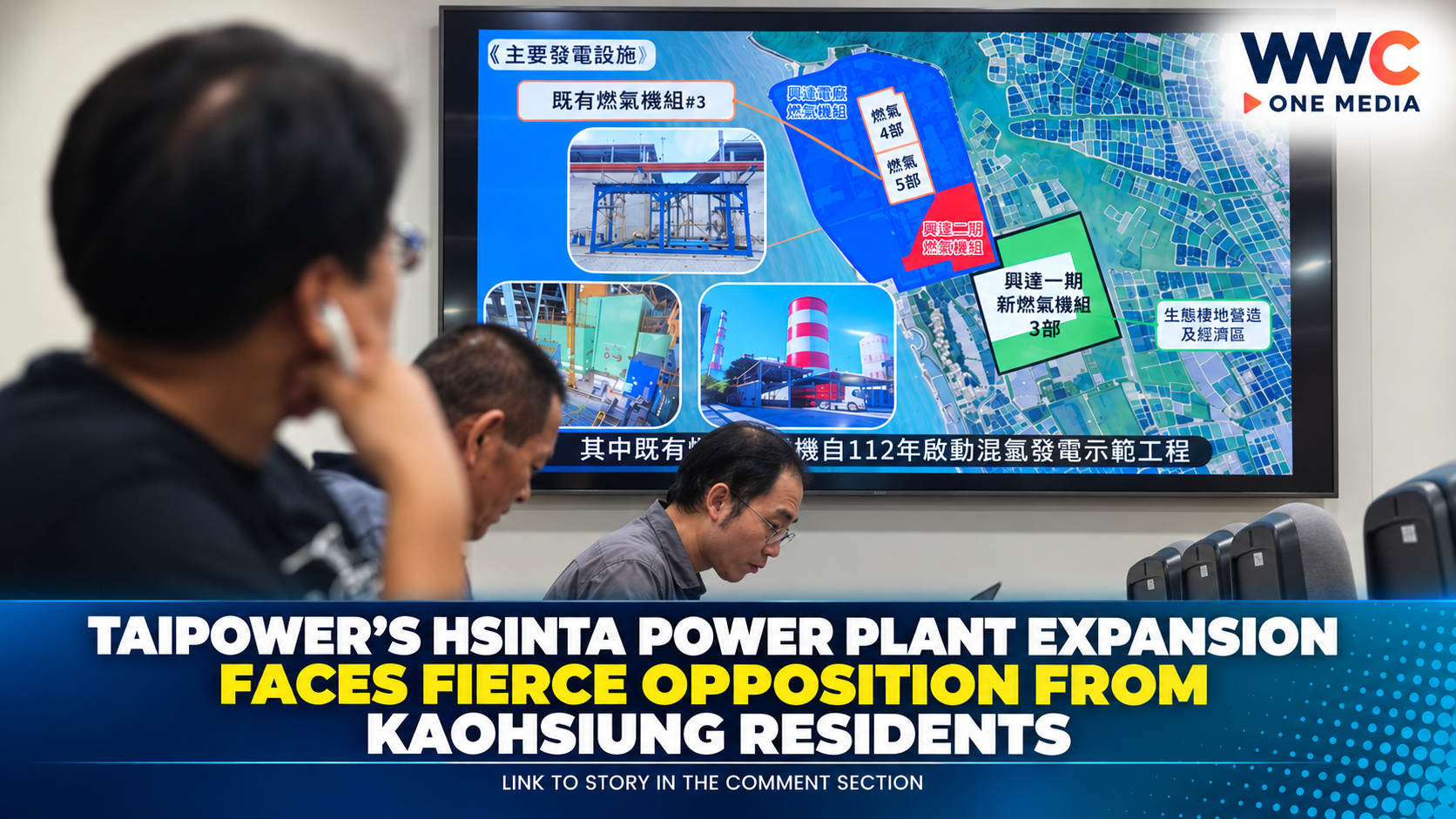
KAOHSIUNG, Taiwan — Taipower’s plan to expand and modernize the Hsinta Power Plant has run into a major roadblock as residents living near the facility demand that unresolved safety and property-damage issues be addressed before the next phase of construction moves forward.
The confrontation intensified on September 7, 2026, when the Ministry of Environment began the initial environmental-impact assessment review of Taipower’s Hsinta Power Plant Phase II Renewal and Reconstruction Project.
Residents from the nearby Wulintou community traveled to the environmental review meeting to protest the project, saying problems associated with the plant’s earlier expansion—including an explosion during testing, alleged property damage, noise and other impacts—have not been adequately resolved.
Their message was blunt: resolve the problems from Phase I before moving ahead with Phase II.
What Taipower wants to build
The Phase II project is designed to strengthen electricity supplies in southern Taiwan as demand rises from semiconductor manufacturing, artificial intelligence and other high-tech industries.
Taipower plans to build two new natural-gas combined-cycle generating units at the existing Hsinta facility in Kaohsiung's Yong'an District.
The proposed project has a planned capacity of up to 2.8 million kilowatts, according to reporting on the environmental assessment.
Taipower and Taiwan's Ministry of Economic Affairs argue that additional generation is necessary to maintain a stable electricity supply as industrial electricity demand continues to grow in southern Taiwan.
But for residents living only a short distance from the plant, the debate is about more than electricity demand.
It is about safety, construction impacts and whether previous problems have actually been fixed.
Residents point to last year's explosion
A major source of distrust is an incident on September 9, 2025, when a newly built gas-fired unit at Hsinta Power Plant experienced a fire and explosion during testing.
No deaths were reported, but the incident heightened anxiety among nearby residents.
Residents say the explosion, together with construction associated with the earlier expansion project, has contributed to concerns over damaged homes, noise and other disruptions. PTS reported that residents said approximately 56 households were affected by the incident and its associated impacts.
The residents' concerns have not disappeared with the end of the testing incident.
Instead, they have become a central issue in the debate over whether Taipower should proceed with another major expansion.
“Fix the damage first”
Residents say they are not necessarily opposed to Taiwan having reliable electricity.
Their objection is to moving ahead with another major project while disputes connected to the previous construction remain unresolved.
During the September 7 environmental review, residents demanded that Taipower complete repairs and compensation-related work for affected properties before Phase II proceeds.
Some residents also called for a dedicated public meeting for people in Xingang Village, one of the communities closest to the power plant, arguing that residents most directly affected by the project should have a greater opportunity to question Taipower.
The issue has become particularly sensitive because residents say previous communication with Taipower did not adequately address their concerns.
Residents challenge Taipower’s “60% support” claim
Another flashpoint is a survey cited in discussions over the project.
Taipower has pointed to survey results indicating majority support for the Phase II project among local residents.
But representatives of the Wulintou Residents' Alliance disputed the claim, arguing that the survey did not accurately reflect the views of people living closest to the facility.
United Daily News reported that residents specifically challenged a claim that 60% of residents support the Phase II expansion, saying the circumstances surrounding local consultation made the figure difficult to accept.
The disagreement highlights a larger problem facing infrastructure projects across Taiwan:
How should governments balance national energy needs with the concerns of communities that live next to major power facilities?
A separate controversy over “behavioral integrity” pledges
The dispute has also expanded beyond construction damage and safety.
Residents protested what they described as a form of “behavioral integrity” pledge connected to applications for Taipower activity subsidies.
According to local reports, residents objected to language that could affect subsidies for groups deemed to have engaged in “irrational protests” or obstructive activities. The Wulintou Residents' Alliance argued that such conditions could discourage residents from protesting or expressing opposition to the project.
Residents demanded that Taipower withdraw the pledge and said community dialogue should not be tied to restrictions on peaceful protest.
These allegations are part of the residents' criticism; they should not be interpreted as an established finding that Taipower unlawfully suppressed residents.
Environmental officials also call for stronger communication
The conflict has drawn attention from environmental-review officials.
During the September 7 preliminary assessment, an environmental review committee member said the concerns surrounding residents' lives and the impact of the first phase required Taipower to strengthen communication and improve its environmental and mitigation measures.
Kaohsiung officials likewise urged Taipower to listen more closely to residents and improve local communication.
That means the environmental review is not simply about whether Taiwan needs more electricity.
It is also examining whether the project has sufficiently addressed environmental, safety and community concerns.
There is another controversial proposal: extending older units
The Phase II plan has another component that has attracted criticism.
Taipower has proposed building the two new gas-fired combined-cycle units while also seeking to extend the operation of five existing gas-fired units until 2037.
Public Television Service reported that environmental groups have questioned the necessity of keeping the older units operating for so long, particularly as Taipower develops newer generating capacity.
Residents and environmental groups therefore face a project that is not simply about constructing two new generators.
It could also affect how long older units remain part of southern Taiwan's electricity system.
Why Taipower says the project matters
Taipower's argument is straightforward: southern Taiwan's electricity demand is changing rapidly.
The region is home to major semiconductor and technology investments, while Taiwan is simultaneously attempting to transition its energy system.
The government says maintaining adequate reserve capacity and regional power stability is essential for industry and households.
Taipower therefore sees the Hsinta modernization project as part of a broader effort to ensure sufficient electricity for southern Taiwan's growing industrial base.
But opponents argue that energy security cannot come at the expense of communities living alongside power infrastructure.
The project is not yet a done deal
Despite the escalating confrontation, the September 7 meeting was an initial environmental assessment—not final approval of the project.
The environmental review process will determine what additional information, mitigation measures or changes Taipower may need to provide before the project can advance.
That leaves both sides with something at stake.
For Taipower, the challenge is demonstrating that the expansion can provide additional electricity while meeting safety and environmental requirements.
For residents, the immediate priority is ensuring that unresolved problems from the earlier project are addressed before another large-scale construction program begins.
Taiwan’s energy dilemma is getting harder to ignore
The Hsinta controversy exposes a difficult reality facing Taiwan.
The island needs more reliable electricity to support semiconductor manufacturing, AI infrastructure and economic growth.
At the same time, new power infrastructure has to be built somewhere—and communities located near those facilities bear much of the immediate impact.
The dispute in Kaohsiung is therefore bigger than one power plant.
It is a test of whether Taiwan can expand its electricity system without losing the trust of the communities expected to live beside it.
For now, Taipower's Phase II project remains under environmental review.
But residents have already made their position clear: until the problems of the past are resolved, they are not ready to accept another expansion.
And that could make the next stage of the environmental review even more contentious.