
Taiwan Signals a Bigger Defence Push as Lai Says Record Spending Is About Protecting Peace

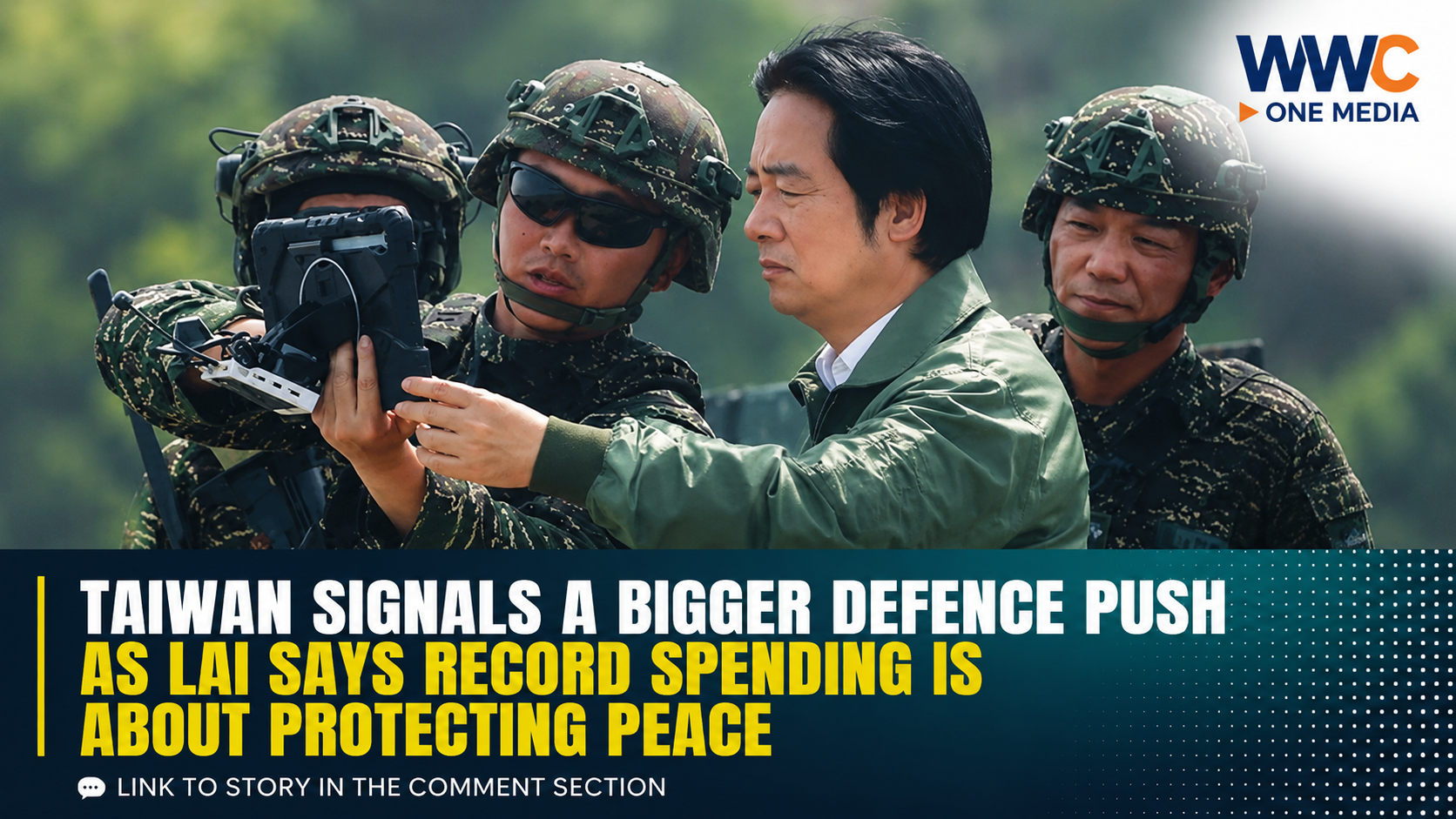
Taiwan is sending a sharper message about its security strategy, with President Lai Ching-te saying the island's record defence spending is intended to demonstrate its determination to protect itself and preserve peace across the Taiwan Strait.
Speaking on Sept. 2, 2026, during Taiwan's Armed Forces Day events, Lai said stronger military preparedness and deterrence are essential to national security and regional stability.
The remarks come after Taiwan's government proposed a 2027 defence budget of NT$1.1225 trillion, taking total defence spending above the NT$1 trillion mark for the first time and above 3% of GDP.
Lai: Defence Spending Is a Message to the World
Lai argued that the proposed spending plan is about more than military hardware.
He said Taiwan will continue developing domestic defence capabilities, its military-industrial sector, artificial intelligence and unmanned systems, with the aim of improving the island's ability to respond to future security challenges.
The president has repeatedly described defence investment as part of Taiwan's broader effort to maintain peace rather than an attempt to provoke conflict.
In August, Lai described the record budget as an investment in peace, while Taiwan's government said the increase reflected the need to strengthen asymmetric capabilities as pressure from Beijing grows.
Why Taiwan Is Spending More
Taiwan has been accelerating military modernisation as China increases military and political pressure around the island.
The proposed 2027 budget follows months of political battles in Taiwan's opposition-controlled legislature over how much money should be allocated to defence.
The government has placed particular emphasis on drones, missiles and other asymmetric weapons, reflecting lessons from conflicts including the wars in Ukraine and the Middle East.
Taiwan's military also recently completed the Han Kuang exercises, which simulated scenarios including attempts to counter a potential Chinese blockade or attack.
Parliament Has Already Pushed Back
The spending increase has not been politically straightforward.
In May, Taiwan's legislature approved about NT$780 billion in special defence funding for US military equipment through 2033, significantly below the government's original NT$1.25 trillion request. Opposition lawmakers argued that major defence allocations required stronger oversight and clearer spending plans.
The dispute intensified in August when parliament rejected the government's proposed NT$210 billion six-year special budget for about 210,000 military drones.
Instead, opposition lawmakers approved their own NT$240 billion framework, with annual spending generally capped at NT$40 billion.
That means Taiwan's push for a larger and more technologically advanced defence force still faces an important domestic political hurdle.
China Fires Back
Lai's latest comments immediately drew criticism from Beijing.
China's Taiwan Affairs Office accused Lai and his administration of inciting confrontation across the Taiwan Strait and wasting public money.
Beijing continues to regard Taiwan as part of China and has not renounced the use of force to bring the island under its control. Taiwan rejects Beijing's sovereignty claims and maintains that its future should be decided by its people.
The competing positions underscore why Taiwan's defence spending has become much more than a budget issue—it is now deeply tied to the island's relationship with China, Washington's security expectations and the wider balance of power in the Indo-Pacific.
Drones Are Becoming a Major Focus
One of the most significant changes in Taiwan's military strategy is the growing emphasis on unmanned systems.
Lai's government has argued that the wars in Ukraine and the Middle East demonstrate how quickly drones are changing modern warfare. Taiwan has therefore been seeking to expand both its military drone inventory and its domestic production capabilities.
The government has also pledged to raise defence spending to 5% of GDP by 2030, although reaching that target will depend on future budgets and legislative approval.
The Bigger Question: Can Taiwan Turn Spending Into Deterrence?
Taiwan's challenge is no longer simply deciding whether to spend more.
It must determine whether additional money can translate into a more resilient military—one capable of surviving missile strikes, maintaining communications, using drones effectively and protecting critical infrastructure in a potential crisis.
For Lai, the argument is straightforward: stronger preparation creates greater security.
For Beijing, however, the same military buildup is viewed as confrontation.
That tension makes Taiwan's record defence budget one of the most closely watched security developments in Asia.
Accuracy Note
The NT$1.1225 trillion figure is a proposed 2027 defence allocation, not money that has already been fully spent or finally approved. It combines regular and special-budget funding and represents more than 3% of GDP. The exact US-dollar equivalent varies with exchange rates; reporting around the announcement has put it in roughly the US$35 billion range.
China's objections and Taiwan's stated security concerns should also be presented as the respective positions of the two sides, rather than as independently established claims about the other's intentions.
WWC ONE MEDIA J.M.D