
Taiwan to Open Global UAV Academy Offices in Taipei and Chiayi as Drone Diplomacy Takes Off

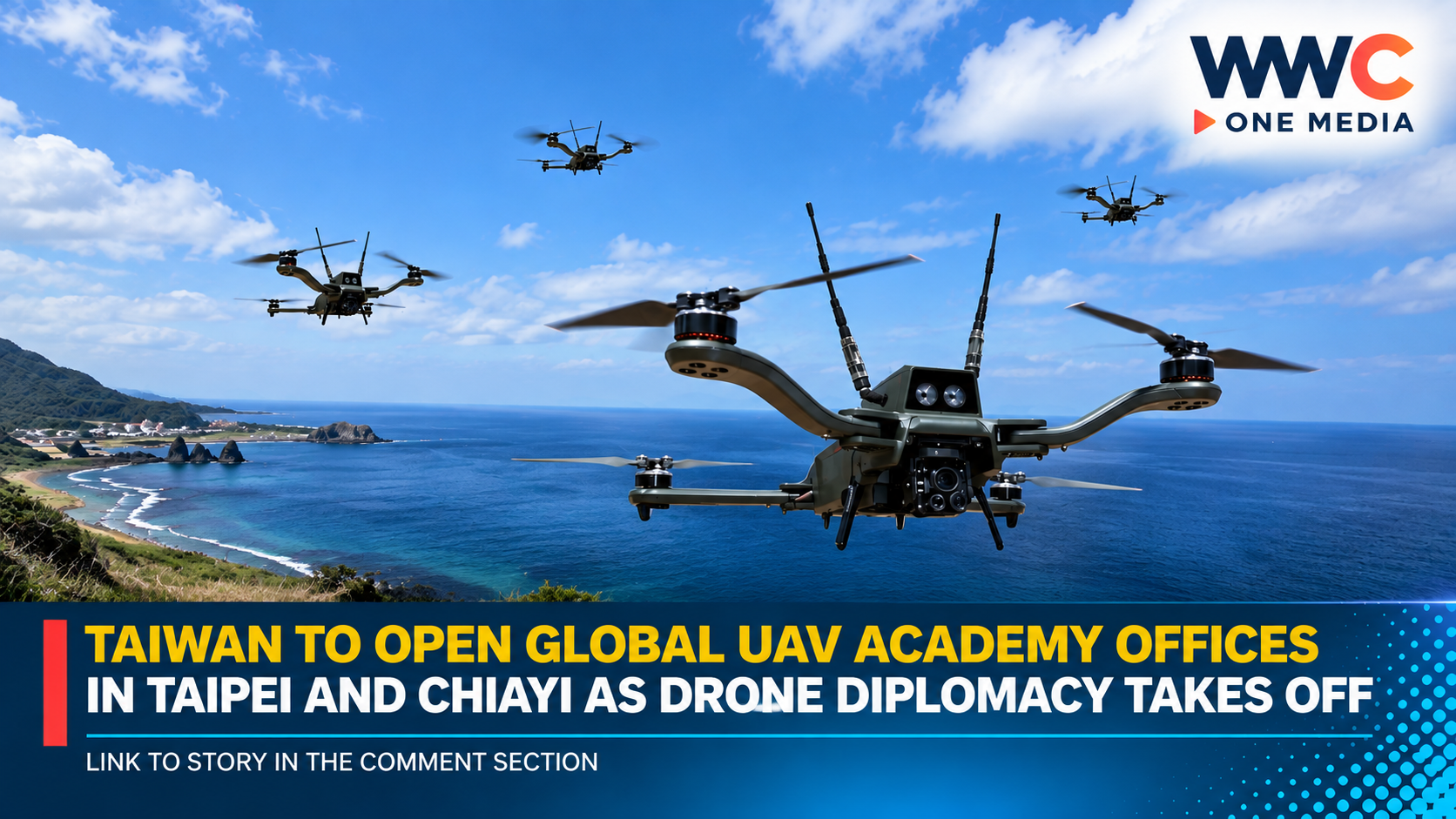
TAIPEI, Taiwan — Taiwan is turning its growing drone industry into a new tool of international diplomacy, with the country preparing to establish Global UAV Academy (GUAVA) offices in Taipei and Chiayi as part of a broader push to train foreign drone operators, develop standards and expand cooperation with international partners.
The offices are expected to be established this year, according to Taiwan's Ministry of Foreign Affairs, with GUAVA also planning to work with organizations overseas to establish branches in other countries.
The initiative signals that Taiwan wants to export more than drones.
It wants to export the training, certification, maintenance, regulatory expertise and technology ecosystem surrounding unmanned vehicles.
Taiwan's new "drone diplomacy"
The plan is part of what Taiwanese officials are calling "drone diplomacy"—an effort to use the island's growing expertise in unmanned aerial vehicles to strengthen relationships with diplomatic allies and other international partners.
The initiative is being developed under Taiwan's broader integrated diplomacy strategy and the Diplomatic Allies Prosperity Project.
The Foreign Ministry established a Drone Diplomacy Task Force in October 2025, bringing together government, industry and academic resources to develop international cooperation involving unmanned systems.
GUAVA was subsequently established as a nongovernmental organization intended to provide greater flexibility in international drone cooperation.
Its mission goes well beyond simply selling aircraft.
From drone exports to "institutional exports"
Taiwan wants GUAVA to become a hub connecting research and development, industrial partnerships, education, certification, maintenance and regulatory compliance.
The strategy represents a shift from simply exporting Taiwanese-made products to exporting the systems and expertise needed to operate and regulate an entire drone ecosystem.
That could include training foreign pilots, helping countries establish drone testing facilities, developing verification standards and assisting partners with regulations.
Taiwan's Foreign Ministry says the approach could help diplomatic partners use UAV technology in fields including:
- Smart agriculture
- Disaster prevention and response
- Coast guard operations
- Medical deliveries
- Digital governance
- Artificial intelligence
- Other civilian and dual-use applications
The initial priority is expected to be drone-pilot training, followed by broader cooperation in testing, certification and regulation.
145 drones to be donated to Taiwan's diplomatic allies
The initiative comes alongside a plan to provide approximately 145 Taiwanese-purchased UAVs to Taiwan's diplomatic allies.
The drones are divided into two broad categories: training models and multifunctional models.
The Foreign Ministry plans to distribute them to allies in stages, with the goal of giving partner countries practical experience while simultaneously building demand for Taiwanese drone technology and expertise.
The move could give Taiwan an additional way to strengthen relationships with countries that maintain formal diplomatic ties with Taipei.
Instead of traditional development assistance alone, Taiwan is increasingly looking toward technology partnerships as a way of creating longer-term economic and strategic links.
Why Chiayi matters
The decision to establish one of GUAVA's offices in Chiayi is particularly significant because the southern Taiwan region has become an important center for drone-related experimentation, manufacturing and training.
Chiayi has hosted national UAV competitions and defense-related drone activities, helping develop an ecosystem involving government, universities and private companies.
Taiwan's wider drone strategy is also increasingly tied to domestic manufacturing capacity.
The country is seeking to establish itself as a reliable supplier of drones and components that do not depend heavily on Chinese supply chains.
Taiwan wants a bigger share of the global drone market
The timing is significant.
Global demand for UAVs has surged as drones have become increasingly important in warfare, surveillance, disaster response, logistics and commercial applications.
The war in Ukraine has demonstrated how inexpensive drones can be deployed on a massive scale for reconnaissance, targeting and battlefield operations.
Taiwanese manufacturers are attempting to capitalize on that growing market.
An AFP report published by the Taipei Times in May noted that Taiwan's drone exports had surged dramatically, with exports reaching 181,159 units during the first four months of 2026, nearly 20 times the volume recorded during the same period a year earlier.
Poland and the Czech Republic were among the major destinations.
The surge illustrates both the opportunity and the challenge facing Taiwan: demand is growing rapidly, but the global drone market is already intensely competitive.
The "non-red" drone push
Taiwan is also positioning itself as a potential alternative supplier for governments and companies seeking drone systems that are less dependent on Chinese components and supply chains.
This has become particularly important in Western markets because of concerns about data security, supply-chain resilience and China's dominance of the commercial drone industry.
Taiwanese companies are therefore promoting what officials and industry participants describe as "non-red" supply chains—a reference to reducing dependence on Chinese-origin components.
But the strategy faces obstacles.
A recent report cited by ICRT and Taiwan's Research Institute for Democracy, Society and Emerging Technology warned that some key upstream materials used in Taiwan's domestic drones still come from China and that stable international demand remains uncertain.
That means Taiwan's ambition to build a fully resilient drone supply chain is still a work in progress.
GUAVA expands international partnerships
GUAVA is already laying the groundwork for international cooperation.
In May, the organization, then operating as a preparatory office, signed a letter of intent with the U.S.-based Association for Uncrewed Vehicle Systems International to promote cooperation between Taiwan and the United States.
In July, it signed another letter of intent with the Japan Drone Consortium, aimed at strengthening Taiwan-Japan cooperation in the drone sector.
Those agreements could provide a foundation for future training programs, technology cooperation and international standards.
The planned overseas branches would take that strategy a step further.
A new kind of diplomacy for Taiwan
For Taipei, the UAV initiative is about more than an emerging technology industry.
It is also about increasing Taiwan's international presence.
Taiwan has long relied on its semiconductor industry as a source of economic influence and diplomatic leverage.
Officials now see drones as another strategic technology where Taiwan could build an international network.
The government has even drawn comparisons between "drone diplomacy" and "chip diplomacy."
The objective is to make Taiwan useful to partner countries not only as a supplier of hardware, but as a source of training, standards, certification, technology and expertise.
Security concerns add urgency
Taiwan's drone ambitions are also closely connected to its own security environment.
China claims Taiwan as part of its territory and has not ruled out the use of force to assert control over the island.
Taiwan therefore has an incentive to develop a domestic drone industry capable of supporting both civilian needs and national defense.
Analysts have described the goal as creating a potential "drone shield" alongside Taiwan's better-known semiconductor "silicon shield."
But Taiwan is not relying exclusively on military demand.
Officials are also promoting civilian applications to ensure the industry has a sustainable commercial base.
The challenge: Can Taiwan compete?
Taiwan has strong advantages in electronics, semiconductors, precision manufacturing and artificial intelligence.
But the global UAV market is dominated by established manufacturers, particularly Chinese companies with enormous production capacity.
Taiwanese drones can also be more expensive because local companies operate at a much smaller scale.
AFP reporting has highlighted the difficult competitive environment, with Taiwanese companies seeking overseas markets while facing competition from China and rapidly developing drone industries in countries such as Ukraine.
That makes GUAVA's international strategy particularly important.
If Taiwan cannot always compete on price, it can attempt to compete on trust, technology, supply-chain security, training and standards.
The bigger picture
The planned GUAVA offices in Taipei and Chiayi are therefore only one piece of a much larger strategy.
Taiwan is attempting to build a global network around unmanned vehicles—one that links government, industry, universities, researchers, international organizations and diplomatic partners.
If successful, the model could transform Taiwan's role in the global drone industry from a relatively small hardware producer into a broader provider of technology and institutional expertise.
For countries looking to reduce dependence on Chinese drone technology, that could make Taiwan an increasingly important partner.
But the race is already underway.
Taiwan has built the launchpad. The question now is whether its new drone diplomacy can take off before its competitors close the gap.