
Teenagers Keep Getting Guns in Southeast Asia—But the Latest School Shootings Reveal Where the Biggest Security Gap May Really Be

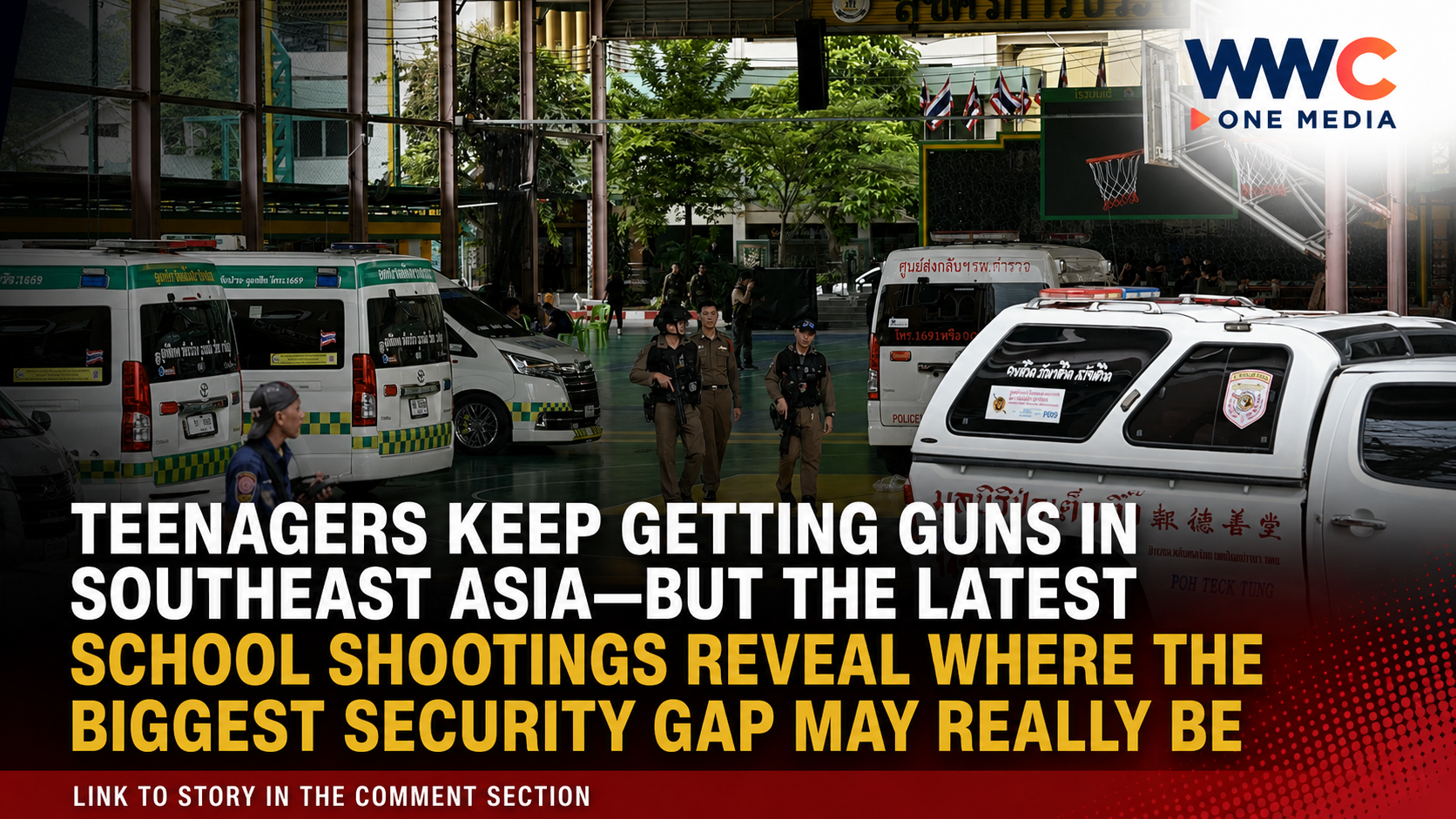
Two deadly school attacks in Thailand and the Philippines have forced governments to confront an uncomfortable question: If minors are not supposed to have firearms, why are teenagers still able to get them?
A pair of shocking school shootings just days apart has put gun access among Southeast Asian teenagers under intense scrutiny, exposing what experts and officials increasingly describe as a problem that goes far beyond what happens at the school gate.
In Thailand, a 14-year-old student used a handgun legally registered to his grandfather in an August 7 attack in Nonthaburi province, outside Bangkok. Authorities said the teenager first killed his grandparents before going to Debsirin Nonthaburi School, where he killed five members of the school staff and fatally wounded a 12-year-old student. The attacker later died by suicide.
Less than two weeks later, another teenager opened fire at a school in Zamboanga City in the southern Philippines.
The August 18 attack at Ateneo de Zamboanga University left a fellow student and the attacker dead and injured others. Philippine authorities said investigators were examining how the teenager obtained the weapons and were scrutinizing his digital activity and possible motive. At least one of the firearms used in the attack was registered to his father, a Bureau of Customs employee.
The two incidents have intensified a question now being asked across the region:
How are children getting access to guns in the first place?
The Guns Were Close to Home
One disturbing similarity between the recent cases is that investigators did not have to uncover an elaborate underground trafficking operation to explain how the teenagers may have obtained firearms.
In Thailand, authorities said the weapon belonged legally to the shooter's grandfather, with whom the teenager lived.
In the Philippines, investigators said a firearm used in the Zamboanga shooting was registered to the teenager's father.
That has shifted part of the debate away from simply asking whether countries need tougher gun laws and toward a more immediate issue: how licensed gun owners store and secure their weapons at home.
Philippine Interior Secretary Jonvic Remulla has called for tougher firearm rules and stronger penalties for gun owners whose negligence allows others to gain access to their weapons following the Zamboanga attack.
Lawmakers have also demanded greater accountability.
The debate is particularly urgent because the Zamboanga shooting was the second deadly Philippine school shooting in less than two months, following an attack in Tacloban in June.
Thailand Has a Much Bigger Gun Problem
Thailand faces an additional challenge: the sheer number of firearms circulating in the country.
Estimates based on the Small Arms Survey put the number of civilian-held firearms in Thailand at roughly 10.3 million, equivalent to around 15 guns for every 100 people. Only about six million were believed to be registered, leaving millions outside the formal licensing system.
That makes Thailand an outlier in Southeast Asia.
By comparison, neighboring Malaysia has been estimated to have fewer than one civilian firearm for every 100 people.
The August attack was also not Thailand's first case involving an adolescent shooter.
In February 2026, a 17-year-old was accused of taking a firearm from police before attacking a school in southern Thailand. And in 2023, a 14-year-old was accused of carrying out a deadly shooting at Bangkok's Siam Paragon shopping mall.
After the latest violence, Prime Minister Anutin Charnvirakul's government ordered another review of firearms policy, including moves to suspend new permits and tighten enforcement against illegal possession and carrying.
But critics say Thailand has tightened gun rules before—often after major shootings—without fully solving the enforcement problem.
A Gun Law Is Only as Strong as Its Enforcement
That may be the central lesson emerging from the recent attacks.
Southeast Asian countries generally do not permit children to legally purchase and possess ordinary firearms. Yet laws governing ownership can do little when weapons are left unsecured inside homes, transferred outside legal channels, improperly registered or inadequately tracked.
The distinction between legal ownership and safe ownership has therefore become increasingly important.
A firearm may have been legally purchased by an adult but still become accessible to a child if it is not securely stored.
Thailand's case also demonstrates another problem: a large pool of unregistered weapons makes tracing possession and enforcing licensing rules considerably harder. Thai authorities have responded to successive mass shootings with restrictions on gun imports and proposals for tougher licensing, but millions of weapons remain in civilian hands.
Social Media Is Part of the Investigation—but It Isn't the Whole Answer
Both shootings have also reignited debate over violent online content.
Thai investigators said the 14-year-old shooter had watched violent material online and had previously shown an interest in firearms. Police said a teacher had confiscated an air gun from him the previous year.
In the Philippines, the Zamboanga attacker livestreamed portions of the attack, according to authorities. Investigators have been examining his online activity as lawmakers debate stronger protections for children using social-media platforms.
That concern extends beyond these two incidents.
A Reuters investigation published earlier in 2026 reported that authorities across several Southeast Asian countries were confronting online communities in which some teenagers encountered extremist propaganda and material glorifying mass attackers.
But investigators and policymakers face a danger in treating online content as the entire explanation.
A teenager may see disturbing material online, but carrying out firearm violence requires something more tangible: access to an actual weapon.
And in the two latest cases, the firearms were reportedly connected to adults inside the teenagers' own families.
Schools Cannot Solve This Alone
Governments have naturally responded by reconsidering school security.
Metal detectors, CCTV systems, emergency drills and tighter access controls can make campuses harder to penetrate.
But Philippine Education Secretary Sonny Angara has warned that preventing school violence requires more than security equipment. Schools, parents, communities and authorities also need better systems for identifying risks and responding before an attack occurs.
The dilemma is especially difficult because teachers in Zamboanga reportedly described the student involved as academically capable and not previously regarded as a serious behavioral concern.
It is one reason the debate is rapidly expanding beyond school security.
The questions now include whether firearm owners should face stronger safe-storage requirements, whether penalties for negligent access are sufficient, how illegal weapons should be removed from circulation, whether licensing systems adequately track firearms and what responsibility adults bear when children gain access to their guns.
Southeast Asia's Next Gun-Control Test
School shootings remain comparatively uncommon across much of Southeast Asia, but the events in Thailand and the Philippines have shaken that assumption.
Their significance lies partly in what they have in common.
In both cases, a teenager reportedly obtained a firearm connected to an adult family member.
And that leaves governments with a difficult conclusion.
The region may pass tougher gun laws, strengthen school gates and regulate children's online activity. But unless firearms already circulating inside communities are securely controlled—and licensed owners are held accountable for keeping them away from minors—the most dangerous gap may remain exactly where legislation has the hardest time reaching:
inside the home.