
Teenagers Keep Getting Their Hands on Guns Across Southeast Asia—And the Biggest Loophole May Be Inside Their Own Homes

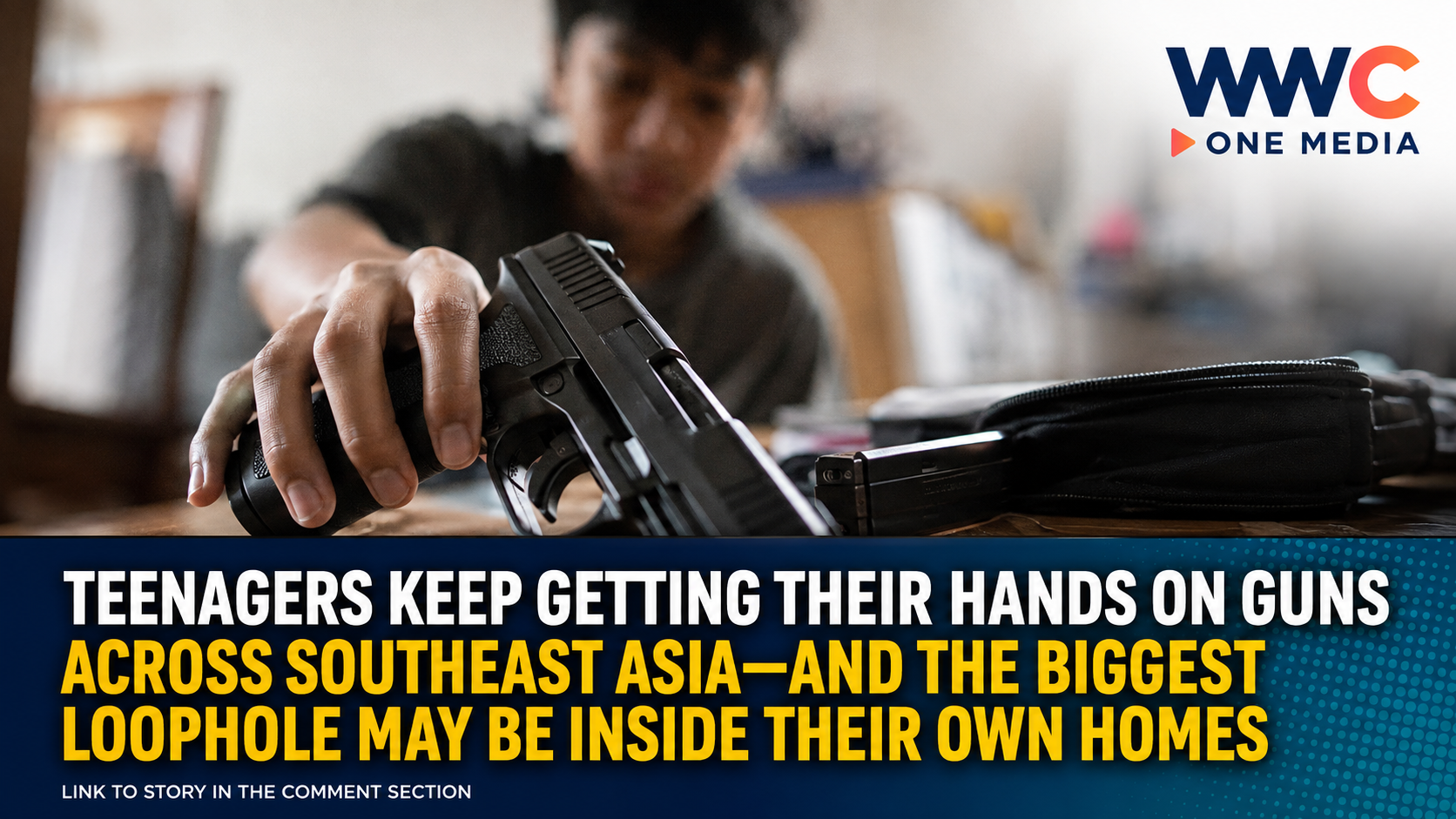
Recent attacks in Thailand and the Philippines have put that question at the center of a widening regional debate—not simply about gun laws, but about what happens to firearms after they are legally purchased or issued.
The emerging pattern is particularly troubling because several of the weapons involved were not mystery guns bought from unknown traffickers. They were reportedly firearms belonging to adults close to the teenagers.
That has shifted attention from the question of who can legally buy a gun to a potentially more urgent one: Who is responsible for making sure children cannot reach it?
A 14-Year-Old Took His Grandfather’s Gun in Thailand
On August 7, a 14-year-old student in Thailand allegedly took a firearm belonging to his grandfather after killing his grandparents at their home, then traveled to Debsirin Nonthaburi School outside Bangkok.
Authorities said he opened fire at the school, killing staff members and injuring 23 people before shooting himself.
The death toll later climbed to nine—including the attacker—after a 12-year-old girl died from her injuries the following day.
Police said the teenager brought the weapon and ammunition with him to school and fired at least 26 rounds during the rampage. Reuters reported that investigators were also examining his previous interest in guns and other factors surrounding the attack.
The tragedy immediately reopened Thailand's long-running debate over firearms.
Thailand has an estimated 10.3 million civilian-held guns, or roughly 15 firearms for every 100 residents, according to estimates cited by Reuters and the Small Arms Survey. Only around six million are believed to be registered.
That makes Thailand the country with the highest estimated rate of civilian firearm possession in Southeast Asia.
Prime Minister Anutin Charnvirakul responded to the latest attack by pushing for tighter restrictions, including tougher controls on public carrying and proposed changes to firearm licensing.
But critics argue that Thailand's problem goes beyond the number of permits being issued.
The country's licensing system has historically allowed possession licenses to remain valid for long periods, while critics have also pointed to weaknesses involving reassessment, safe storage and the enormous number of guns already circulating outside the registered system.
And once millions of weapons exist in homes and communities, restricting new purchases does not necessarily prevent an unauthorized family member from reaching one.
Then Another Teenager Brought Guns Into a Philippine School
Less than two weeks after the Thailand attack, another school shooting shocked the region—this time in Zamboanga City in the southern Philippines.
On August 18, a Grade 9 student entered the junior high school campus of Ateneo de Zamboanga University carrying firearms and fatally shot a Grade 10 student.
The attacker later died by suicide.
The incident was particularly disturbing because part of the attack was livestreamed using a body-worn camera. Reuters verified footage showing the teenager entering classrooms and firing.
But investigators soon discovered something else.
The guns were connected to the teenager's father.
The Bureau of Customs confirmed that one weapon was a Glock 22 .40-caliber pistol issued by the agency to the boy's father, who was serving as a Customs official in Zamboanga.
A second weapon recovered from the scene was also legally licensed to the father.
The father was relieved from his Customs post while authorities investigated how his son gained access to the firearms.
Customs officials said the case could raise administrative liability over whether proper firearm safekeeping procedures were followed.
A later Inquirer report said authorities were told that the firearms had allegedly been left in a vehicle—a detail investigators began examining as they reconstructed how the teenager obtained them.
The incident immediately prompted lawmakers to ask how two weapons could have been brought onto a school campus despite heightened concern over school security.
It Was the Second Philippine School Shooting in Less Than Two Months
The Zamboanga attack was not an isolated event.
On June 22, another shooting at San Jose National High School in Tacloban City killed three students and injured around 20 others.
The suspected attackers were teenagers aged 14 and 15.
Once again, investigators found that the firearms apparently originated from adults or institutions legally allowed to possess them.
Reuters reported that one weapon was a police-issued 9mm Glock, while another was a revolver registered to a private security agency.
The Tacloban shooting triggered major changes at the school.
Students returning to campus were subjected to tighter security measures including metal detectors, bag inspections, CCTV monitoring and police deployment. Around 1,100 students were also given transparent backpacks.
But another shooting occurring in Zamboanga only weeks later demonstrated the limitations of relying solely on security at the school gate.
A metal detector can potentially find a weapon once it arrives on campus.
It cannot explain why a child was able to obtain that weapon in the first place.
Southeast Asia's Gun Problem Is Highly Uneven
Firearm ownership varies dramatically across Southeast Asia.
Research by the Small Arms Survey has estimated roughly 3.8 million civilian firearms in the Philippines, while Thailand has around 10.3 million.
Earlier Small Arms Survey research estimated approximately 1.9 million registered firearms and about two million unregistered firearms circulating in the Philippines.
Thailand, meanwhile, was estimated to have roughly 6.2 million registered and 4.1 million unregistered weapons.
The picture elsewhere in Southeast Asia is very different.
Countries including Singapore, Malaysia and Indonesia maintain much tighter restrictions on private firearm ownership, while civilian possession is effectively prohibited or exceptionally restricted in countries including Cambodia, Laos and Vietnam.
Small Arms Survey research has previously identified Thailand and the Philippines as the two Southeast Asian countries where civilian firearm ownership is particularly widespread.
That makes the two countries especially important test cases for a broader question facing the region.
Strict rules governing who may legally purchase a firearm may accomplish little if guns are later poorly secured, diverted, illegally transferred or accessed by unauthorized family members.
The Legal Gun Can Become the Dangerous Gun
Discussion after mass shootings frequently focuses on illegally trafficked weapons.
That remains an important issue.
The Small Arms Survey says trafficking networks and informal firearms circulation continue to make weapons difficult to track, particularly across border regions. Its latest work warns that traditional arms-control mechanisms increasingly struggle to keep pace with changing illicit markets.
ASEAN governments have also recognized the cross-border firearms problem, adopting regional measures aimed at combating arms smuggling.
But the latest school shootings expose another route to gun access that can be far less complicated.
Sometimes the weapon is already inside the family home.
In Thailand, authorities say the 14-year-old shooter used his grandfather's firearm.
In Zamboanga, investigators say the teenager accessed firearms belonging to his Customs-official father.
And in the earlier Tacloban case, one firearm had reportedly been issued to a police officer while another was registered to a security agency.
That pattern has intensified calls for stronger safe-storage rules, owner accountability and penalties when legally possessed firearms end up in unauthorized hands.
Philippine Interior Secretary Jonvic Remulla has called for tougher firearm rules and stronger penalties for negligent gun owners following the Zamboanga attack.
Social Media Has Entered the Debate, Too
The firearms issue is only one part of the discussion.
The Zamboanga attack was livestreamed, raising separate concerns about social media, violent content and the speed at which disturbing footage can spread among young people.
Senate President Francis “Chiz” Escudero's successor, Senate President Win Gatchalian, has advocated restrictions on social media use by children under 16, while Philippine officials have also called for greater scrutiny of how online environments may influence vulnerable young people.
Education Secretary Sonny Angara has cautioned that school safety cannot be solved purely through physical security measures such as fences, CCTV cameras and metal detectors.
Teachers reportedly described the Zamboanga attacker as academically strong and not previously viewed as a problematic student—illustrating how difficult it can be to identify who may pose a risk before violence occurs.
That complicates the debate.
There is no single explanation for why a teenager commits extreme violence, and social-media use, gaming, mental health or school pressures should not be treated as automatic causes without evidence.
But access to a firearm changes what a moment of crisis can become.
The Bigger Question Is What Happens After Someone Buys a Gun
Thailand and the Philippines already have firearm laws.
The more uncomfortable question exposed by recent attacks is whether those laws adequately govern a firearm throughout its entire life.
Who verifies that it is securely stored?
What happens when an owner repeatedly fails to secure it?
How frequently should licenses be reviewed?
Who is liable when a child obtains a weapon?
And how closely are government-issued firearms monitored when they leave police, customs or other official inventories?
Those questions are becoming more urgent because Southeast Asia does not merely face a problem of teenagers somehow “finding guns.”
In several of the region's latest school shootings, the trail appears to lead directly back to legally possessed firearms that teenagers should never have been able to access.
That distinction matters.
Because governments can install more cameras, deploy more guards and search more school bags.
But if the gun is already sitting unsecured at home, the most important security failure may have happened long before the teenager ever reached the school gate.