
Tesla’s Steering-Wheel-Free Cybercab Hits Austin Streets — Riders Have No Way to Take Control

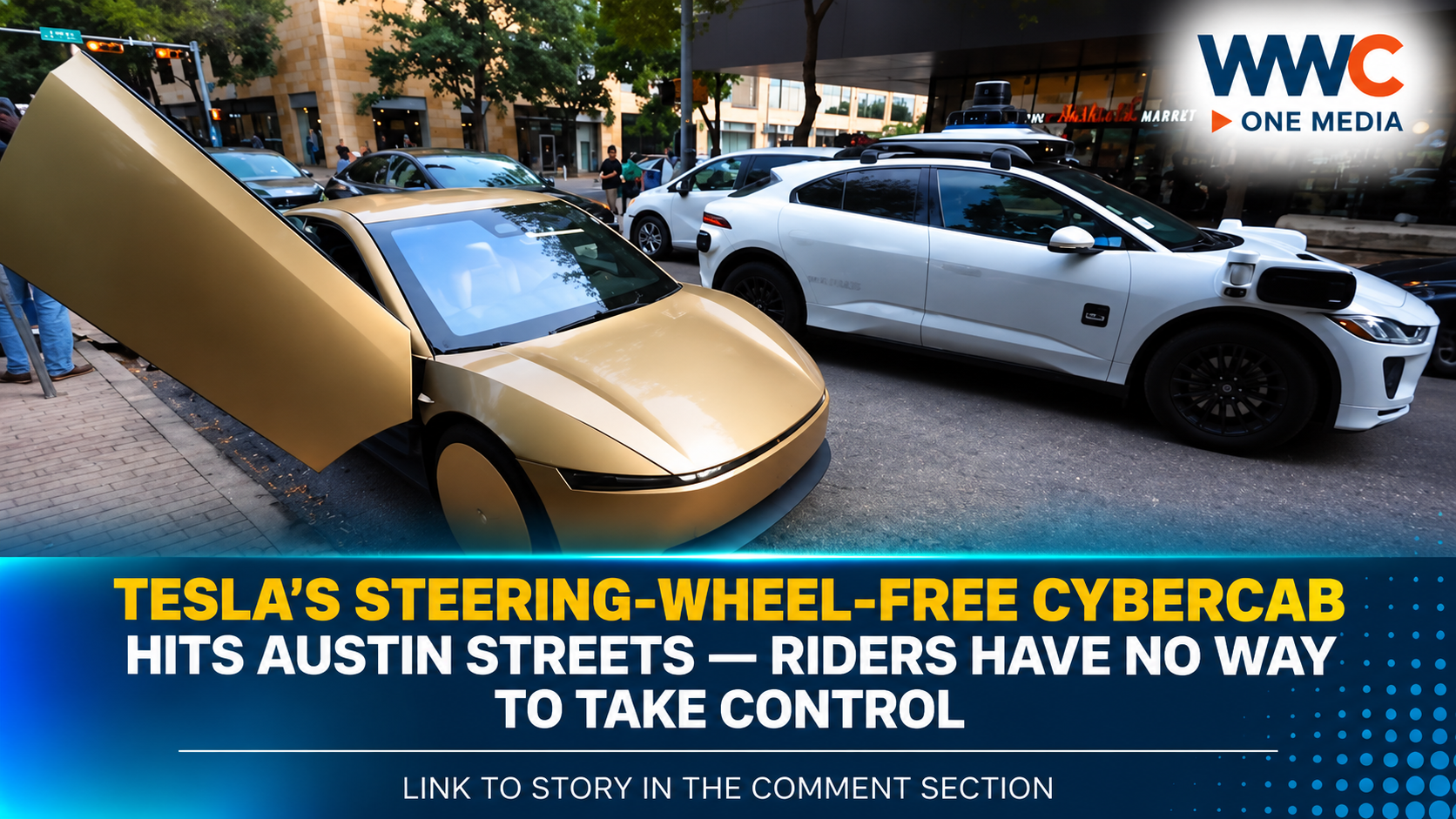
Elon Musk is putting Tesla’s biggest autonomous-driving bet to the ultimate test: passengers are now being offered rides in a car with no steering wheel and no pedals.
Tesla has begun offering rides in its new two-seat Cybercab in limited areas of Austin, Texas, marking a major step in the company’s push to turn fully autonomous vehicles into a mainstream taxi service. The launch took place on Thursday, Sept. 3, with the futuristic gold-coloured vehicles beginning to appear on Austin roads.
But the technology is arriving with an immediate question: What happens if something goes wrong when there is no steering wheel, brake pedal or accelerator for a passenger to use?
That question is now drawing attention from US safety regulators.
No steering wheel. No pedals. No human driver.
Unlike Tesla's existing Robotaxi service, the Cybercab was designed specifically to operate autonomously.
The two-seat vehicle has no conventional steering wheel or pedals, meaning passengers cannot manually take control if they become uncomfortable or encounter an emergency. Reuters also reported that the production Cybercab lacks conventional exterior mirrors.
Tesla has been developing the Cybercab as a purpose-built robotaxi rather than simply adapting an existing passenger car.
The company ultimately wants the vehicle to become a central part of a much larger autonomous transportation network.
For now, however, the rollout remains limited to selected areas of Austin.
US safety regulator is already watching
The launch has attracted the attention of the National Highway Traffic Safety Administration (NHTSA).
A NHTSA spokesperson told Reuters that the agency is in contact with Tesla and is evaluating the situation, without providing additional details.
That scrutiny matters because federal vehicle safety rules generally require equipment such as steering controls and other conventional vehicle features.
Tesla's steering-wheel-free design therefore represents not merely a technological change, but also a regulatory challenge as autonomous vehicles move closer to commercial deployment.
Tesla is betting people will trust the machine
The biggest hurdle may not be manufacturing the Cybercab.
It may be convincing ordinary passengers to sit inside one.
A February Pew Research Center survey cited by the Associated Press found that seven in 10 US adults were not too or not at all comfortable riding in a driverless vehicle. Only 7% described themselves as extremely or very comfortable, while another 16% said they would be somewhat comfortable.
That means Tesla is trying to sell something psychologically difficult: a taxi ride in which the passenger has no driver and no physical controls.
For many riders, the idea of being unable to grab a steering wheel or hit a brake could be more unsettling than the technology itself.
Tesla is still behind Waymo in robotaxi scale
Tesla is entering a market where another company already has a substantial head start.
Waymo operates more than 4,000 driverless vehicles across 14 cities, according to the Associated Press. Tesla, meanwhile, has more than 200 unsupervised robotaxis operating across several US cities, according to RobotaxiTracker figures cited by AP.
Tesla's existing Austin robotaxi service began with vehicles that still had steering wheels and pedals and initially used safety drivers.
The Cybercab changes that equation by removing the traditional controls altogether.
Tesla's camera-only approach faces another test
There is also a major technological difference between Tesla and some of its competitors.
Tesla relies heavily on cameras and computer vision for its autonomous-driving system, while competitors such as Waymo and Amazon's Zoox use cameras alongside technologies including radar and lidar.
That leaves Tesla with a significant challenge: proving that its system can reliably handle pedestrians, unusual road situations, poor visibility and other unpredictable conditions without relying on additional sensing technologies.
The timing is critical for Tesla
The Cybercab launch comes as Tesla attempts to shift investor attention toward artificial intelligence, robotics and autonomous transportation while its traditional electric-vehicle business faces increasing competition.
Tesla shares rose more than 5% on Thursday amid investor optimism surrounding the Cybercab launch, according to AP and Reuters reporting.
Musk has long argued that autonomous vehicles could eventually transform Tesla's business model.
One of his longer-term ambitions is to allow Tesla owners to put their vehicles into a robotaxi network when they are not using them, potentially creating a large fleet without Tesla having to own every vehicle itself.
But this is not yet the driverless revolution Musk promised
Despite the headlines, the Austin launch should be viewed as an early commercial deployment, not proof that fully autonomous driving has been solved everywhere.
The Cybercab rides are currently limited geographically, and Tesla still faces regulatory, technological and public-trust hurdles before the concept can be expanded on a much larger scale. Reuters reported that Tesla's broader autonomous ambitions have progressed more slowly than some of Musk's earlier projections.
The company's existing Full Self-Driving system also remains distinct from a universally available, unrestricted autonomous driving service.
That distinction is important: a limited robotaxi operation in defined areas is very different from a car that can safely drive itself anywhere without human supervision.
The real test begins now
Tesla has finally put its steering-wheel-free Cybercab into a real-world passenger service.
Now comes the harder part.
Can passengers trust a vehicle they cannot control?
Can Tesla demonstrate consistent safety outside controlled demonstrations?
And can regulators determine how vehicles without traditional driving controls should fit into existing safety rules?
Those questions may ultimately determine whether the Cybercab becomes a breakthrough in transportation — or another ambitious Tesla promise that takes much longer to scale.
WWC ONE MEDIA J.M.D