
THAILAND ON ALERT: 51 Attacks Rock the Deep South as Yala, Narathiwat and Pattani Face a Night of Fire and Explosions — What Happens Next?

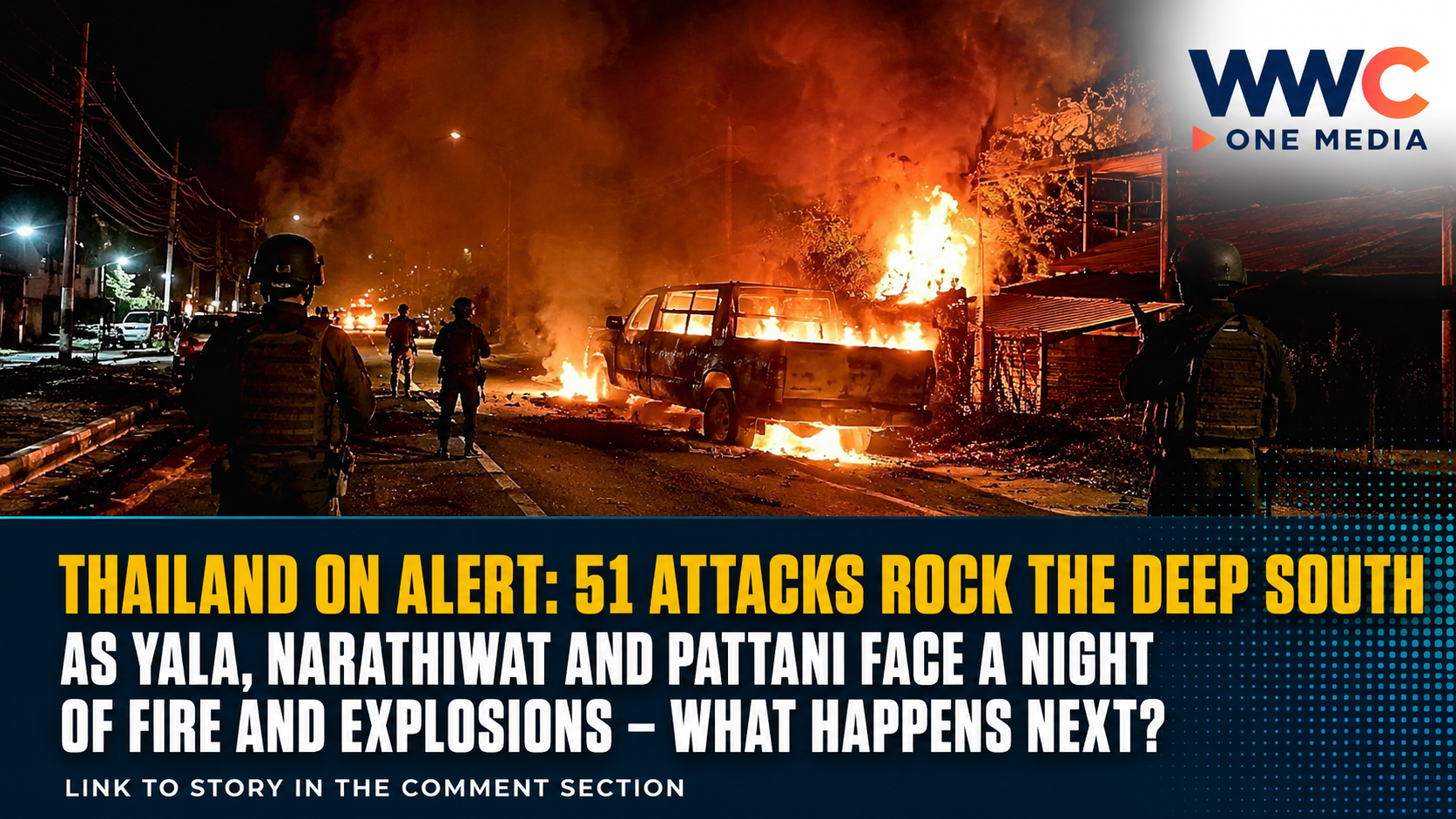
BANGKOK — Thailand’s troubled southern border was hit by a wave of coordinated-looking disturbances Saturday night, with fires, explosions, attacks on infrastructure and other incidents reported across Yala, Narathiwat and Pattani.
The scale of the violence initially appeared smaller before authorities expanded and verified the number of incidents.
Thai PBS reported that by 9:42 p.m. on August 22, security authorities had recorded 32 incidents across the three provinces — 14 in Yala, 13 in Narathiwat and five in Pattani. The incidents included suspected explosions, gunfire, arson and property damage.
A subsequent update from Thailand’s Internal Security Operations Command Region 4 put the total at 51 incidents by midnight, comprising 22 in Narathiwat, 18 in Yala and 11 in Pattani. Officials said the figures were still subject to investigation and verification.
Yala Sees a Major Concentration of Incidents
Yala emerged as one of the hardest-hit areas during the initial wave.
Thai PBS reported incidents involving burning tires, damage to surveillance equipment, fires involving government vehicles, attacks on telecommunications infrastructure and suspected attempts to disrupt roads.
By the following morning, provincial authorities had expanded their assessment and reported 20 locations across five districts in Yala where disturbances had occurred, including arson, damage to communication infrastructure, burning vehicles and tires, road markings and the scattering of road spikes.
The incidents were not confined to Yala.
Narathiwat and Pattani Also Targeted
In Narathiwat, authorities reported multiple incidents involving explosions, arson and damage to public infrastructure.
Thai PBS reported fires involving an administrative organization building and vehicles, attacks on roads and suspected explosive incidents in several districts.
Pattani also recorded attacks involving burned vehicles and tires, suspected gunfire, suspicious objects and an explosion at a convenience store in the Bang Pu area.
Thai media later reported that assailants targeted additional public facilities, telecommunications infrastructure and other sites across the three provinces.
Authorities responded by increasing security deployments and urging residents to avoid affected areas while bomb-disposal and security teams inspected locations.
Curfew Imposed in Narathiwat
The escalation prompted authorities in Narathiwat to impose a nighttime curfew.
The Narathiwat Task Force announced that residents were prohibited from leaving their homes from 10:15 p.m. on August 22 until 6 a.m. on August 23, except in urgent circumstances and with authorization from relevant authorities.
Thai PBS likewise urged residents to stay away from incident locations and areas designated as controlled zones while authorities conducted inspections.
No Immediate Claim of Responsibility
Authorities have not publicly attributed the latest wave of attacks to a specific group.
That is significant because Thailand’s southern border conflict has persisted for more than two decades, with separatist groups including the Barisan Revolusi Nasional (BRN) associated with the broader insurgency.
Reuters reported this week that the conflict has killed more than 7,800 people since 2004, when the latest major phase of the insurgency began. The violence has centered primarily on the predominantly Malay-Muslim provinces of Pattani, Yala and Narathiwat.
The latest attacks also come at a sensitive moment for Thailand’s attempts to revive peace negotiations.
Violence Comes as Thailand Tries to Restart Peace Talks
Thailand’s chief negotiator for the southern peace process, Thanut Suvarnananda, told Reuters on August 19 that Bangkok is considering a different approach to the decades-long conflict.
Rather than focusing solely on exchanging concessions for reductions in violence, Thai authorities are considering discussions about governance and decentralization in the southern border region.
Thanut also said proposals involving amnesty, pardons or reduced sentences for some suspected insurgents were being considered.
But the renewed violence threatens to complicate that effort.
Reuters reported that a July attack in Narathiwat killed five security personnel and injured six civilians, adding to concerns about the fragile peace process.
Thailand’s Southern Conflict Is Far From Over
The latest violence is not an isolated development.
Thailand has repeatedly extended emergency security measures in the southern border provinces. In July, the government approved another three-month extension of the Emergency Decree covering specified areas of Narathiwat, Pattani and Yala, running from July 20 through October 19, 2026.
The region has also experienced attacks against security checkpoints, government facilities, roads and commercial locations over the years.
The Nation reported in July that the latest car-bomb incident brought the number of insurgency-linked car bombings recorded since 2005 to 68, illustrating the long-running nature of the security challenge.
What Happens Next?
For residents of Thailand’s Deep South, the immediate priority is security and the restoration of normal activity.
Authorities are continuing to inspect the reported incident sites, collect evidence and assess whether the attacks were part of a coordinated operation.
For Bangkok, however, the implications are broader.
The attacks come just days after Thailand signaled that it wants to rethink its approach to the southern insurgency and reopen a stalled peace process. If investigators establish that the latest violence was coordinated, it could increase pressure on the government to strengthen security measures even as negotiators attempt to address the political grievances at the heart of the conflict.
For now, officials are urging residents to remain vigilant and avoid suspicious objects, vehicles and restricted areas.
What remains unanswered is the most important question: who coordinated the latest wave of attacks — and why did it happen now?