
Thailand Welcomes Myanmar’s New Military Chief Just Weeks After Min Aung Hlaing—But Bangkok’s Next Move Could Reshape ASEAN’s Myanmar Policy

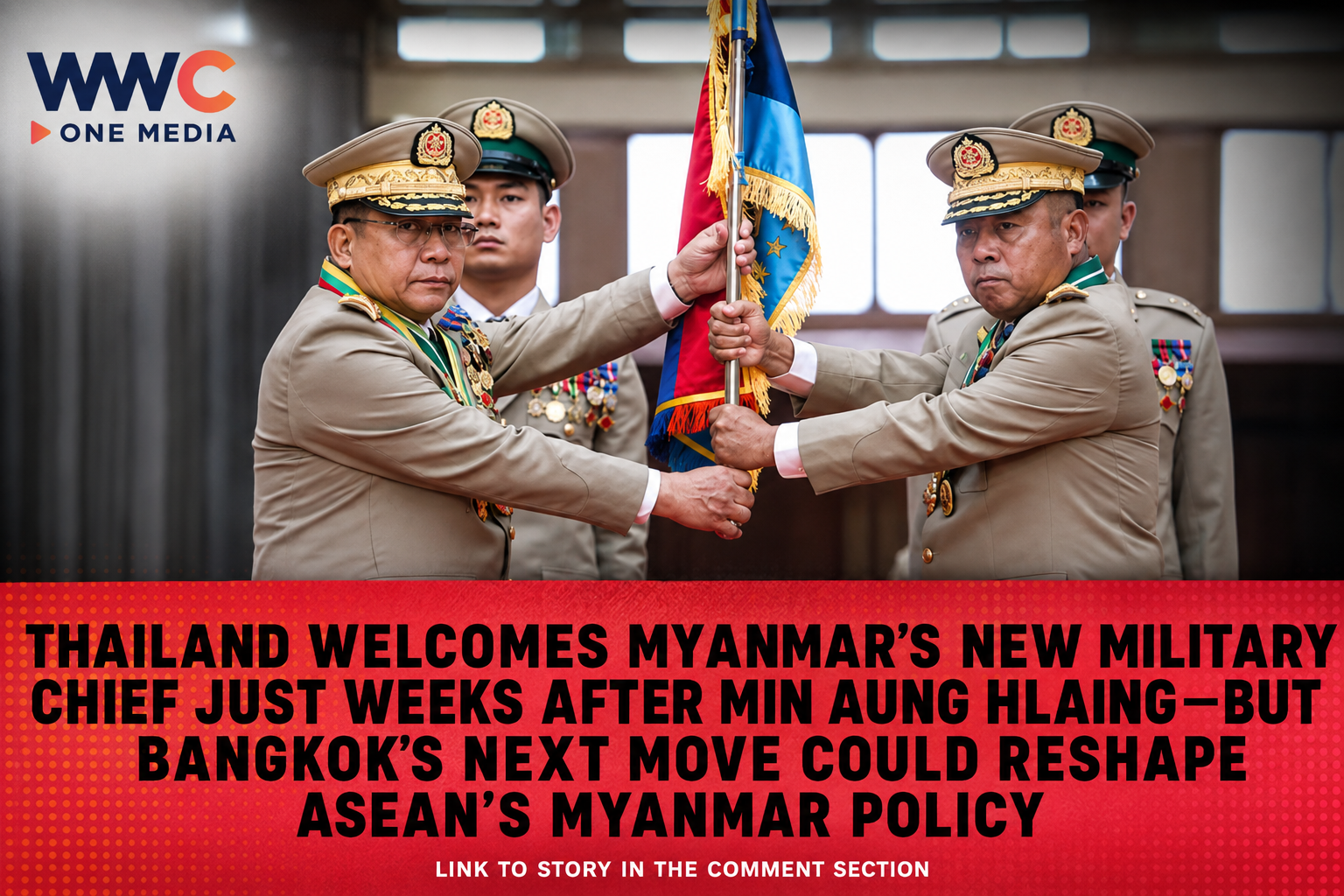
BANGKOK — Thailand is accelerating its engagement with Myanmar’s military establishment, hosting newly appointed armed forces chief Gen. Ye Win Oo in Bangkok just weeks after President Min Aung Hlaing received an official welcome from the Thai government.
Ye Win Oo is in Thailand from August 19 to 21, 2026 for the ninth Myanmar-Thailand High-Level Committee meeting, a bilateral military mechanism focused on defence cooperation, border stability and security threats affecting the two neighboring countries. Thai and Myanmar officials had publicly confirmed the meeting in their joint statement following Min Aung Hlaing’s visit earlier this month.
The visit is significant not simply because of who Ye Win Oo is, but because of what the trip says about Thailand’s evolving approach toward Myanmar.
Bangkok is increasingly favoring direct engagement with Myanmar’s military-backed government even as the country remains engulfed in civil conflict and faces continuing international criticism over attacks on civilians and political repression.
Ye Win Oo’s First Major Foreign Trip Sends a Message
Ye Win Oo took over as Myanmar’s commander-in-chief at the end of March after longtime military leader Min Aung Hlaing relinquished command and moved into the presidency.
Reuters has described Ye Win Oo as a former intelligence chief and one of Min Aung Hlaing’s most trusted loyalists. He played a prominent role during the February 2021 military takeover and was involved in the operation that detained then-leader Aung San Suu Kyi. His rapid ascent through Myanmar’s military leadership has been widely interpreted as evidence that Min Aung Hlaing intends to preserve influence over the armed forces even after formally moving into civilian political office.
His visit to Thailand is particularly notable because it is among his first major diplomatic engagements since assuming command.
The Bangkok meetings are expected to reinforce military-to-military ties and expand cooperation on border management, narcotics, transnational criminal networks and security coordination.
Thailand and Myanmar share a border stretching more than 2,000 kilometers, making instability inside Myanmar a direct security, economic and humanitarian issue for Bangkok.
Online Scam Networks Are Now a Major Security Concern
One of the most immediate areas of cooperation is the fight against transnational crime.
Thailand and Myanmar agreed earlier this month to strengthen joint action against online scam centres, narcotics trafficking and illegal financial flows, including greater information-sharing and cooperation between anti-money-laundering authorities.
Scam compounds operating in areas along Myanmar’s borders have become an international security problem. Criminal networks have been accused of trafficking workers into compounds where they are forced to run online investment, romance and cryptocurrency scams targeting victims around the world.
For Thailand, dismantling those networks has become both a domestic security priority and an international diplomatic issue.
The two governments also agreed to cooperate on illegal trade, environmental problems and border stability.
The Timing Is Politically Sensitive
Ye Win Oo’s trip comes only about two weeks after Min Aung Hlaing made his own high-profile official visit to Bangkok on August 6–7.
Thai Prime Minister Anutin Charnvirakul hosted Min Aung Hlaing at Government House, where the two governments committed to deeper cooperation in politics, defence, trade, energy and border security. Thailand also hosted a bilateral business forum during the visit.
Ahead of the meeting, Anutin openly called for what he described as a “calibrated re-engagement” with Myanmar.
That language represents a potentially important shift in regional diplomacy.
Since the 2021 coup, ASEAN has tried to isolate Myanmar’s senior military leadership from its highest-level meetings because of the authorities’ failure to make substantial progress on the bloc’s Five-Point Consensus peace plan.
Thailand, however, has increasingly argued that geographic reality makes direct engagement unavoidable.
Myanmar’s conflict affects Thailand through refugee movements, cross-border fighting, trafficking networks, pollution, trade disruptions and energy security.
But Engagement Comes With a Political Cost
Critics say Thailand risks giving Myanmar’s military leadership something it badly wants: international legitimacy.
Min Aung Hlaing has embarked on an increasingly active diplomatic campaign since assuming Myanmar’s presidency, visiting regional partners and seeking broader recognition of the military-backed political order.
Shortly after his Thailand trip, he traveled to Russia, where President Vladimir Putin hosted him for talks covering energy, defence and major infrastructure projects.
Myanmar’s authorities argue that the country is returning to constitutional government after elections and the installation of a new administration.
Critics and many international observers reject that characterization, pointing to restrictions on political opposition, the exclusion of major democratic forces and continuing armed conflict across much of the country.
Myanmar’s War Is Still Intensifying
The expanding diplomatic engagement is unfolding against a grim security backdrop.
Reuters reported in July that Myanmar’s military had intensified attacks on civilians following the leadership transition that placed Ye Win Oo at the top of the armed forces.
Data cited from the Armed Conflict Location & Event Data Project, or ACLED, indicated that more than a dozen mass-killing incidents had contributed to more than 450 civilian deaths during the first half of 2026, particularly in central Myanmar.
Myanmar has been locked in nationwide conflict since the military overthrew Aung San Suu Kyi’s elected government in February 2021.
Resistance forces, People’s Defence Forces and numerous ethnic armed organizations continue fighting the military across large areas of the country.
That means the deeper Thailand-Myanmar relationship is developing while the underlying political and military crisis remains unresolved.
Why Thailand Is Still Choosing Engagement
For Bangkok, the policy appears to be driven less by ideological alignment than by proximity and pragmatism.
Thailand cannot easily isolate a country with which it shares a long border, deep trade connections and intertwined security problems.
Thai officials say closer dialogue could help control border violence, suppress criminal networks, protect trade routes and potentially give Bangkok greater leverage in supporting peace efforts.
During Min Aung Hlaing’s August visit, Anutin’s government also said Thailand would continue supporting efforts to reconnect Myanmar with ASEAN and promote a peace process inside the country.
The difficult question is whether that engagement gives Thailand meaningful influence over Myanmar—or simply gives Myanmar’s military-backed government greater diplomatic acceptance without requiring major concessions.
For now, Bangkok appears willing to test the first possibility.
And Ye Win Oo’s visit suggests Thailand’s outreach is no longer limited to civilian-style diplomacy with Min Aung Hlaing’s government. It is extending directly into the military command structure that still holds enormous power inside Myanmar.
Why This Matters
Thailand’s decision to host Myanmar’s new commander-in-chief could become another important step in the gradual normalization of Myanmar’s military-backed leadership across Southeast Asia.
If other ASEAN members follow Bangkok’s approach, Myanmar could slowly regain regional diplomatic access despite limited progress toward ending the war.
But if violence inside Myanmar continues escalating while diplomatic relations improve, Thailand and ASEAN may face growing questions over whether engagement is producing peace—or merely helping Myanmar’s leaders escape years of isolation.
That may be the real significance of Ye Win Oo’s Bangkok trip: not simply another military meeting, but another sign that Myanmar’s rulers are finding their way back into the regional diplomatic room.