
Trump Is Betting Big on AI Data Centers — But His Own Voters Could Turn Them Into a GOP Midterm Nightmare

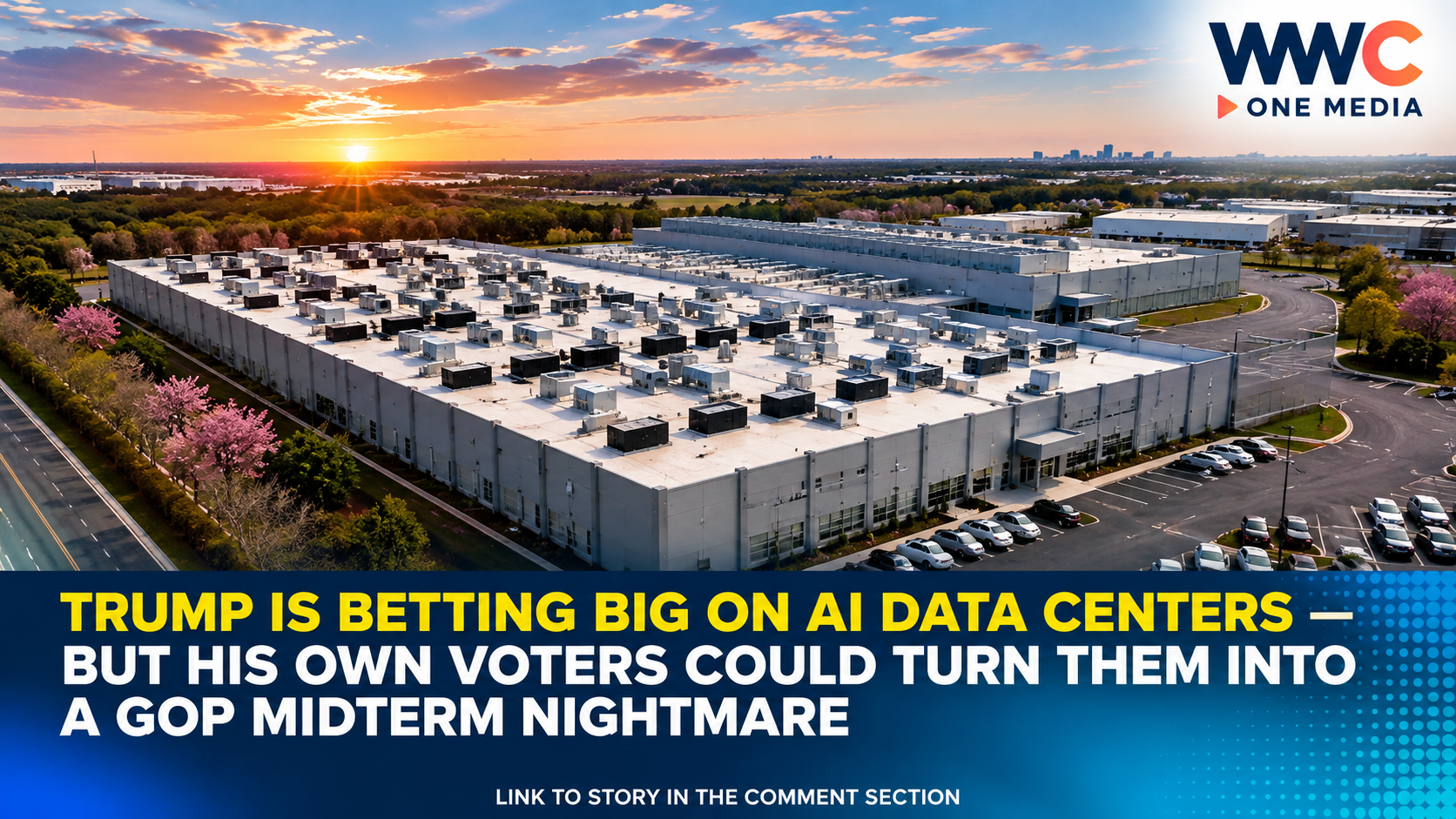
President Donald Trump has made the rapid expansion of artificial-intelligence data centers a key part of his vision for keeping the United States ahead of China.
But as the 2026 midterm elections approach, that strategy is creating an unexpected political headache: Republican candidates in several battleground states are increasingly distancing themselves from the president’s aggressive pro-data-center position.
The fight is no longer simply about artificial intelligence.
It is increasingly about electricity bills, water consumption, tax incentives, local control and whether ordinary Americans will ultimately pay for the massive infrastructure needed to power the AI boom.
And that could turn data centers into a much bigger election issue than either party initially expected.
Trump says America cannot afford to fall behind
Trump has repeatedly argued that the United States needs to accelerate AI infrastructure to maintain its technological advantage over China.
His administration has promoted policies designed to speed up data-center construction, including measures aimed at easing permitting and encouraging investment.
Trump has also pushed back aggressively against communities and politicians seeking to slow the expansion.
In a social-media post on Aug. 31, Trump warned that communities rejecting data centers risked becoming “backwards and poor,” arguing that the facilities bring jobs, investment and tax revenue.
His argument is straightforward: if America slows down AI infrastructure while China continues building, the United States could lose a critical technological race.
But voters in some of the communities where these facilities are being proposed are increasingly asking a different question:
Who is going to pay for all of it?
Electricity bills are becoming the political flashpoint
AI data centers require enormous amounts of electricity to operate the computers that train and run increasingly powerful AI models.
That has created concern among residents who fear that rapidly growing demand could require expensive new power plants, transmission lines and grid upgrades.
Critics worry those costs could eventually be passed on to households.
A national Economist/YouGov survey conducted Aug. 21–24 found that 61% of Americans opposed having a new data center built in their community, including 47% of Republicans, according to The Washington Post. The same survey found 51% disagreed with Trump's assessment that communities should welcome data centers.
The issue has become particularly potent because the debate isn't confined to Democrats.
Republican voters are increasingly raising the same concerns about affordability and local control.
Texas shows how quickly the politics can change
Perhaps nowhere is the Republican dilemma clearer than Texas.
Texas Governor Greg Abbott previously promoted the state as a major center of AI development. But amid growing opposition, he has moved toward tougher restrictions on new data-center projects.
Republican Attorney General Ken Paxton, who is campaigning for the U.S. Senate, has also adopted a more skeptical position.
Reuters reported that Republican candidates in at least five states — including Texas, Michigan, Wisconsin and Pennsylvania — have recently adopted tougher rhetoric or proposed restrictions on data-center development.
That creates an unusual split inside the Republican Party.
Trump is arguing that America needs to build more.
Some Republican candidates are increasingly telling voters that America needs safeguards before it builds more.
The political math is getting harder for Republicans
The timing could not be worse for the GOP.
The 2026 midterm elections are approaching, and Democrats have discovered that opposition to data centers can be used as a potent local campaign issue.
An NPR analysis of political advertising data found that campaigns and outside groups have spent more than $45 million since January on advertisements mentioning data centers in House, Senate and gubernatorial races.
The messaging is remarkably similar across many races:
- Data centers could increase pressure on electricity systems.
- Communities may be giving technology companies generous tax incentives.
- Water consumption is becoming a concern.
- Local residents want more say over where massive facilities are built.
- Big technology companies should pay for the infrastructure they require.
That message has found support across party lines.
Even Republicans in Congress are divided
The political pressure is also reaching Capitol Hill.
House Republicans have been wrestling with legislation intended to protect electricity customers from being forced to absorb infrastructure costs associated with large data centers.
A House Energy and Commerce Committee bill, approved 52-0 in July, would require states to consider standards ensuring that large electricity users cover the costs of necessary grid upgrades.
But Republicans remain divided over how far federal regulation should go.
Some lawmakers argue that data centers must pay their fair share.
Others warn that excessive restrictions could slow America's AI development and hand an advantage to China.
That tension is at the heart of the Republican debate.
Big Tech is fighting back
Technology companies are not sitting quietly while the political narrative turns against them.
Reuters reported that major technology interests have been spending heavily to defend data-center development, including more than $300 million in midterm-related spending by big tech companies and affiliated groups, according to election records and disclosures reviewed by the news agency.
Companies and industry groups argue that data centers bring economic investment, construction activity, technological leadership and jobs.
They also argue that the United States needs a massive expansion of computing infrastructure if it wants to remain competitive in AI.
But opponents counter that the number of permanent jobs at an operating data center can be relatively small compared with the size of the facilities and the infrastructure they require.
That disagreement is increasingly becoming an election issue.
The “ratepayer protection” battle
The Trump administration has attempted to address public concerns through a Ratepayer Protection Pledge, under which major technology companies and utilities commit to measures designed to prevent ordinary electricity customers from bearing the costs of data-center expansion.
More than 300 utilities, cooperatives and AI “hyperscalers” have reportedly signed the pledge.
The problem for critics is that the pledge is voluntary.
Republicans in Congress are therefore debating whether some of those protections should become federal requirements rather than remain voluntary commitments.
That debate could become one of the most consequential pieces of the AI infrastructure fight.
It is no longer just an AI debate
The political backlash reveals something important about America's AI boom.
For years, the conversation surrounding artificial intelligence focused primarily on technological breakthroughs, investment and competition with China.
Now the debate is becoming much more tangible.
People are asking:
Will my electricity bill increase?
Will my community's water supply be affected?
Will taxpayers subsidize billion-dollar technology projects?
How many jobs will actually remain once construction is finished?
And perhaps the most politically important question:
Who gets the benefits — and who pays the costs?
Those questions have helped turn data centers from a relatively obscure technology issue into an increasingly visible campaign issue.
The GOP's biggest dilemma
Trump's position is based on a national strategy: build quickly, invest heavily and make sure the United States remains the world's AI leader.
Republican candidates facing voters locally have a different calculation.
They have to answer to residents who may welcome the investment but don't want higher utility bills, strained infrastructure or large developments imposed on their communities.
That explains why some Republicans are trying to occupy a middle ground:
Support AI. Support economic growth. But make technology companies pay for the infrastructure they use.
Whether that compromise can satisfy voters — while still allowing America to move quickly enough in the AI race — remains one of the biggest questions heading into the midterms.
And for Trump, the political danger is becoming increasingly clear.
The president may believe AI data centers are essential to America's future.
But if voters decide those same facilities are making their communities more expensive to live in, the AI boom could become a very different kind of political liability for the Republican Party.
WWC ONE MEDIA M.J.E