WALL STREET JUST GOT A LIFELINE — BUT THE BOND MARKET WARNING BEHIND THE RALLY COULD BE MUCH BIGGER

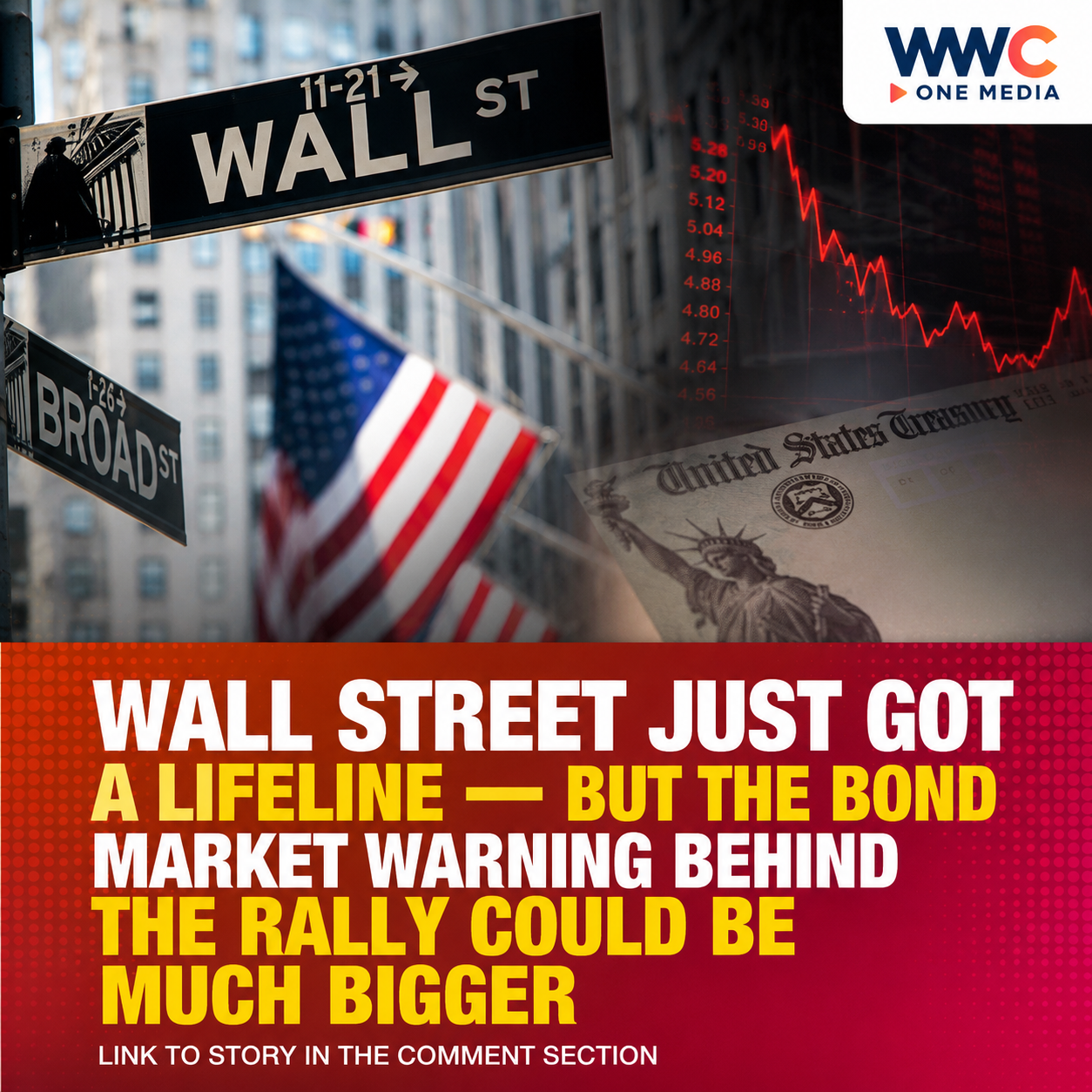
NEW YORK — Wall Street regained its footing Wednesday after the U.S. Treasury moved to ease pressure in the bond market, giving investors temporary relief from a surge in long-term borrowing costs that has increasingly threatened stocks, businesses and the broader economy.
The S&P 500, Dow Jones Industrial Average and Nasdaq Composite all finished higher, snapping a three-session losing streak. The S&P 500 gained about 0.2%, while the Dow and Nasdaq also advanced roughly 0.2%.
But the modest stock-market rebound masks a much bigger story unfolding in U.S. government debt.
Treasury steps in as bond-market pressure intensifies
The U.S. Treasury announced that it would double the size of its liquidity-support buyback operations for longer-dated Treasury securities to at least US$4 billion per operation, from US$2 billion previously.
The move came after long-term Treasury yields surged to levels not seen in years, with the 30-year yield recently moving above 5% and briefly approaching 5.34%, its highest level in nearly two decades.
The announcement helped push long-term yields lower, with U.S. long-dated government yields falling by as much as 10 basis points on Wednesday.
That mattered immediately for stocks.
When Treasury yields rise sharply, borrowing becomes more expensive across the economy. Mortgage rates, corporate financing costs and the cost of funding major investments can all move higher.
For Wall Street, the problem is particularly important for technology companies pouring billions of dollars into artificial-intelligence infrastructure.
Why investors are watching Treasury yields so closely
The recent bond-market selloff has been driven by several forces rather than one isolated event.
Investors are increasingly concerned about large government deficits, persistent inflation, heavy borrowing and geopolitical risks, particularly the impact of elevated oil prices associated with the conflict involving the United States and Iran.
Higher oil prices can feed inflation by increasing transportation and production costs.
That creates a difficult situation for the Federal Reserve.
If inflation remains stubbornly high, policymakers may have less room to cut interest rates — and could potentially consider additional increases.
Minutes from the Federal Reserve's July meeting showed that several policymakers were prepared to raise interest rates if inflation failed to decline toward the central bank's 2% target. Three voting members dissented from the decision to leave rates unchanged.
Yet markets have recently reduced their expectations for an immediate September rate increase following softer inflation and employment data.
That leaves investors caught between two competing forces: an economy that may be losing momentum and inflation that remains uncomfortably high.
The AI boom is now facing a new test
The bond-market turmoil is particularly significant because the latest stock-market rally has been heavily tied to expectations surrounding artificial intelligence.
Big technology companies and other "hyperscalers" are committing enormous sums to data centers, chips and computing infrastructure.
Much of that investment is being financed through debt.
As long-term Treasury yields rise, companies may have to pay more to borrow. That can raise the cost of AI expansion and potentially make investors question whether the enormous spending required to build AI infrastructure will generate enough profits to justify it.
Reuters noted that investors were already questioning whether heavy AI spending would produce tangible returns quickly enough to justify the extraordinary valuations attached to parts of the technology sector.
That helps explain why technology and semiconductor shares came under heavy pressure during Tuesday's session.
Wall Street recovered — but not everything is fixed
Wednesday's rebound was broad but relatively small.
According to AP, the S&P 500 rose 16.22 points, or 0.2%, to 7,707.98. The Dow gained 119.65 points, also 0.2%, to 53,463.05, while the Nasdaq climbed 41.38 points, or 0.2%, to 26,331.09.
The recovery also came as corporate earnings provided additional support.
Moderna was one of the day's biggest standouts, surging 177% after positive results involving its experimental melanoma vaccine developed with Merck. Merck shares also jumped sharply.
But the market remains vulnerable.
Oil prices continued climbing as uncertainty surrounding the Strait of Hormuz added another layer of inflation risk. Reuters reported U.S. crude settled at about US$85.59 a barrel, while Brent reached about US$91.42.
The dollar is weakening while gold and bitcoin jump
The Treasury announcement also triggered major moves outside the stock market.
The U.S. dollar index fell about 0.84%, while gold jumped more than 4% to around US$4,508.64 an ounce. Bitcoin also rose more than 6% during the session.
That combination is notable because falling bond yields generally make non-yielding assets such as gold more attractive.
It also highlights the growing debate surrounding the U.S. government's debt trajectory.
The Treasury's buyback program can improve liquidity in the bond market, but it does not eliminate the underlying fiscal challenge of financing large government deficits.
The bigger question: Can Treasury intervention last?
This is where the market story becomes more complicated.
The Treasury's move provided immediate relief, but analysts have warned that buybacks cannot solve the fundamental forces pushing long-term yields higher.
AP reported that some analysts believe the intervention could ultimately have limited impact because the United States still faces substantial borrowing needs while major technology companies are also issuing large amounts of debt to finance AI infrastructure.
In other words, the Treasury may have bought the market some breathing room — but it has not removed the underlying pressure.
That distinction could become crucial if inflation remains elevated, oil prices stay high and government borrowing continues to expand.
What investors are watching next
For Wall Street, the next major question is whether Wednesday's rebound marks the beginning of a stabilization — or simply a pause in a much larger bond-market repricing.
Investors will be watching Treasury yields, oil prices, inflation data, Federal Reserve policy signals and corporate earnings, particularly from companies whose valuations depend heavily on continued AI investment.
The Fed's next major communication could also become important. AP notes that attention is turning toward Federal Reserve Chair Kevin Warsh's upcoming speech at the Jackson Hole economic symposium on Aug. 28, which could provide additional clues about the central bank's thinking on inflation and interest rates.
For now, Wall Street has been given a reprieve.
But the real test may not be whether stocks can rise for another day.
It may be whether the Treasury can keep long-term borrowing costs under control without convincing investors that the government is simply treating the symptoms of a much larger debt and inflation problem.
And that is the question markets will be watching next.