
Woman Loses S$108,500 Prudential Claim After Brain Aneurysm Surgery — The Clause That Decided Everything

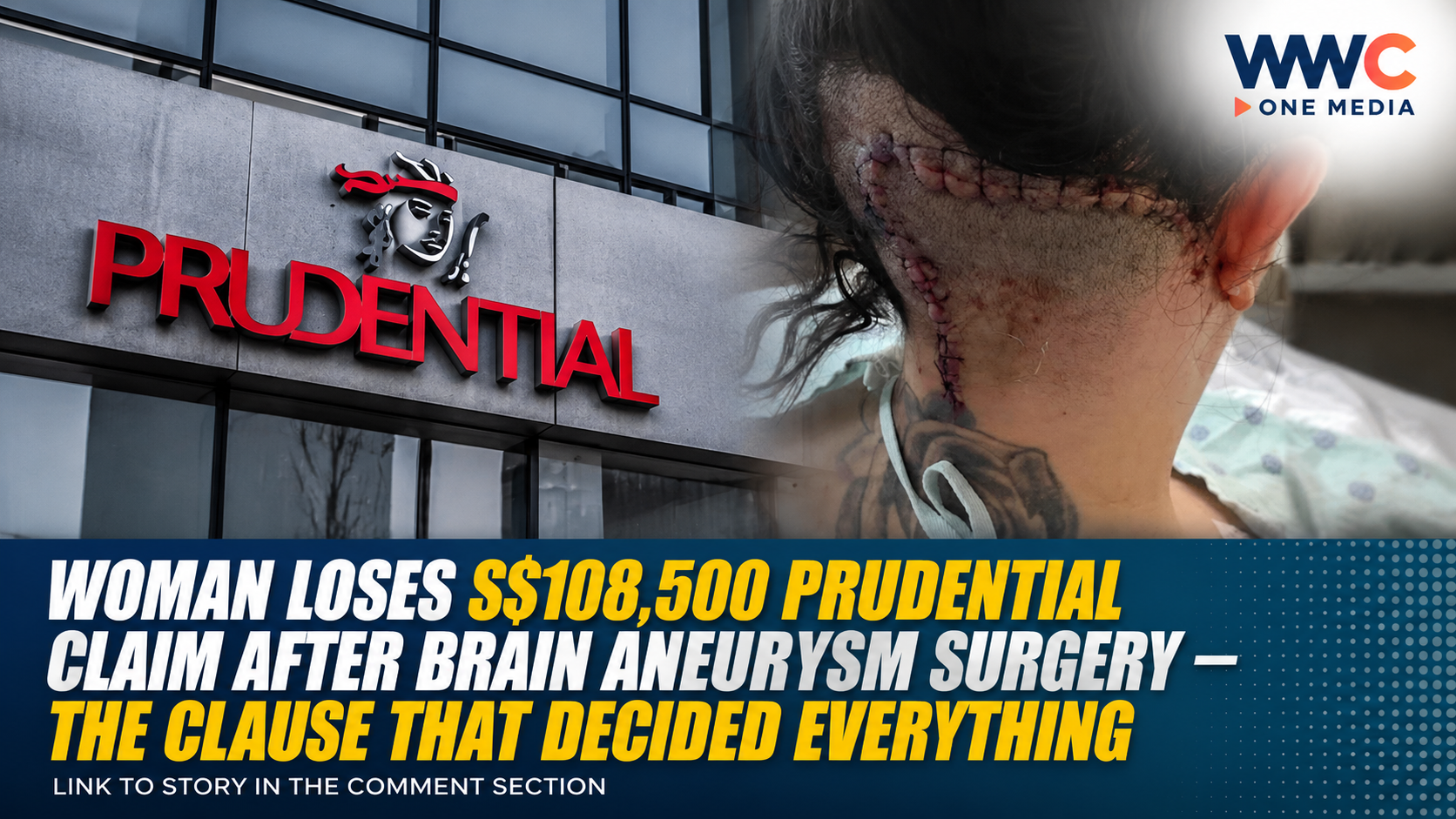
SINGAPORE — A 45-year-old woman who survived a ruptured brain aneurysm has lost her legal battle against Prudential Assurance Company Singapore after the insurer refused to pay a S$108,500 critical illness claim over the type of surgery she underwent.
The case has drawn attention to a question many insurance policyholders may never consider until it is too late: Can an insurer reject a serious medical claim because the treatment performed does not match the specific procedure written into an older policy?
In a written judgment issued on Thursday, Sept. 3, District Judge Teo Guan Kee dismissed Cai Yunhong’s claim, rejecting her argument that Prudential had effectively hidden the relevant exclusion in its policy documents.
The judge said the policy, viewed objectively and as a whole, left no room for doubt that the benefit would not apply when an insured person underwent endovascular repair rather than the specified surgical craniotomy.
The medical emergency that started the dispute
Cai suffered a stroke in 2023 after a brain aneurysm ruptured. She collapsed while travelling on a bus and was taken to the National University Hospital, where she underwent emergency treatment.
She spent 21 days in hospital, including eight days in intensive care, and subsequently recovered.
Her treatment involved endovascular repair — a minimally invasive procedure performed through blood vessels rather than by opening the skull.
That distinction ultimately became the centre of the insurance dispute.
Cai had purchased Prudential’s PruLife Multiplier policy in 2016 through Standard Chartered Bank, together with an Early Crisis Cover Multiplier supplementary benefit.
She sought S$108,500 under that benefit, along with approximately S$12,000 relating to premiums and a request for future premium relief.
Why Prudential rejected the claim
The policy defined “brain aneurysm surgery” in terms of the actual performance of surgical craniotomy — an open-skull procedure used to repair an intracranial aneurysm or remove an arteriovenous malformation.
It also specifically stated that endovascular repair or procedures were not covered.
Cai argued that this amounted to a “buried clause” because the exclusion was not sufficiently prominent or understandable to an ordinary policyholder.
She also argued that she did not have a meaningful choice over the procedure because her aneurysm had ruptured and she was receiving emergency treatment.
Prudential took the opposite position.
The insurer argued that the policy was clear and that the benefit depended not merely on having a brain aneurysm, but on satisfying the contractual definition of the covered surgical procedure.
The court rejects the “buried clause” argument
Judge Teo ultimately sided with Prudential.
The court found that describing the relevant provision as hidden or “buried” was not a fair characterisation of the policy.
The judgment focused on the wording of the contract itself rather than Cai’s expectations about what the insurance should cover.
The judge also noted that Cai had a 14-day period after receiving the policy to review its terms and conditions and cancel the policy if she was dissatisfied with them.
Importantly, the judge did not make findings concerning any potential duty or liability owed to Cai by parties who were not defendants in the case, including Standard Chartered or its employees.
The controversy goes beyond one insurance claim
The case has also highlighted how medical treatment can evolve faster than the wording of older insurance policies.
When Cai bought her policy in 2016, Prudential said insurers had different approaches to covering endovascular repair, with some insurers excluding the procedure.
Prudential has since changed some of its coverage.
The insurer told CNA that some of its critical illness policies, including a plan launched in March 2026, now cover the type of procedure Cai underwent.
Earlier reporting during the trial also showed that the dispute centred heavily on how the policy was presented and understood.
Cai questioned Prudential's head of life claims about why certain exclusions appeared where they did and argued that the policy documents were complicated and ambiguous.
What the case means for insurance policyholders
The dispute offers a stark reminder that an insurance policy's headline coverage may not tell the whole story.
Two policies can appear to cover the same illness while imposing very different definitions, procedural requirements or exclusions.
In this case, the court's decision turned on the precise contractual definition of the covered surgery rather than simply the fact that Cai had suffered a life-threatening brain aneurysm.
For consumers, the lesson is straightforward: when reviewing critical illness insurance, the definitions and exclusions can be just as important as the headline payout.
And medical advances can create another complication. A treatment considered standard or preferable years later may not necessarily satisfy the wording of an older insurance contract.
Cai likely to appeal
Despite losing the case, Cai has indicated that she is likely to appeal.
Her original lawsuit was also framed as an effort to draw attention to what she regarded as unfair insurance practices and to push insurers toward greater transparency about exclusions.
For now, however, the District Court has ruled against her.
The case leaves behind a question that extends far beyond one S$108,500 claim:
When an emergency leaves a patient no practical choice over the treatment used, should insurance coverage depend on the exact procedure written into a policy years earlier?
For the Singapore court, in this case, the answer was determined by the contract.
WWC ONE MEDIA MJE