
Your Matte Foundation May Not Be the Problem—This Thai Makeup Artist Says the Real Fix Starts Before You Apply It

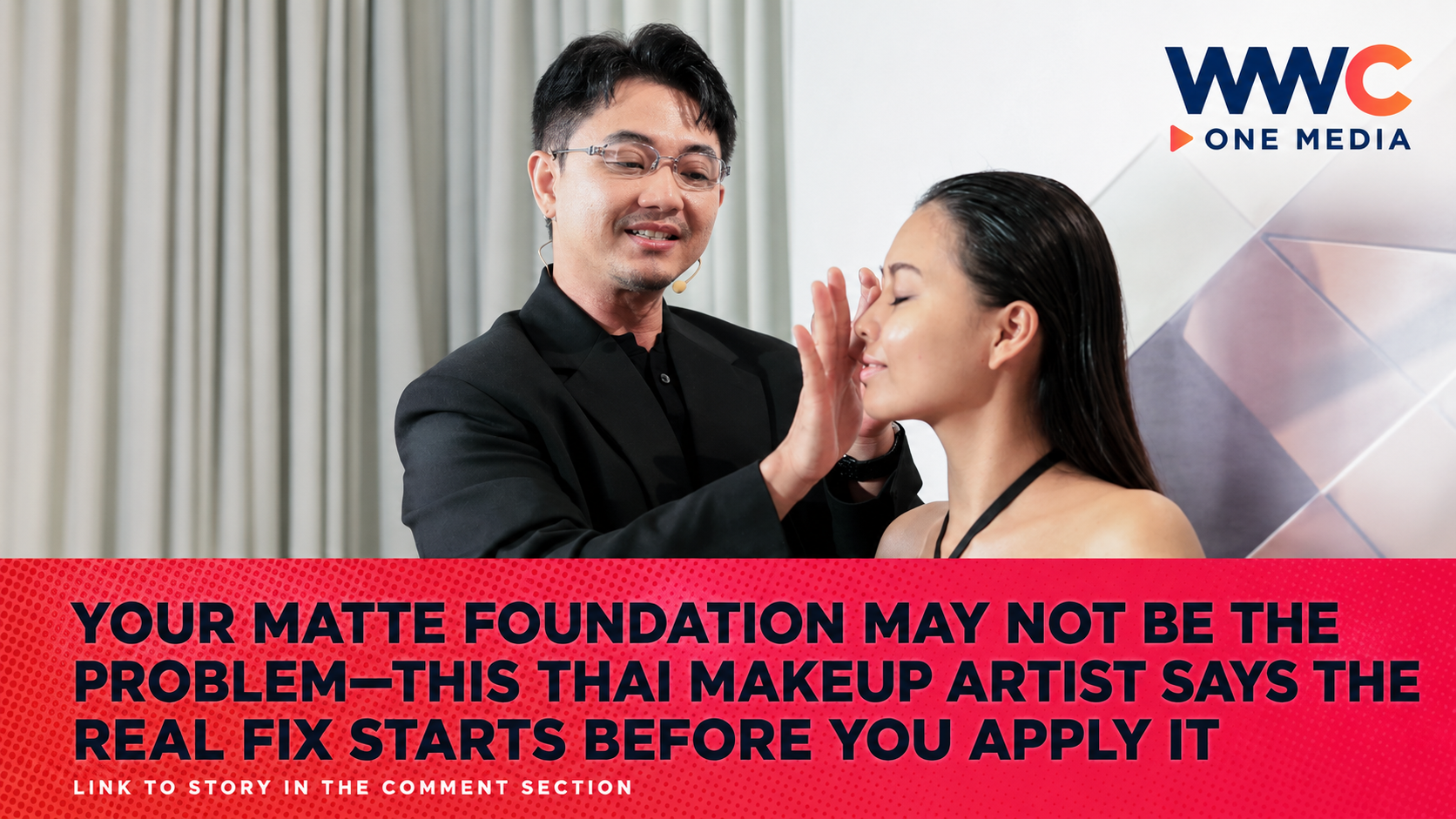
Matte foundation has a reputation for being unforgiving: apply too much and it can look heavy, skip skin preparation and it may cling to dry patches, while too much powder can leave the complexion looking flat.
But according to NARS Thailand makeup artist Suphachat “Tee” Thawisin, achieving a polished matte finish is less about piling on more product and more about how the base is prepared, applied and finished. Manila Bulletin recently featured Thawisin’s seven tips for achieving better-looking matte foundation.
The advice comes at a time when matte makeup is getting a modern update. Instead of the thick, completely flat complexion associated with older matte trends, today's approach increasingly favors a soft, blurred and skin-like finish.
NARS' own professional guidance follows a similar philosophy. Its Natural Matte Longwear Foundation instructions recommend starting with properly prepared skin, applying the foundation in thin, even layers and setting only areas that actually need additional oil control.
1. Start with the skin, not the foundation
One of the biggest mistakes people make is treating foundation as the first step toward a flawless complexion.
It isn't.
The condition of the skin underneath can dramatically affect how a matte formula sits. NARS recommends beginning with skincare that supports hydration and balance, followed by primer when necessary. The brand also advises allowing each layer to absorb before applying the next one.
That approach is particularly relevant in hot and humid climates, where excess moisture, sweat and sebum can quickly change the appearance of makeup.
Recent beauty guidance from Vogue similarly emphasizes that skin preparation should be tailored to the individual's skin condition rather than relying on a rigid, one-size-fits-all routine.
2. Less foundation can actually look better
When foundation starts looking cakey, the instinct is often to add more.
That can make the problem worse.
Professional application generally favors thin layers that are built gradually instead of one heavy layer. NARS recommends pressing and smoothing matte foundation in thin, even layers, concentrating coverage where it is needed.
Allure's recent reporting on matte foundations reaches a similar conclusion, noting that makeup artists recommend applying full-coverage formulas sparingly and building coverage as necessary.
The result is coverage without unnecessarily masking the skin's natural dimension.
3. Concentrate coverage where you actually need it
Your entire face may not require the same amount of foundation.
The center of the face often needs more coverage than the outer areas. NARS' application guide recommends starting where more coverage is required—typically around the center of the face—and blending outward.
This technique can prevent the complexion from becoming unnecessarily thick around the hairline, jaw and cheeks.
It also helps create the modern version of matte skin: controlled shine without making every part of the face look completely flat.
4. Give the formula time to work
Fast application can be tempting, especially when you're getting ready in a hurry.
But complexion products perform better when they're applied deliberately.
NARS recommends warming liquid foundation with the fingertips before application, then gently spreading it from areas requiring more coverage toward the perimeter of the face.
The brand's Soft Matte Complete Foundation tutorial similarly recommends starting with a small amount and pressing it into the skin using a stippling motion before blending outward.
The takeaway is simple: control the amount before trying to perfect the finish.
5. Don't automatically powder your entire face
More powder does not automatically mean longer-lasting makeup.
NARS' current Natural Matte guidance recommends setting selectively, particularly in areas prone to shine, rather than covering the entire complexion with powder. The brand also recommends blotting or lightly touching up areas that need attention throughout the day.
That approach can help maintain dimension while still controlling excess shine.
It is especially useful for people who want matte skin without the overly powdered appearance that can emphasize texture.
6. Choose your finish according to your skin
Matte does not mean every person should use the same type of foundation.
Skin type, texture and desired coverage all matter.
NARS describes its Natural Matte Longwear Foundation as intended for normal, combination and oily skin, while its Natural Radiant Longwear Foundation is positioned toward normal and dry skin.
Recent Allure coverage also notes that foundation choices should evolve with changes in skin condition, with lighter and more hydrating formulas often making sense when dryness or texture becomes more noticeable.
In other words, the best matte foundation is not necessarily the most aggressively matte one.
7. Think “soft matte,” not “flat matte”
This may be the biggest shift in the way matte makeup is being worn in 2026.
Beauty trends are moving away from the completely flat, heavily powdered complexion toward finishes that retain some dimension while still controlling shine. Recent beauty reporting describes matte makeup's comeback as more hydrated and velvety, rather than the dry, one-dimensional finish associated with older matte trends.
A 2026 makeup-artist guide similarly recommends using matte strategically—particularly in areas that need oil control—while allowing other parts of the face to retain a more natural finish.
That means flawless matte skin does not necessarily mean matte everywhere.
Why these tips matter in hot and humid weather
For people living in tropical climates, foundation longevity can be an entirely different challenge.
Heat, humidity, sweat and oil can cause makeup to separate, fade or become patchy. Recent summer-makeup testing by Tom's Guide likewise found that skin preparation and lightweight product choices play an important role in helping makeup withstand humidity.
The solution, however, isn't simply adding more foundation and powder.
A better strategy is to build the complexion in controlled layers:
Prep → apply sparingly → build coverage → set selectively → touch up only where necessary.
That philosophy also aligns closely with NARS' own current application guidance for its matte foundation.
The real secret to matte foundation?
It may not be the foundation itself.
The difference between a cakey matte base and a polished one often comes down to preparation, product quantity, placement and technique.
And that is why Thawisin's seven-tip approach is worth paying attention to: instead of treating matte makeup as a battle against shine, the modern approach is about creating a controlled finish that still looks like skin.
For anyone struggling with foundation that turns patchy, heavy or overly dry by midday, the first step may be surprisingly simple:
Stop adding more—and start applying smarter.