
A Philippine Coast Guard Commission Is Being Proposed — But One Senior Officer Says the Real Fix Must Come First

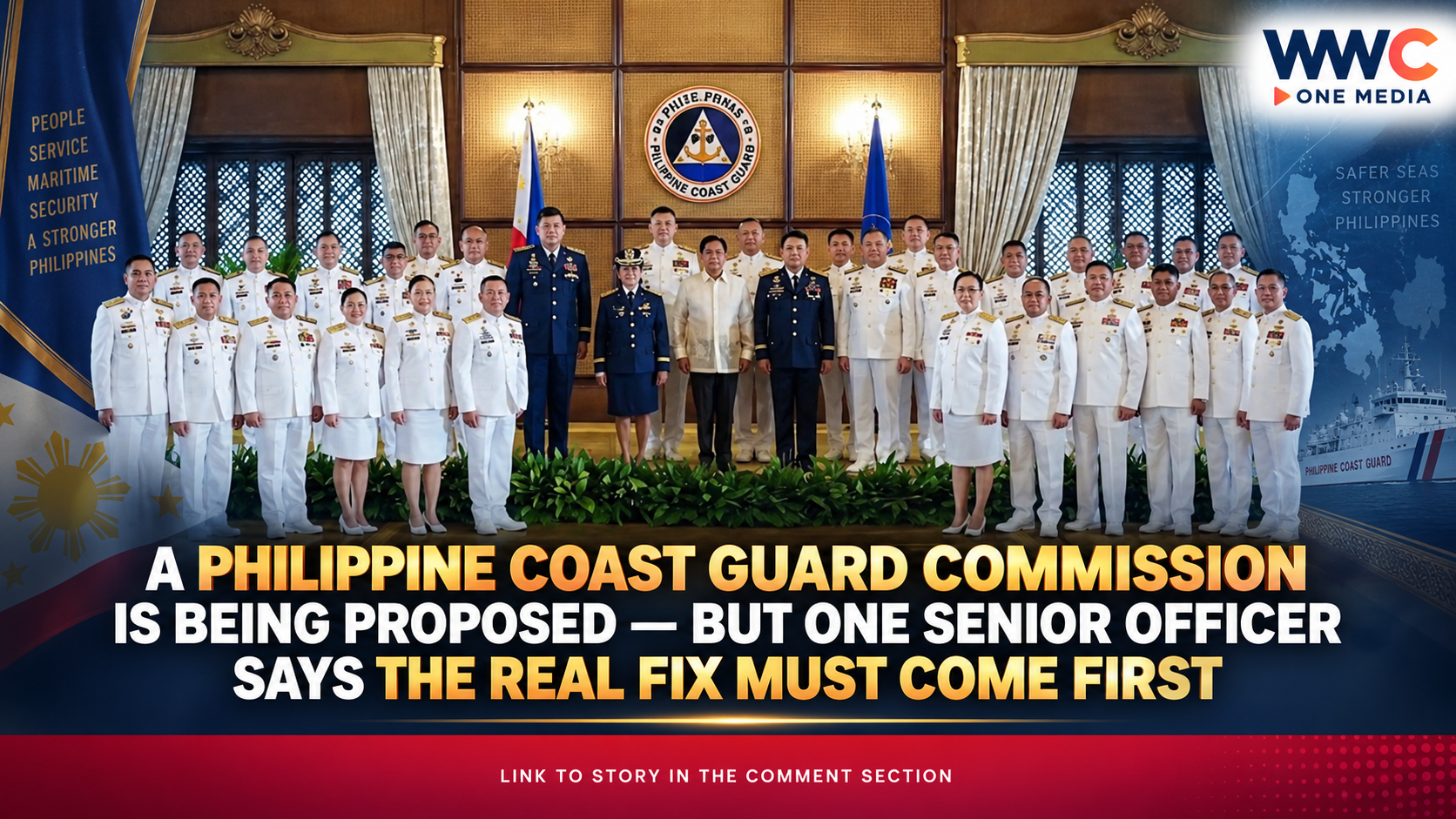
MANILA, Philippines — The Philippine Coast Guard is in the middle of one of the biggest institutional overhauls in its history, but a new debate is emerging over a question that ships, radar systems and bigger budgets cannot answer: Who should ensure that tomorrow’s Coast Guard leaders are actually the most qualified people for the job?
A proposal by retired Vice Admiral Joseph M. Coyme to establish a permanent Philippine Coast Guard Commission has opened a wider discussion about political influence, promotions, career development and accountability inside a maritime service that has grown dramatically over the past three decades.
Now, Commodore Dann August A. Carino, the PCG's Deputy Chief of Staff for Operations, is challenging the sequence of that proposal.
Carino does not dispute that governance needs improvement.
His argument is different: before creating another outside body to scrutinize the Coast Guard, the PCG must first build stronger internal systems that clearly establish who is qualified for promotion, command and senior leadership.
The distinction could become increasingly important as Congress simultaneously works on sweeping legislation to restructure and professionalize the Coast Guard.
From roughly 3,000 personnel to nearly 36,000
The scale of the transformation helps explain why this argument is happening now.
Coyme says that when the PCG was transferred from military to civilian authority in 1998, it had roughly 3,000 personnel.
Today, he estimates that it has nearly 36,000, with an authorized organizational strength approaching 38,000 personnel.
Its responsibilities have expanded alongside that growth.
The Coast Guard now handles search and rescue, maritime law enforcement, marine environmental protection, maritime safety, disaster response and increasingly sensitive operations connected to Philippine sovereign rights and jurisdiction in the West Philippine Sea.
That means decisions about who becomes a district commander, flag officer or ultimately commandant are no longer simply internal personnel matters.
They can affect maritime security, diplomatic encounters, billions of pesos in assets and the Philippines' ability to respond to crises at sea.
Coyme's conclusion is that the institution has grown faster than the governance system around it.
Carino agrees with much of the diagnosis.
They differ sharply over the prescription.
Coyme wants a Philippine Coast Guard Commission
Coyme's proposal is modeled in principle — though not necessarily in exact structure — on the relationship between the Philippine National Police and the National Police Commission.
He argues that responsibility for Coast Guard institutional development is currently fragmented among several government bodies.
The Department of Transportation provides administrative supervision. The Civil Service Commission has jurisdiction over relevant personnel matters. The Commission on Audit examines public spending, while the Office of the Ombudsman can investigate misconduct and corruption.
But Coyme argues none of them exists specifically to manage the PCG's long-term professional development.
A dedicated Coast Guard Commission, in his proposed model, could deal with issues such as workforce planning, promotion standards, leadership development, specialized career tracks, institutional assessments, organizational planning and professional qualifications.
Operational command would remain with the Coast Guard commandant.
In other words, the commission would theoretically govern the institution without commanding its ships and personnel in the field.
Coyme has described legislation as the ultimate solution, although he has also suggested an evolutionary approach that could begin with a governance mechanism inside the Department of Transportation and later proceed to an interim national body before Congress creates a permanent commission.
Carino: Fix the machinery inside the Coast Guard first
Carino's counterargument goes to the heart of the debate.
He separates external governance from internal governance.
External oversight can audit, investigate, review and hold officials accountable.
Internal governance determines how officers are trained, how competence is measured, what qualifications are required for key positions, how career paths are structured and how promotion boards make decisions.
And according to Carino, that internal architecture has to exist before an external commission can effectively judge it.
His concern is straightforward.
Suppose a new commission is instructed to review Coast Guard promotions.
What exactly would commissioners examine if the PCG has not first codified detailed competency requirements for every major position?
If there are no sufficiently clear career tracks, transparent standards and documented reasons behind selection-board decisions, outside reviewers could end up examining personalities rather than measurable qualifications.
That would not necessarily eliminate discretion.
It could simply move discretion from inside the Coast Guard to another group of government appointees.
The critical difference: qualification before discretion
Carino's argument is not that commanders should lose all judgment over appointments.
Command positions inevitably require confidence and trust.
Instead, he argues that discretion should come after qualification has already been established.
Under that model, the system would first identify a pool of officers who satisfy objective education, experience, competency and career requirements.
Senior leadership could then select from that qualified pool.
The danger, he argues, comes when personal confidence or proximity begins replacing objective qualifications instead of supplementing them.
That distinction could sound bureaucratic, but it has significant consequences.
If an officer knows that completing difficult assignments, specialist training and professional education materially affects promotion prospects, the system creates incentives to build competence.
If those achievements are easily overridden by relationships or changing leadership preferences, the incentive becomes weaker.
Congress has already started rewriting the system
This debate is not happening in a legislative vacuum.
On August 11, the Senate unanimously approved Senate Bill No. 2116, or the proposed Revised Philippine Coast Guard Law, on third and final reading, with 19 senators voting in favor.
The proposal goes considerably beyond buying ships.
It would reorganize the Coast Guard into functional, support and technical commands and establish 17 Coast Guard districts.
The Senate version also addresses ranks, promotion procedures, career structures, compensation and benefits and would create a Philippine Coast Guard Academy.
Crucially for the current governance argument, the measure also provides for a Coast Guard Internal Affairs Service, strengthening the institution's internal disciplinary machinery.
Senator Raffy Tulfo, the principal sponsor, has characterized the legislation as a way to give the PCG clearer authority and administrative independence while bringing personnel structures and compensation closer to those of the Armed Forces and Philippine National Police.
The House is also moving.
On September 2, the House Committee on Transportation listed for consideration a substitute bill consolidating numerous measures seeking to strengthen the Philippine Coast Guard through policy and organizational reforms.
That means the argument over governance is arriving at exactly the moment lawmakers are deciding what the Coast Guard of the next generation will look like.
One reform has already changed the top job
Congress has already demonstrated that it can strengthen institutional rules without creating a separate commission.
President Ferdinand Marcos Jr. signed Republic Act No. 12122 in February 2025.
The law sets the PCG commandant's maximum term at three years, unless sooner terminated by the President.
It also establishes specific qualifications: the commandant must be chosen from among Coast Guard flag officers, possess a command-at-sea badge and have previously served as a Coast Guard district commander.
Carino points to that type of statutory standard as evidence that Congress can build qualifications directly into the institution.
The significance goes beyond the commandant.
The same approach could theoretically be extended downward through the organization: define what experience, education and command credentials are necessary for specific senior jobs and require promotion systems to document how candidates meet them.
What about Commission on Appointments scrutiny?
Coyme has also highlighted a structural difference between the Coast Guard and the Armed Forces.
Article VII of the Constitution requires Commission on Appointments confirmation for certain presidential appointees, including officers of the Armed Forces from the rank of colonel or naval captain.
The Supreme Court established an important limit on that authority in its 1999 Manalo v. Sistoza decision.
The Court ruled that senior Philippine National Police officers do not fall within that constitutional category simply because their ranks resemble those in the military. Congress cannot expand the Commission on Appointments' confirmation authority beyond the appointments covered by the Constitution.
Coyme argues that the constitutional distinction helps explain why Coast Guard flag officers do not undergo the same legislative confirmation process as senior AFP officers.
An important accuracy qualification is necessary here: Manalo v. Sistoza directly concerned the PNP, not the Philippine Coast Guard. Applying its reasoning to Coast Guard appointments is part of Coyme's legal and policy argument, rather than a Supreme Court ruling specifically deciding a PCG appointment case.
But does outside review guarantee merit?
This is where Carino turns the argument back toward the experience of other uniformed services.
NAPOLCOM has substantial statutory powers over the PNP and operates entrance, promotional and executive-service eligibility processes.
For example, the Police Executive Service Eligibility system is a requirement for appointment to senior third-level police ranks, and NAPOLCOM says its examinations are designed to ensure recruitment and advancement are based on competence and merit.
Yet the existence of an external commission has not eliminated disputes over political influence in police appointments.
The Senate has itself debated the issue. In 2023, lawmakers pushing PNP organizational reforms cited concerns about the influence of local politicians over chief-of-police appointments.
Similar concerns have historically surrounded the AFP's Commission on Appointments process. Senior military officials and lawmakers have at different times argued that legislative confirmation can itself become politically influenced.
That does not prove outside oversight is ineffective.
It does show why simply adding another layer of approval cannot by itself guarantee a meritocracy.
The debate may be presenting a false choice
The strongest takeaway from the two positions may be that internal governance and external accountability do not necessarily have to compete.
Coyme is identifying a legitimate long-term issue: a nearly 36,000-person armed and uniformed service carrying increasingly strategic national responsibilities needs governance mechanisms that survive changes in commandants and presidential administrations.
Carino is identifying a different vulnerability: an external watchdog cannot objectively enforce standards that the institution itself has never clearly written down.
Those ideas can coexist.
The PCG could first codify competency requirements, strengthen professional education, establish transparent promotion criteria, institutionalize selection boards and preserve records explaining major personnel decisions.
Once those standards exist, external reviewers would have something concrete to audit.
That would shift the question from “Do we trust this officer?” toward a more defensible one:
“Did this officer meet the established requirements, and did the institution follow its own rules?”
The timing could hardly be more important
The Philippine Coast Guard's growth is unlikely to slow.
The service is approaching its authorized personnel strength, while officials say the next priority is adding vessels, facilities and modern capabilities needed to patrol the country's enormous maritime domain. PCG officials have recently emphasized modernization and additional assets as priorities for stronger operations, particularly in the West Philippine Sea.
Its political and strategic visibility has also changed dramatically.
Coast Guard officers now operate at the front line of some of the Philippines' most sensitive encounters at sea. Decisions that once would have been viewed largely as internal personnel matters can now affect national security policy.
That makes the governance question harder to dismiss as administrative housekeeping.
The Philippines is investing heavily in the Coast Guard's hardware.
The next argument is about the institution operating that hardware.
The real question is what should come first
Coyme's proposed commission asks an important question:
Who should independently ensure that the Philippine Coast Guard remains professional and accountable as it expands?
Carino's response asks an equally important one:
What can an outside commission effectively oversee if the rules inside the organization are not yet strong, transparent and permanent enough to survive leadership changes?
Congress may ultimately have to answer both.
The Senate-approved Coast Guard overhaul already moves toward clearer personnel systems, internal discipline and professional education, while the House continues considering its own consolidated reforms.
The next step could determine whether reform simply produces a larger Coast Guard bureaucracy — or a more professional institution.
Because the biggest test of Philippine Coast Guard modernization may not be how many ships it acquires. It may be whether the system can consistently put the right people in command of them.
WWC ONE MEDIA M.J.E