
AI Meets History as Gyeongju Prepares for Landmark World Heritage Industry Expo

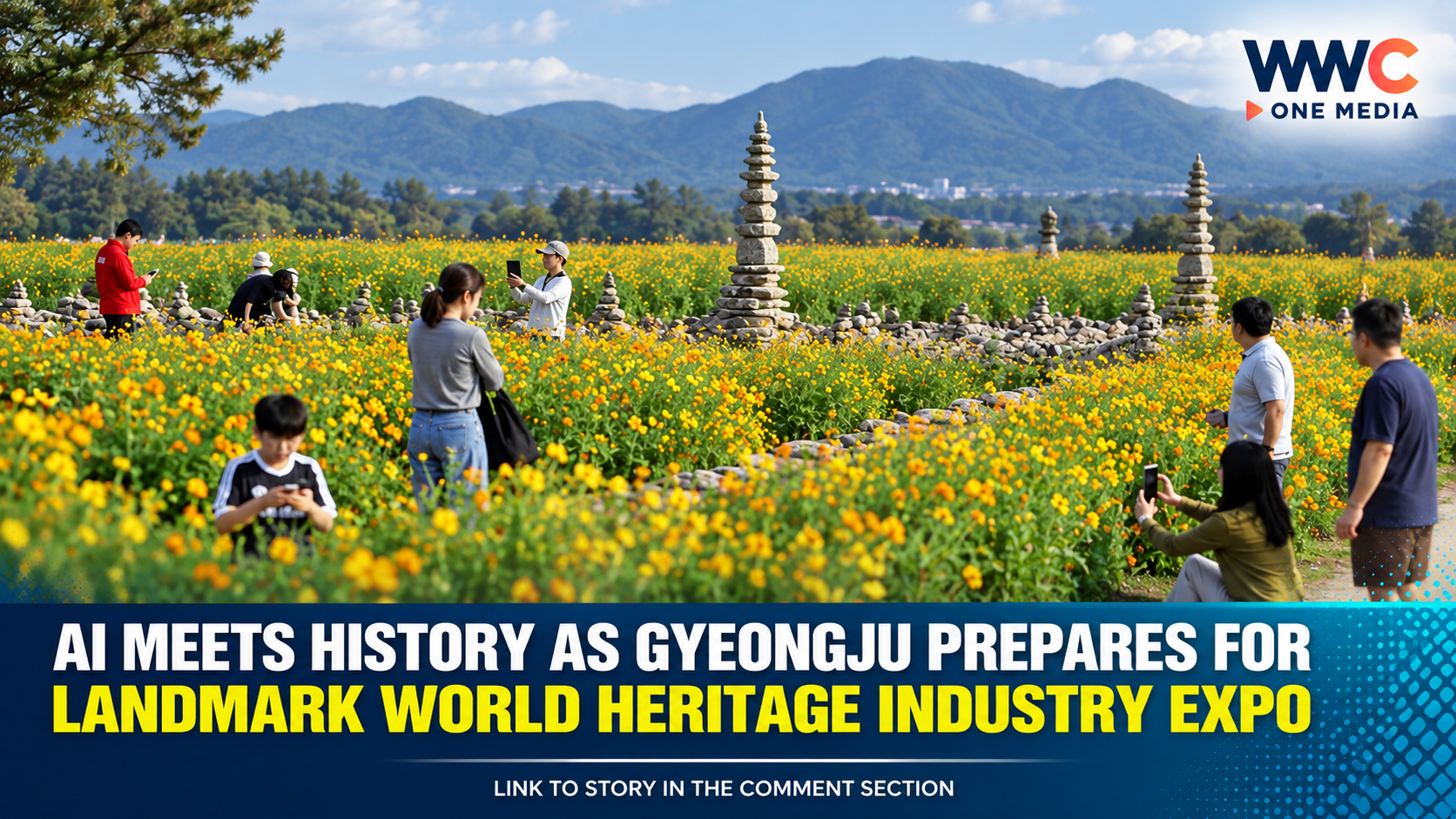
GYEONGJU, South Korea — What happens when one of Korea’s oldest cultural centers meets one of the world’s fastest-moving technologies?
Gyeongju is about to find out.
The 2026 World Heritage Industry Expo will open September 10 at the Gyeongju HICO convention center, bringing artificial intelligence, extended reality, digital content and advanced conservation technology together with the historical legacy of the former Silla capital.
Now in its 10th edition, the three-day event is being positioned as a major meeting point between cultural heritage and emerging technology, with a record 133 companies and organizations participating.
The theme this year is “Heritage × Tech × Industry,” reflecting South Korea’s push to transform cultural heritage from something preserved behind glass into a resource for technology, tourism, education and new industries.
When AI becomes part of the history lesson
One of the most eye-catching parts of this year’s program is Heritage AI Cinema, which will showcase 11 short films created using AI to reinterpret national heritage.
The program is designed to explore how artificial intelligence can produce new forms of storytelling around Korea’s historical sites, objects and traditions. Gyeongju officials say the initiative demonstrates the potential for AI to create new cultural content while opening additional possibilities for the heritage industry.
The technology focus extends beyond film.
The expo will feature exhibits covering heritage conservation and restoration, safety-management systems, digital technology, research and development, AI applications, consumer products, crafts, food and cultural performances.
That makes the event less of a traditional museum-style exhibition and more of a technology-and-business showcase built around Korea’s cultural inheritance.
Lee Se-dol brings the AI debate into the spotlight
Perhaps the biggest draw for the public will be Lee Se-dol, the former professional Go player who became internationally famous after his 2016 matches against Google's AlphaGo.
Lee will join neuroscientist Jang Dong-sun for a public discussion examining human value and the meaning of cultural heritage in the age of AI.
The conversation is particularly symbolic given Lee’s own history with artificial intelligence. His match against AlphaGo became one of the defining public moments in the early history of modern AI, when a world-class human player confronted a machine in a battle watched around the globe.
Now, a decade later, Lee is returning to the AI conversation from a very different angle: What remains uniquely human when machines can increasingly create, analyze and reinterpret culture?
Gyeongju officials have listed the discussion as part of the expo's “Rediscovering Heritage” program.
From Silla capital to technology laboratory
Gyeongju provides a striking setting for the experiment.
The city was the capital of the Silla Kingdom from 57 B.C. to A.D. 935, making it one of the most historically significant locations on the Korean Peninsula.
Its archaeological sites and monuments are collectively recognized as a UNESCO World Heritage property known as the Gyeongju Historic Areas.
That ancient landscape is now being placed alongside technologies designed to preserve, reconstruct and reinterpret history.
The contrast is precisely what organizers are emphasizing: rather than seeing technology and heritage as opposing forces, the expo presents them as industries that can reinforce each other.
Five areas showcase the future of heritage
The national government's program divides the main exhibition into five major areas:
- Conservation — preservation and restoration technologies
- New Technology — including AI and other advanced systems
- Products — heritage-related consumer products and materials
- Utilization — ways heritage can be turned into content and experiences
- Promotion — cultural and industrial outreach
The event will also feature technology for heritage discovery, repair and maintenance, safety management and research and development.
This year's expo is also being held alongside the Hanok Culture Fair, expanding the event's focus to traditional Korean architecture, construction technologies, materials and cultural content.
A decade of turning heritage into an industry
The expo began in 2017 and is marking its 10th edition this year.
Organizers say the goal has evolved beyond simply displaying cultural artifacts. The broader objective is to identify the economic and social value of national heritage and develop technologies and businesses capable of turning that potential into sustainable industries.
The scale of the 2026 edition reflects that ambition.
With 133 participating companies and institutions—the highest number in the expo's history—the event represents a growing effort to connect government heritage policy with private-sector technology and commercial applications.
AI-generated history raises a bigger question
But the marriage of AI and cultural heritage also raises difficult questions.
If an algorithm reconstructs a historical scene, how much of what audiences see is history—and how much is interpretation?
If AI generates a new image or film based on an ancient monument, who determines whether the result is historically faithful?
And as generative AI becomes increasingly capable of producing convincing historical environments, will digital recreations eventually influence how people remember the past as much as authentic artifacts do?
Those questions are not merely theoretical.
They are becoming increasingly relevant as museums, governments and cultural organizations worldwide experiment with virtual reconstruction, digital archives, immersive experiences and generative AI.
Gyeongju's expo puts those issues directly into a city whose identity is inseparable from its ancient past.
The bigger story behind Gyeongju's AI experiment
The 2026 World Heritage Industry Expo is therefore more than a technology fair.
It represents a broader shift in how South Korea views cultural heritage: not simply as something to protect, but as something that can generate new knowledge, experiences, technologies and economic opportunities.
And Gyeongju is an ideal place to test that idea.
For centuries, the city preserved the legacy of Silla. Now, AI and other emerging technologies are being invited to help determine what that legacy could look like in the future.
The central question may ultimately be bigger than whether AI can recreate the past.
It is whether technology can help a new generation experience history without changing the meaning of the history itself.