
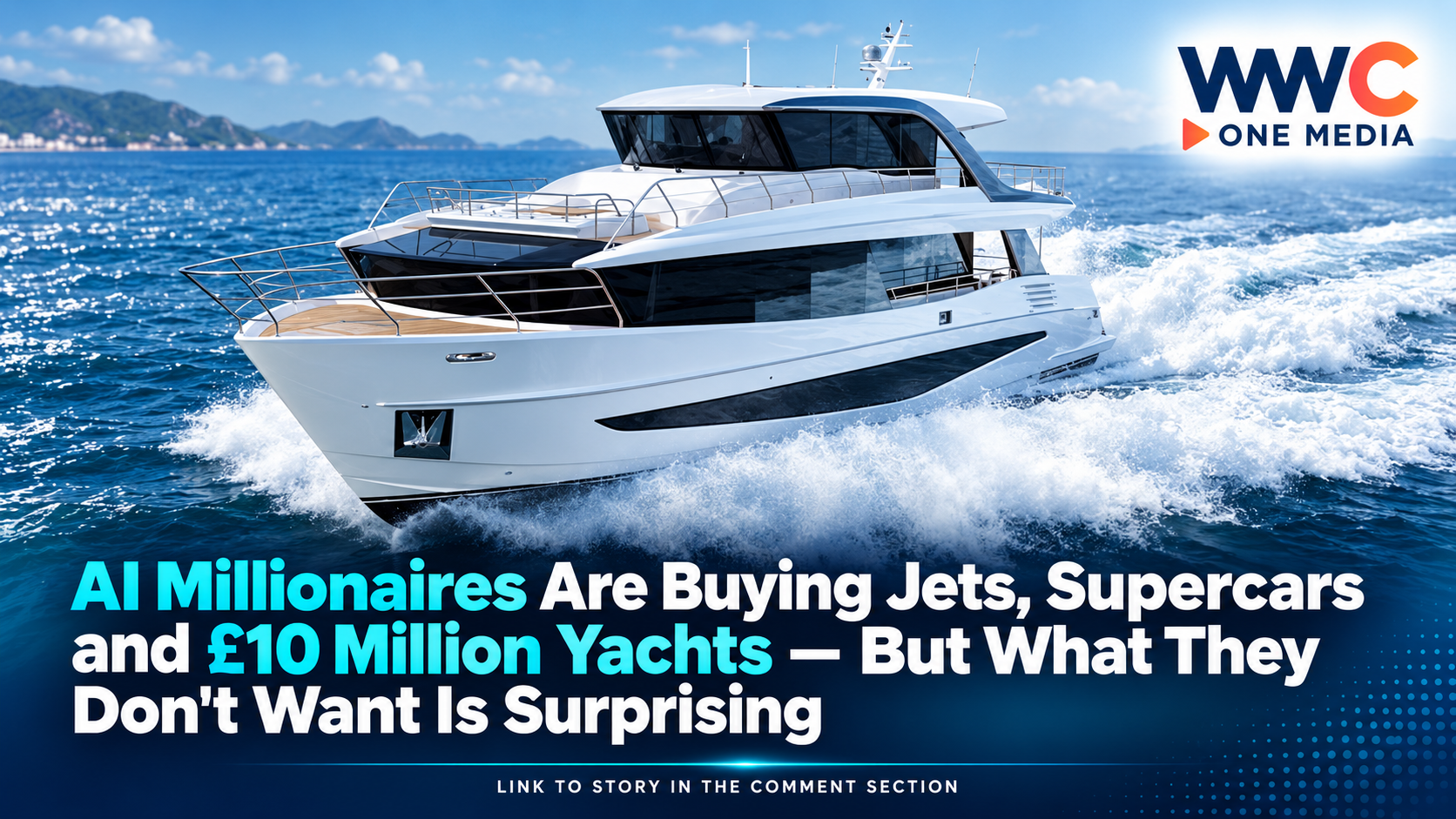
AI Millionaires Are Buying Jets, Supercars and £10 Million Yachts — But What They Don't Want Is Surprising

SAN FRANCISCO — The newest generation of tech millionaires does not necessarily want champagne waiting beside a white tablecloth on a private jet.
They may be more interested in getting a flight confirmed through WhatsApp within minutes, having high-speed internet available from takeoff to landing, eating health-focused meals and paying with cryptocurrency.
On a yacht, the priority might not be an elaborate cocktail bar. It could be a serious gym, a Peloton, Starlink connectivity, additional privacy and enough space for diving equipment or hydrofoils.
And when it comes to cars, exclusivity increasingly means owning something that almost nobody else can duplicate.
That shift is emerging as wealth generated around artificial intelligence and the wider technology boom creates a younger class of ultra-rich consumers — customers who have enormous spending power but often very different expectations from the generations luxury companies built their businesses around.
The AI Boom Isn't Just Creating Technology — It's Creating Wealth
The numbers behind the broader wealth boom are significant.
UBS reported that global personal wealth increased 10.8% in 2025, its fastest growth since 2017. Nearly one million new US-dollar millionaires were added worldwide during the year — more than 2,600 every day — with the United States accounting for more than 440,000 of them.
At the very top, the number of billionaires worldwide climbed about 13% to a record 3,302 in the year through April 2026, according to UBS figures cited by multiple news organisations.
Not all of those fortunes came from artificial intelligence, of course.
But AI-related companies, semiconductor stocks, venture investments and technology liquidity events are creating a particularly visible pocket of new wealth — and some luxury industries are already seeing the results.
The original Financial Times report republished by CNA Luxury describes customers connected with AI businesses, Nvidia investors and other technology entrepreneurs appearing in everything from yacht dealerships to private aviation.
And the first place some of that money is showing up is much closer to home.
San Francisco's Housing Market Is Showing the AI Wealth Effect
San Francisco, home to major AI companies and startups, has become one of the clearest examples of what happens when technology wealth spills into the physical economy.
Citing Compass, the FT/CNA report said the median price of a single-family home in San Francisco reached US$2.1 million in June, almost 25% above the level a year earlier.
Separate Redfin research strengthens the case that something unusual is occurring at the expensive end of the Bay Area market.
Luxury-area home prices in the San Francisco Bay Area increased an average 13.4% during the two years following ChatGPT's launch, more than twice the 6.3% gain recorded in the next-lower price tier. The lowest-priced areas actually saw values decline.
Redfin also reported that San Francisco luxury-home sales jumped 22.2% year over year in March 2026, while non-luxury sales increased only 3.8%.
By September, Associated Press was reporting that wealthy buyers — including employees of AI companies — were continuing to support the Bay Area's high-end property market despite mortgage rates and prices that were keeping many conventional buyers on the sidelines.
But buying the house may only be the beginning.
Private Jets Are Becoming Less About Champagne — And More About Time
Private aviation may provide the clearest evidence of how younger technology wealth differs from traditional luxury spending.
Some new customers are reportedly far less interested in ceremonial service and much more focused on speed.
They want quotes quickly.
They want to communicate through apps or messaging services.
They want privacy.
And they increasingly expect the experience to work like the digital products they already use rather than the highly choreographed luxury travel industry of previous generations.
There is hard data suggesting that demand is rising.
Reuters reported that flights through fractional or shared-ownership private-jet programmes increased 11.8% globally during the first five months of 2026, compared with the same period in 2025.
Flights operated by private aircraft owners increased even faster — 13.4%.
Aviation law firm Soar Aviation Law also reported a 25% jump in business during the year as technology investors and newly wealthy buyers pursued aircraft transactions.
Flexjet, meanwhile, has seen its customer base get younger as AI, technology and crypto fortunes expand. The Financial Times reported that the average age of its clients has dropped by roughly a decade.
For traditional luxury operators, that demographic change matters.
A 30-year-old technology entrepreneur may have the money of a conventional billionaire customer — but not necessarily the same habits.
Supercars Are Becoming Giant Personalised Gadgets
That attitude is showing up in the garage too.
Lamborghini's Urus has reportedly attracted younger technology buyers partly because of its enormous range of customisation options. The model can be configured in more than 150 colours, with additional carbon-fibre and aerodynamic modifications offering buyers further ways to distinguish their vehicles.
That may sound superficial, but it points to a deeper shift.
For traditional luxury consumers, brand recognition itself could be the status symbol.
For digital-native buyers accustomed to personalised software, customised hardware and algorithmically tailored experiences, owning the same expensive product as everyone else may not be enough.
One luxury concierge company cited in the FT/CNA report bought a low-mileage Rolls-Royce Cullinan for an AI entrepreneur in his twenties and transformed its traditional appearance with a custom bright blue-and-orange treatment.
Ferrari and Porsche are watching the same emerging customer base.
Ferrari CEO Benedetto Vigna has described technology-driven wealth as an opportunity for the company, while Porsche CEO Michael Leiters said the automaker was actively trying to reach new customer groups emerging from the AI boom.
The message for luxury car companies is increasingly clear:
Being expensive is no longer enough.
The product also has to feel personal.
Then There Are the Yachts — With Gyms, Starlink and Fewer Cocktails
The yacht business is seeing perhaps the most revealing transformation.
New technology-rich customers on America's West Coast are showing interest in vessels built less like floating palaces and more like extremely expensive adventure platforms.
Dealers cited by the FT/CNA report described customers seeking faster vessels capable of travelling longer distances, carrying recreational equipment and handling difficult Pacific conditions.
Privacy is becoming increasingly important too, with buyers requesting features such as darker windows.
Then there is fitness.
Princess Yachts has received requests for Technogym equipment, strength-training facilities and even a Peloton bike installed on a yacht's flybridge.
Starlink terminals are also being requested — hardly surprising for customers who may be running technology businesses while travelling.
Princess said it had already sold five examples of its new 90-foot X90, which costs upward of £10 million (about US$13.6 million), to American buyers ahead of its official September launch.
The contrast with the stereotypical billionaire yacht could hardly be sharper.
Instead of designing the entire experience around lounging, alcohol and formal service, some buyers want to exercise, dive, explore, remain connected and keep working.
Luxury is shifting from being served to being enabled.
But There Is a Catch: The Whole Luxury Industry Isn't Booming
This AI-driven spending surge should not be mistaken for a universal luxury boom.
The industry's broader picture remains difficult.
European luxury stocks fell sharply in early September as investors became increasingly cautious about the strength of the sector's recovery. LVMH, Hermès and Kering were among the companies hit, while analysts pointed to softer spending in several major markets.
Another CNA/Financial Times analysis earlier this year said luxury brands were leaning heavily on wealthy American consumers to revive growth after a difficult 2025. At the same time, companies were struggling to win back less-affluent “aspirational” customers after years of steep price increases.
That creates an unusual divide.
The middle of the luxury market can struggle even while demand at the extreme top remains powerful.
AI millionaires and billionaires therefore may not rescue every fashion house, watchmaker or luxury retailer.
But they could become extremely important to businesses selling products for which price is almost secondary: private aircraft, bespoke vehicles, multimillion-dollar property and superyachts.
The Bigger Story Isn't What AI Millionaires Are Buying
The most important part of this trend may not be the size of the purchases.
It is how these customers define luxury.
For generations, the industry sold exclusivity through ceremony: chauffeurs, champagne, expensive dining, formal service and visibly recognisable status symbols.
The emerging technology elite appears to be placing greater emphasis on a different combination:
Speed. Privacy. Personalisation. Connectivity. Fitness. Control.
A private jet is valuable because it saves hours.
A supercar matters because nobody else has exactly the same one.
A yacht becomes more attractive when it functions as an office, gym and adventure base simultaneously.
And a service loses appeal when booking it feels slower than ordering something through a smartphone.
The AI boom therefore may be changing more than who can afford luxury.
It could be changing what the world's richest customers believe luxury should be.
For companies built around traditions developed decades ago, that may be the multibillion-dollar question they can no longer afford to ignore.
WWC ONE MEDIA M.J.E