
Alarm Bells Ring at Thailand’s Lam Pao Reservoir—But the Latest Blackchin Tilapia Search Reveals a Twist

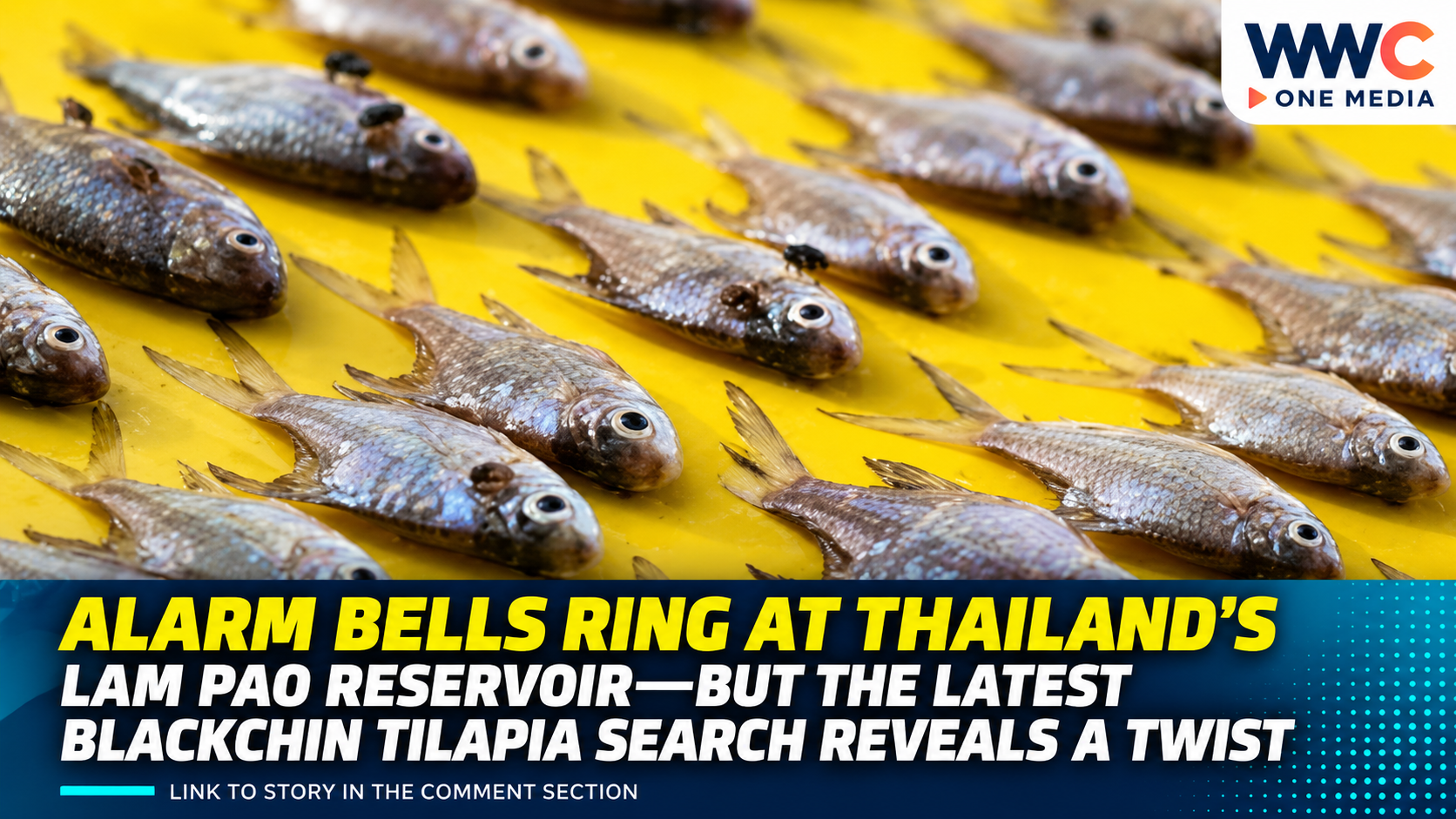
KALASIN, Thailand — Thailand’s latest search for the invasive blackchin tilapia at Lam Pao Reservoir has produced an important result, but not necessarily the all-clear authorities were hoping for.
Fisheries officials and local fishing communities have reported no blackchin tilapia in their latest field checks at Lam Pao Reservoir in Kalasin province, following reports that fishermen had caught a fish resembling the invasive species.
Officials stressed, however, that the finding does not conclusively prove the fish is absent from the reservoir. Authorities are continuing surveillance and plan another netting operation in about two weeks.
That distinction is crucial: there is currently no confirmed evidence of an established blackchin tilapia outbreak at Lam Pao Reservoir.
What happened at Lam Pao?
The alarm began after a local fisherman reportedly caught a fish he identified as blackchin tilapia near Ban Na Ouan in Nong Sarong subdistrict, Nong Kung Si district, on August 31.
The fisherman photographed and filmed the catch before it was consumed. Subsequent reports cited other fishermen who said they had encountered fish with similar characteristics, although those additional reports have not been independently confirmed as blackchin tilapia.
That prompted Kalasin fisheries officials to investigate.
An initial survey examined six locations around Lam Pao Reservoir, with officials questioning fishermen and fish buyers and conducting sampling using fishing nets and traps. No blackchin tilapia was found during that operation.
Latest search: nearly 100 traps checked
The latest operation went further.
On September 4, fisheries officials worked alongside the Lam Pao local fishing network to retrieve and inspect fishing gear placed around the area where the suspicious fish had reportedly been caught.
Officials also examined fish caught using nearly 100 traps, along with fish caught using other traditional fishing equipment.
The catch consisted predominantly of Nile tilapia and native freshwater species, including several local carp and minnow species. No blackchin tilapia was detected.
Officials said they intend to repeat the netting operation in approximately two weeks, meaning the investigation is far from over.
Why officials are still worried
The absence of blackchin tilapia in the latest samples is encouraging—but invasive species can be notoriously difficult to detect when populations are small.
The Isaan Record reported that fisheries officials themselves have not been able to confirm whether blackchin tilapia is actually established in the reservoir. The fact that officials did not catch one during sampling cannot, by itself, establish that none are present.
That is why authorities are treating the situation as a surveillance issue rather than declaring the reservoir completely free of the invasive fish.
Thailand has already experienced significant problems with blackchin tilapia in other parts of the country. The species has been associated with damage to aquatic ecosystems and pressure on native fish and other aquatic organisms. The Guardian recently reported on the economic and ecological impact the invasive fish has had on Thai fishing communities.
The bigger concern: how could it have reached Kalasin?
One of the biggest unanswered questions is how a blackchin tilapia could have reached Lam Pao Reservoir if the reported sightings are eventually confirmed.
Local fisheries officials have been examining possible pathways, including the movement of fish stock from other regions.
A September 3 report said authorities had inspected fish farms that sourced fingerlings from central Thailand, including Chachoengsao, Prachin Buri and Nakhon Pathom. No additional blackchin tilapia was found during those inspections.
Another report raised a separate possibility: a blackchin tilapia was allegedly found mixed with Nile tilapia transported from the Mahachai market. That claim remains part of the investigation and should not be treated as an established explanation for how the fish reached Lam Pao.
A potential ecological warning for northeast Thailand
The concern goes beyond a single reservoir.
If an established population were eventually confirmed at Lam Pao, it could raise serious questions about the potential movement of an invasive fish into connected freshwater systems.
Experts cited by The Isaan Record have warned that blackchin tilapia has demonstrated an ability to adapt to freshwater environments and reproduce rapidly. The report also notes that previous cases show why early detection matters: a small number of apparently isolated fish can become much more difficult to control if reproduction becomes established.
The Lam Pao investigation therefore has significance well beyond Kalasin's fishing communities.
Authorities issue a strong warning
Officials are also warning people not to deliberately bring blackchin tilapia from elsewhere into Lam Pao Reservoir, including for social-media content.
Thai authorities have prohibited the breeding of blackchin tilapia, and violations of relevant fisheries restrictions can carry substantial penalties. Thai PBS reported that unauthorized breeding can result in imprisonment and/or fines, while releasing the fish into public waters carries potentially higher penalties.
This warning comes as blackchin tilapia continues to be treated as a major invasive-species problem in Thailand.
The Thai government has said it is continuing measures to control the species and reduce its ecological impact, including monitoring, removal and other management measures.
No outbreak confirmed—but the story is not over
For now, the most accurate conclusion is straightforward:
Fisheries officials have not found evidence of a blackchin tilapia outbreak at Lam Pao Reservoir during their latest searches.
But that is different from saying the reservoir has been definitively cleared.
A fisherman did report catching a suspicious fish. Authorities have investigated multiple locations, conducted additional sampling and found no blackchin tilapia in their latest checks. Another survey is expected in roughly two weeks, while officials continue to investigate the possible source of the reported fish.
And that leaves the question hanging over Lam Pao:
Was the reported fish an isolated incident—or the first warning of something authorities have yet to detect?
For now, the nets are coming up empty.
But fisheries officials aren't ready to stop looking.
WWC ONE MEDIA M.J.E