
Cebu Power Crisis Threatens Economic Growth as Business Leaders Demand Long-Term Solution

CEBU CITY, Philippines — Cebu’s worsening power crisis is no longer just a household inconvenience. Business leaders are warning that recurring brownouts and an increasingly strained Visayas power grid could threaten the province’s economic growth, raise consumer costs and weaken its appeal to investors.
The warning came as Cebu business groups renewed their call for a long-term, coordinated solution to the region’s power supply and infrastructure problems, saying temporary measures such as backup generators and the return of individual power plants will not be enough to secure Cebu’s economic future.
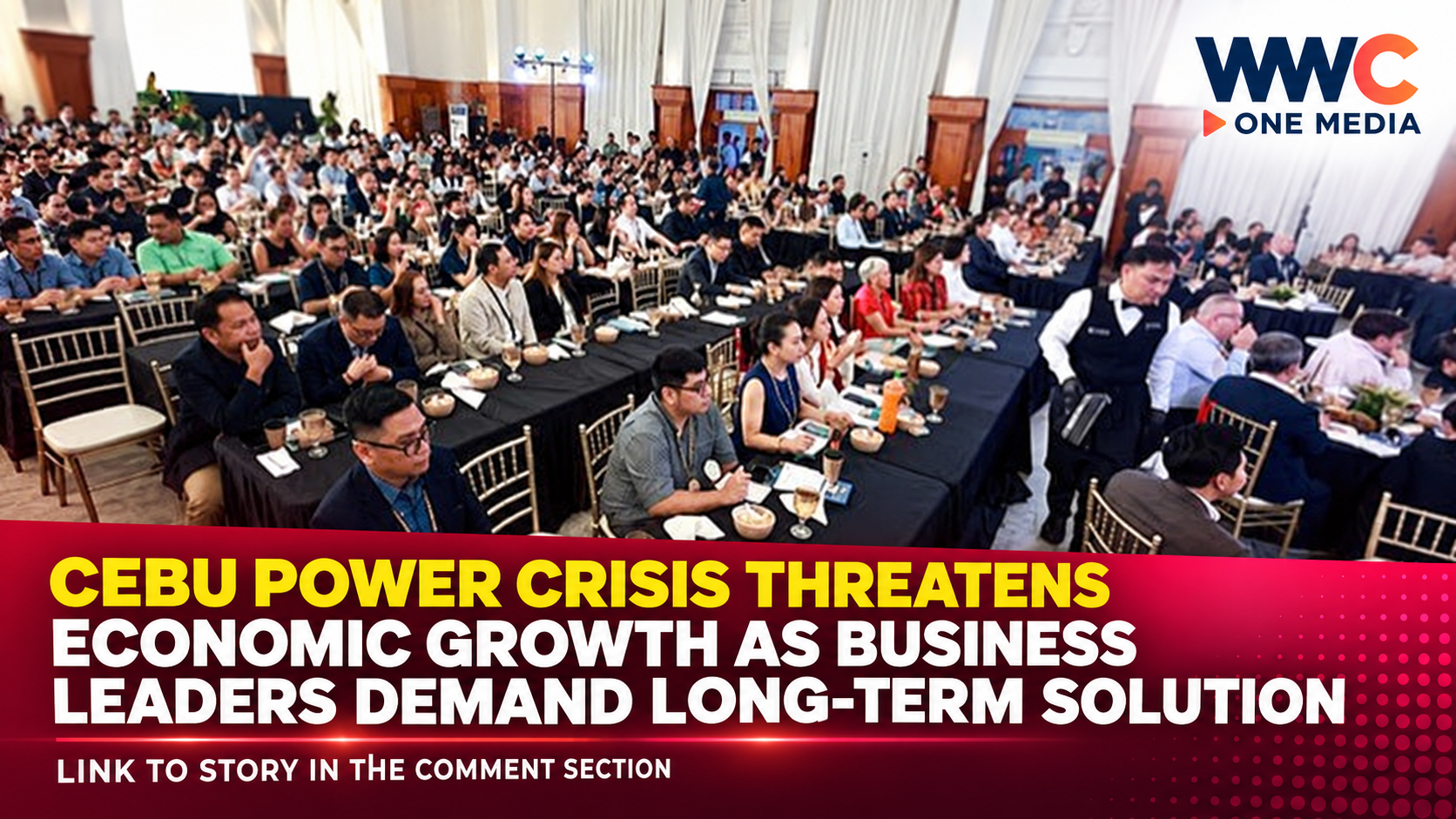
At the Cebu Economic Forum 4.0 on September 8, Cebu Chamber of Commerce and Industry (CCCI) President Regan Rex King and former Mandaue Chamber of Commerce and Industry President Mark Anthony Ynoc said unreliable electricity was already creating additional costs for businesses and could influence investment decisions.
SunStar reported that companies, particularly manufacturers, have been forced to turn to diesel-powered generators, adjust working hours and modify production schedules whenever scheduled power interruptions occur.
Ynoc warned that the additional cost does not necessarily stop with businesses.
Higher fuel consumption, emergency generation and disruptions throughout the supply chain can eventually translate into higher prices for consumers.
Investors are watching Cebu’s power situation
For Cebu, the problem carries consequences beyond individual brownouts.
The province has positioned itself as one of the Philippines’ major centers for manufacturing, tourism, logistics, business-process operations and other industries. Reliable electricity is therefore a basic requirement for companies deciding whether to expand existing operations or establish new ones.
King said stable power supply has become an important consideration for international companies evaluating investment opportunities in Cebu.
That concern was echoed by earlier reports from Cebu business groups, which have repeatedly identified electricity reliability and cost as major competitiveness issues.
In July, SunStar reported that business and energy stakeholders were pushing for a coordinated strategy to strengthen the Visayas power system, with calls for additional dependable generation, a more diversified energy mix and stronger transmission infrastructure.
The Freeman likewise reported on September 9 that Cebu business leaders were calling for additional baseload power and stronger transmission infrastructure, stressing that the power problem could undermine production, investor confidence and the province’s ability to sustain economic growth.
Why the Visayas grid keeps coming under pressure
The latest warnings come amid repeated Yellow and Red Alerts affecting the Visayas grid.
On September 7, the National Grid Corporation of the Philippines placed the Visayas grid under Red Alert for several hours after available capacity fell below projected demand.
NGCP data cited by Inquirer showed available capacity of 2,284 megawatts against projected demand of 2,470 MW, leaving a 186-MW gap at the time of the advisory.
The grid situation was worsened by several generating units being on forced outage or operating at reduced capacity. NGCP identified the unavailability of major coal-fired facilities, including Therma Visayas Inc. Unit 1 and Panay Energy Development Corp. Unit 3, as major factors. Limited power imports from Mindanao also contributed to the tight supply situation.
A Red Alert means the available supply and reserves are insufficient to comfortably meet demand and required contingencies, increasing the possibility that grid operators may resort to measures such as manual load dropping to protect system stability.
Cebu is particularly vulnerable
The situation is especially significant for Cebu because of the province’s large electricity demand.
In a report on the proposed congressional investigation into the Visayas power crisis, Inquirer cited an NGCP assessment identifying Cebu as a weak point in the regional system.
The report indicated a simulated evening peak shortfall of 422 MW, with peak demand reaching 1,077 MW against dependable capacity of only 655 MW in the scenario cited by lawmakers.
The figures illustrate why Cebu can remain vulnerable even when individual generating units return to service: the problem involves not only generation but also transmission, distribution and the ability of the wider grid to deliver sufficient power when demand peaks.
Brownouts are becoming an economic problem
For businesses, an outage can mean more than several hours without electricity.
Manufacturers can face interrupted production, idle workers, delayed deliveries and potential equipment problems. Retail establishments and service businesses can lose transactions, while companies dependent on uninterrupted digital operations can face disruptions.
Businesses that operate generators also absorb additional fuel and maintenance costs.
Those expenses can eventually move through the supply chain.
That is why Cebu’s business leaders are arguing that the issue should no longer be treated simply as a temporary shortage of electricity.
It is increasingly an economic and investment issue.
Short-term fixes cannot replace a stable grid
Several measures are already being used to ease pressure on the system.
Businesses are adjusting operating schedules, installing solar systems and relying on generators. Large commercial establishments have also been encouraged to participate in programs that allow them to temporarily reduce their demand during periods of tight supply.
But business leaders say these measures are defensive responses rather than a permanent solution.
The broader requirement is a coordinated plan covering power generation, transmission and distribution.
The Freeman reported that business groups are seeking closer coordination among the Department of Energy, Energy Regulatory Commission, NGCP, power generators and distribution utilities.
That aligns with earlier calls from NGCP officials for a longer-term Visayas energy strategy built around adequate baseload capacity, a geographically diversified generation mix and resource-adequacy planning.
Cebu government prepares for a bigger energy discussion
Cebu Gov. Pamela Baricuatro has also moved to bring government and private-sector stakeholders together.
The provincial government has scheduled a convergence meeting on October 7 to discuss longer-term solutions to Cebu’s energy problems, according to SunStar’s latest report.
The move follows earlier efforts by the provincial government to work with business groups and energy stakeholders on the region’s supply problems.
In April, the Cebu Provincial Government said private-sector representatives had backed efforts to address energy and supply-chain concerns, emphasizing the need for coordinated action between government and business.
The province has also previously supported efforts related to reliable electricity distribution in Metro Cebu, including the renewal of Visayan Electric Company’s franchise.
The bigger question: Can Cebu keep growing without reliable power?
Cebu’s economic growth has created a difficult contradiction.
The province wants to attract more investors, expand industries and strengthen its position as a major economic center in the Philippines.
But those ambitions require dependable infrastructure.
Repeated grid alerts and rotational brownouts create uncertainty precisely when businesses need confidence that Cebu can provide reliable electricity for factories, offices, hotels, commercial centers and technology-driven operations.
The problem is not unique to Cebu.
Inquirer reported that other parts of the Visayas have also experienced prolonged rotational brownouts, with lawmakers now seeking a congressional investigation into the region’s power crisis.
That means Cebu’s solution cannot be limited to one city, one utility or one generating plant.
The challenge is regional.
The message from Cebu’s business community
For Cebu’s business leaders, the message is becoming increasingly direct:
The province cannot build a stronger investment economy while operating on an unreliable power system.
Generators may keep individual businesses running. Solar installations may reduce dependence on the grid. Returning power plants may temporarily increase available capacity.
But none of these measures eliminates the underlying vulnerability.
What Cebu needs is a power system capable of matching its present demand — and preparing for the demand its future growth will create.
The October 7 convergence meeting could therefore become an important test of whether the government and private sector can turn repeated warnings into a concrete energy roadmap.
For businesses and investors watching Cebu, the question is no longer simply whether the lights will stay on today.
It is whether Cebu can guarantee the reliable power needed to keep its economy growing tomorrow.
WWC ONE MEDIA J.M.D