
China’s Forgotten Castles: Why Cycling Is the Best Way to Discover Kaiping’s UNESCO Watchtowers

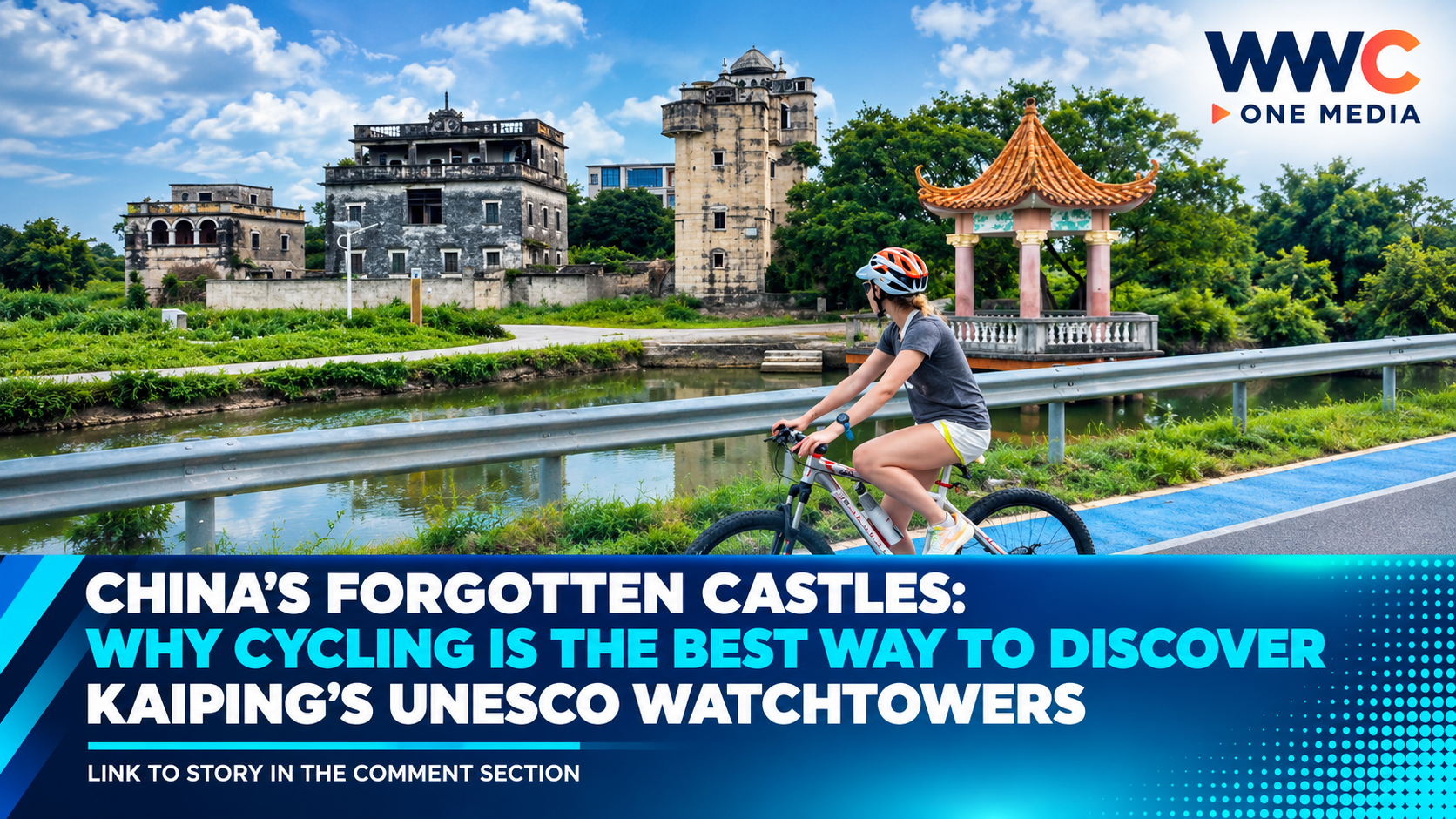
KAIPING, CHINA — Rising unexpectedly from rice fields and quiet villages in southern China, the watchtowers of Kaiping look like something from another world.
Some resemble European castles. Others feature Roman columns, domes and ornate Western-style facades. Yet these unusual structures stand deep in the countryside of Guangdong province, surrounded by ponds, farmland and traditional Chinese villages.
The best way to discover them, many travellers are finding, is not from behind the window of a tour bus.
It is on two wheels.
Cycling through Kaiping offers visitors a slower and more intimate way to experience one of China's most unusual UNESCO World Heritage sites — a landscape where centuries of migration, wealth, insecurity and cultural exchange are written directly into the architecture.
The Kaiping Diaolou and Villages were added to UNESCO's World Heritage List in 2007. UNESCO describes the site as an extraordinary fusion of Chinese and Western architectural traditions, reflecting the influence of overseas Chinese communities who returned home from North America, Southeast Asia and other parts of the world.
Towers that tell the story of China's global migration
The distinctive structures are known as diaolou — multi-storey fortified towers that once served as homes, watchtowers and places of refuge.
Their history is closely connected to Kaiping's enormous overseas Chinese diaspora.
During the late 19th and early 20th centuries, many people from Kaiping left China in search of work and opportunity abroad. They travelled to Southeast Asia, North America and Australia, becoming part of the vast Chinese diaspora that helped build railways, businesses and communities around the world.
Some eventually returned home with wealth and new architectural ideas.
The result was extraordinary.
Traditional Chinese buildings began appearing alongside structures decorated with influences from Europe and North America. Columns, balconies, domes and elaborate facades were combined with the practical requirements of fortified rural life.
UNESCO says the towers represent a “complex and confident fusion” of Chinese and Western architectural styles and provide physical evidence of the connections between Kaiping and overseas Chinese communities across the world.
Built not just for beauty, but survival
Despite their elegant appearance, the diaolou were built with a serious purpose.
Kaiping's countryside historically faced threats from banditry and flooding. Multi-storey fortified towers gave villagers a place to observe approaching danger and seek protection during attacks.
UNESCO identifies three broad types of diaolou: communal towers used as temporary refuges, privately owned fortified residences and watchtowers primarily designed for observation and defense.
That mixture of luxury and security is what makes Kaiping so fascinating.
A building might feature a grand European-inspired facade, yet behind it were thick walls, defensive positions and elevated spaces designed to protect families during times of danger.
They were symbols of success — but also monuments to uncertainty.
Why a bicycle changes the experience
Kaiping's watchtowers are scattered across a broad rural landscape rather than concentrated inside a single historic district.
That makes cycling particularly appealing.
Instead of rushing from one famous attraction to another, riders can travel through small villages, past rice paddies and along quiet country roads where another diaolou can suddenly emerge above the trees.
The journey itself becomes part of the experience.
A bicycle allows travellers to notice details easily missed from a car: an old ancestral hall, a farmer working in the fields, traditional homes hidden behind narrow lanes or a watchtower standing alone against the horizon.
The slower pace also better reflects the relationship between the towers and the countryside around them — a connection UNESCO specifically considers part of the site's cultural significance.
A landscape filled with architectural surprises
Kaiping's watchtowers are striking partly because no two seem exactly alike.
Some appear inspired by Gothic or Roman architecture. Others contain decorative elements that would not look out of place in colonial-era buildings in Southeast Asia.
The variety reflects the international experiences of the people who financed them.
Returning migrants brought home memories, photographs and ideas collected from distant countries. Builders then adapted those influences to local conditions.
The result is architecture that cannot be neatly classified as entirely Chinese or entirely Western.
It is both.
And neither.
That cultural hybridity is precisely why UNESCO considers Kaiping exceptional. The towers demonstrate how migration can reshape not only economies and societies, but also the physical landscapes people leave behind.
More than a tourist attraction
At its peak, Kaiping reportedly had thousands of diaolou scattered across its countryside.
Today, many remain, although only selected clusters form part of the UNESCO-listed property.
The towers have increasingly become an important symbol of heritage preservation in Guangdong.
When UNESCO granted World Heritage status in 2007, local officials pledged to prioritize conservation and involve local communities in protecting the structures for future generations.
That responsibility remains important as tourism grows.
Unlike a modern theme park, Kaiping's appeal lies in its authenticity. The towers are inseparable from the villages, agricultural land and rural atmosphere surrounding them.
Overdevelopment could threaten exactly what makes the site special.
Escape the city and enter another era
For travellers coming from major urban centres such as Guangzhou, Kaiping offers a dramatic contrast.
China's skyscrapers, high-speed trains and sprawling megacities can feel worlds away from the quiet countryside where these century-old towers remain standing.
The journey reveals another side of China's history — one shaped not by emperors or modern economic reforms, but by ordinary migrants who crossed oceans in search of better lives.
Some never returned.
Others came home and built castles.
Today, those castles stand quietly among the rice fields.
A ride through history
Cycling through Kaiping is ultimately about more than visiting a UNESCO site.
It is about understanding the landscape.
The distance between villages matters. The unexpected appearance of a tower matters. The slow movement through farmland helps explain why these structures were built high above the surrounding homes.
On a bicycle, travellers are not simply transported between attractions.
They move through the story.
From a quiet village road, a European-style tower appears in the distance.
A few kilometres later, another rises behind a cluster of trees.
Then another.
Each one represents a different family, a different journey and a different connection between a small corner of southern China and the wider world.
Kaiping's watchtowers were built to look outward — to watch for danger and, in many ways, to reflect the global experiences of the people who created them.
More than a century later, the best way to see them may be to slow down.
Forget the rush. Get on a bicycle — and let China's strangest countryside skyline reveal itself one tower at a time.
WWC ONE MEDIA J.M.D